Background
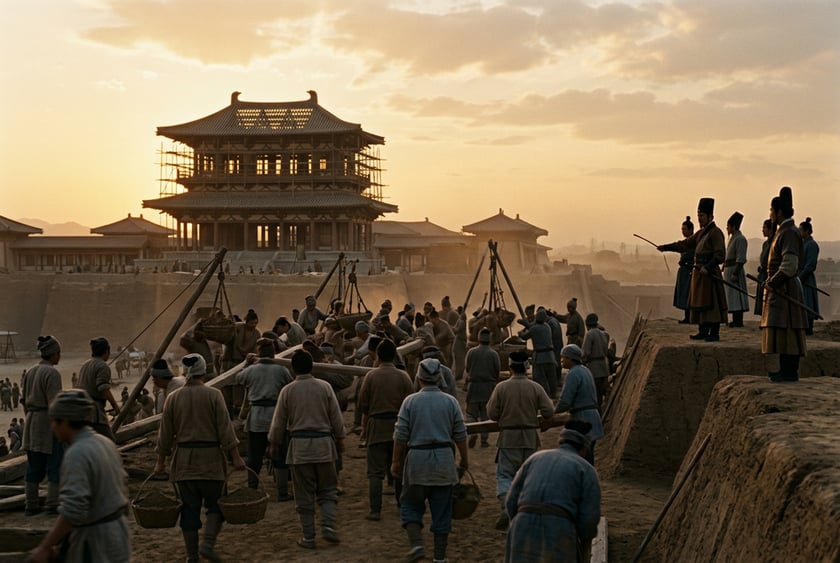
“Emperor Ming of Wei's Lavish Palace Construction” should be understood here as a political narrative about the construction of palaces, gardens, and related facilities under Cao Rui, rather than as referring to a single palace. The material provided comes from Chapter 105 of Romance of the Three Kingdoms: it places the events in the third year of Qinglong, 237, during the reign of Wei Emperor Ming, and says that the Three Kingdoms were “not at war.” Cao Rui was at Xu Chang, while construction was underway in Luoyang on buildings including Chaoyang Hall, Taiji Hall, and Zongzhang Tower, and Fanglin Park was being expanded. The period specified by the user is 230–237, but this passage falls specifically in the third year of Qinglong; it cannot establish the precise start or duration of each project across that entire period.
The narrative presents the construction as a state project driven by the ruler, overseen by officials, and carried out by craftsmen and laborers: it says that more than 30,000 skilled craftsmen were selected and more than 300,000 laborers conscripted, with work proceeding day and night, and describes the results as extravagantly magnificent. These figures and details come from the novel and should not be treated without qualification as independently verified construction statistics. Even as literary narration, however, they clearly set the grandeur of the palaces against the enormous burden of forced labor, drawing attention to the social cost of construction.
Key Figures
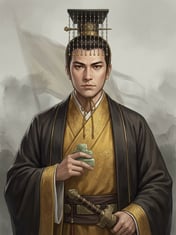
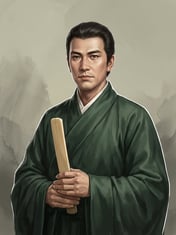
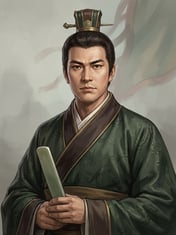
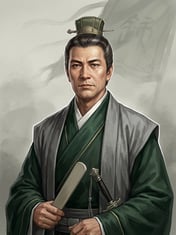
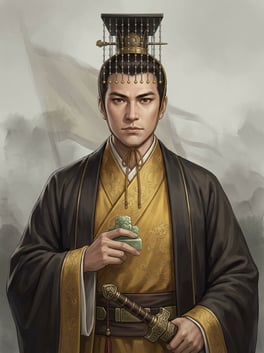
Cao Rui is the decision-making center of this construction narrative. He is portrayed not merely as approving building plans, but as actively expanding the scope of the projects, pursuing grand vistas, and linking construction to his desire for long life. Ma Jun serves as a technical official: he is appointed to supervise the construction and later ordered to go to Chang'an to dismantle the bronze figure and the dew-catching plate atop the Bailiang Terrace. The narrative thus depicts not simply a ruler’s extravagance, but the way imperial authority uses project management, technical expertise, and coerced labor to turn personal will into state action.
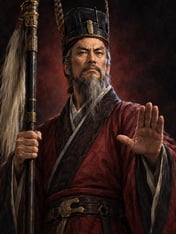
The remonstrators play different roles. In the passage, Dong Xun submits a strongly worded memorial of remonstrance. Cao Rui is furious, but at the attendants’ request that Dong Xun be executed, he first reduces him to a commoner instead. Zhang Mao also submits a memorial of remonstrance and is portrayed as being executed. Later, Grand Tutor Yang Fu submits another memorial, showing that opposition continued to arise within the court; however, the excerpt provided does not include the contents of his memorial or say what became of him. Chen Qun, Xin Pi, and Gaotang Long, also listed by the user, do not appear in these excerpts with specific actions or words, so one cannot conclude from them whether those men supported, opposed, or took part in any particular project.
Core Issues
The first core issue is the allocation of state resources. Palaces, towers, gardens, and exotic birds and trees represent not only architectural taste but also political priorities: even as the narrative describes the people as exhausted and public complaints as unceasing, construction continues and expands to include the dismantling and transport of existing installations such as bronze figures and dew-catching plates. Through this contrast, the work poses an implicit question: is a ruler’s vision of grandeur worth the cost of mass conscription and the exhaustion borne by the people? The text, however, provides no systematic accounting of taxes, construction timelines, or actual casualties, so the burden cannot be quantified.
The second issue is the boundary between a ruler’s desires and political reason. Cao Rui tells Ma Jun that he wants to build towering terraces and lofty pavilions in order to commune with the immortals and obtain the secret of long life. Ma Jun then plays to the emperor’s wishes and guides him by recounting the story of Emperor Wu of Han, the Bailiang Terrace, and the dew-catching plate. The novel goes on to describe the bronze figure “weeping” as the terrace is dismantled, then a violent wind causing it to collapse and kill more than a thousand people. The construction is thereby rendered as a tragedy imbued with a warning from Heaven. Such causal links and supernatural details belong to the novel’s narrative and are useful for analyzing how the work criticizes the pursuit of immortality and extravagant building; they should not be treated as verifiable historical records of an accident.
The third issue is whether remonstrance can restrain imperial authority. Dong Xun’s demotion and Zhang Mao’s execution, set against Yang Fu’s continued remonstrance, create a tension: loyal counsel has not vanished from the narrative, but comes at a high cost, and it is unclear whether it can change policy. For modern political-historical analysis, this depicts a conflict between institutional consultation and personalized decision-making. Yet the excerpt does not explain the actual deliberative procedures of Cao Wei, nor does it suffice to show that all opinions within the court were suppressed.
Political Consequences
As for the consequences directly established by this passage, the construction brings exhaustion among the people and public complaints, while remonstrance is met with punishment. The court’s mobilization demonstrates the regime’s ability to organize craftsmen, laborers, and supplies on a large scale, but also exposes the social costs that could result when that capacity lacked effective restraint. It is reasonable to analyze palace construction as a symbol through which rulers displayed order, authority, and wealth, but one cannot go further and claim that it caused the regime to collapse, triggered popular revolt, or led to a definite change in policy, since the material provided gives no such outcomes.
The construction is also portrayed as transforming urban space and the symbolic order of the court: the bronze figure and dew-catching plate from the old terrace are moved to Luoyang, the bronze pillars are ordered broken up and recast as Wengzhong statues, bronze dragons and phoenixes are displayed before the halls, and the gardens are planted with more exotic flowers and trees and stocked with rare birds and strange beasts. These descriptions show that the court was not merely expanding its residences, but also rearranging symbols, landscapes, and the visibility of imperial authority. The material does not, however, say whether all the plans were completed, how the expenses were met, or whether remonstrances by Yang Fu and others brought construction to a halt. The final outcome of the events therefore remains unclear.
Counterfactual Analysis
If Cao Rui had accepted the remonstrators’ advice early on, limited the scale of the projects, set clear caps on forced labor, and redirected resources to more urgent public or military needs, then, according to the causal logic of the text itself, the people’s exhaustion and complaints might have eased, and the waste of resources driven by the ruler’s pursuit of immortality might have been reduced. This is only a conditional inference based on the novel’s presentation of events, not a historical fact; the material provides no fiscal, demographic, or construction data from which to estimate the actual savings.
Conversely, if construction had continued to expand while remonstrators faced ongoing severe punishment, the court might have gained stronger short-term mobilization capacity, but feedback would have been further weakened, making it harder for the ruler to learn promptly of the people’s burdens and the risks of the projects. If regular review had been established, labor costs disclosed, and differing views from Chen Qun, Xin Pi, Gaotang Long, Yang Fu, and others allowed to enter decision-making, this could in theory have created an institutional check on the ruler’s preferences. But the surviving excerpts do not establish these figures’ specific positions on the matter, nor do they show that such institutional arrangements ever existed. The soundest conclusion, therefore, is that this story uses extravagant construction, the pursuit of immortality, and the suppression of remonstrance to form a critical narrative, while the actual results of the projects and their historical impact cannot be determined from the cited material.