Overview
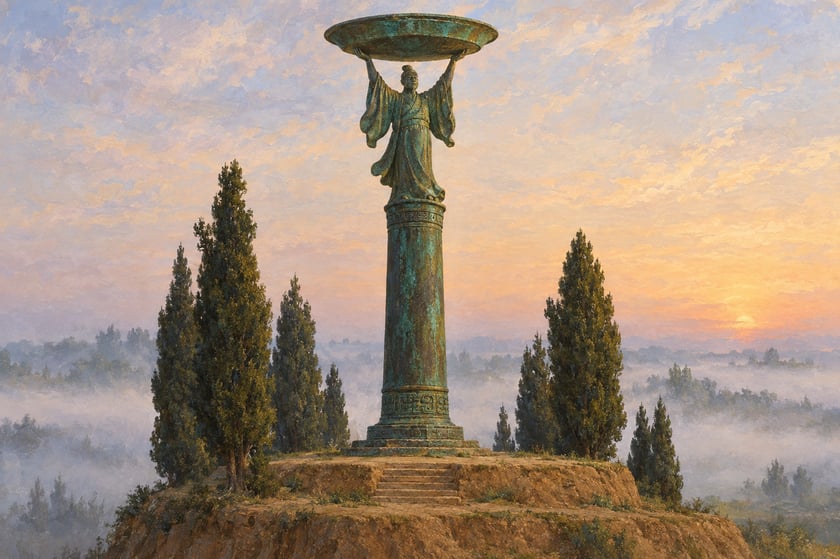
The Dew-Receiving Plate is a plate for collecting dew. In Romance of the Three Kingdoms, it is held in the hands of a bronze figure atop Bailiang Terrace in Chang'an. Both books describe Emperor Ming of Wei, Cao Rui, having it brought from Chang'an: in Records of the Three Kingdoms, the account appears in Pei Songzhi's commentary, and in the Romance, in chapter 105. Pei Songzhi's commentary quotes Han Jin chunqiu, which called the bronze figure a “metal Di figure”; the later poet Li He called it the “golden-bronze immortal,” while his poem's preface called it the “immortal holding the dew plate.” Neither book uses the four characters “jin tong xian ren” (金铜仙人).
Origins
In chapter 105 of Romance of the Three Kingdoms, Cao Rui wishes to build lofty terraces and towering pavilions in pursuit of immortality and consults Ma Jun. Ma Jun reports that Emperor Wu of Han once built Bailiang Terrace within the palace at Chang'an. Atop it, a bronze figure holds a plate called the “Dew-Receiving Plate,” which collects the misty dew descending from the Northern Dipper during the third watch, known as heavenly nectar or sweet dew. Mixed with finely ground jade and consumed, it can restore youth to the old. Delighted, Cao Rui orders Ma Jun to travel overnight to Chang'an, dismantle the bronze figure, and move it to Fanglin Garden.
Provenance
Pei Songzhi's commentary to Records of the Three Kingdoms quotes Weilue, which recorded that during Emperor Ming of Wei's Lavish Palace Construction, the emperor moved the bell stands, camels, bronze figure, and Dew-Receiving Plate from Chang'an that year. However, “the plate broke,” and the bronze figure was too heavy to transport and was left at Bacheng. Weilue dated this event to Jingchu 1 (237). Emperor Ming then requisitioned more bronze to cast two bronze figures, called “Wengzhong,” which were seated outside Sima Gate. The same commentary also quotes Han Jin chunqiu, which stated that Emperor Ming moved the plate, but it broke and was consequently left at Bacheng.
In Romance of the Three Kingdoms, Ma Jun leads ten thousand men to Chang'an to dismantle the bronze figure, brings it and the golden plate back to Luoyang, and presents the bronze figure and Dew-Receiving Plate. The bronze pillar weighs a million jin and cannot be transported, so Cao Rui orders it broken up and taken to Luoyang, where it is cast into two bronze figures called “Wengzhong,” which are placed outside Sima Gate.
Notable Episodes
Pei Songzhi's commentary quotes Han Jin chunqiu, which stated that when the plate broke, the sound could be heard for several dozen li, and “the metal Di figure perhaps wept”. The commentary also quotes Weilue, which recorded that Zhang Mao, an attendant to the crown prince, and Dong Xun, a military adviser in the office of the Minister over the Masses, submitted memorials remonstrating against Emperor Ming's lavish palace construction. Zhang Mao denounced “erecting a dew-receiving plate” as “carrying out the extravagant undertakings of Emperor Wu of Han,” while Dong Xun also listed the Dew-Receiving Plate among objects of no benefit.
In Romance of the Three Kingdoms, Bailiang Terrace is twenty zhang high, and the bronze pillar measures ten armspans in circumference. When the men dismantle the bronze figure, tears stream from its eyes; a violent wind suddenly rises, the terrace collapses and the pillar falls, crushing more than a thousand people to death. Afterward, Junior Preceptor Yang Fu submits a memorial of remonstrance, but Cao Rui ignores it and merely urges Ma Jun to build a lofty terrace on which to install the bronze figure and Dew-Receiving Plate.
History and the Romance
The two books give different outcomes. Pei Songzhi's commentary quotes Weilue, which stated that the Dew-Receiving Plate broke during transport, the bronze figure was too heavy and was left at Bacheng, and the Wengzhong figures were cast from a separate requisition of bronze. In Romance of the Three Kingdoms, however, Ma Jun transports the bronze figure and golden plate back to Luoyang and presents them, while the Wengzhong figures are cast from the broken-up bronze pillar.
As for the bronze figure shedding tears, on the side of Records of the Three Kingdoms, there is only the phrase “the metal Di figure perhaps wept,” quoted from Han Jin chunqiu in Pei Songzhi's commentary. Romance of the Three Kingdoms describes tears streaming from the bronze figure's eyes and adds the collapse of the terrace and pillar, which crushes more than a thousand people to death. Records of the Three Kingdoms does not record Ma Jun overseeing the dismantling and transport, his account of Emperor Wu of Han consuming dew to attain immortality, or Bailiang Terrace being twenty zhang high.
Scholarship
According to the preface to Li He's Jin tong xian ren ci Han ge, in the eighth month of Qinglong 1, Emperor Ming of Wei ordered palace officials to take carts west to fetch Emperor Xiaowu of Han's immortal holding the dew plate, intending to erect it before the front hall. After the palace officials removed the plate, tears streamed from the immortal's eyes as it was about to be loaded. The year given in this preface differs from Jingchu 1, the date assigned by Weilue; both accounts coexist.