Overview
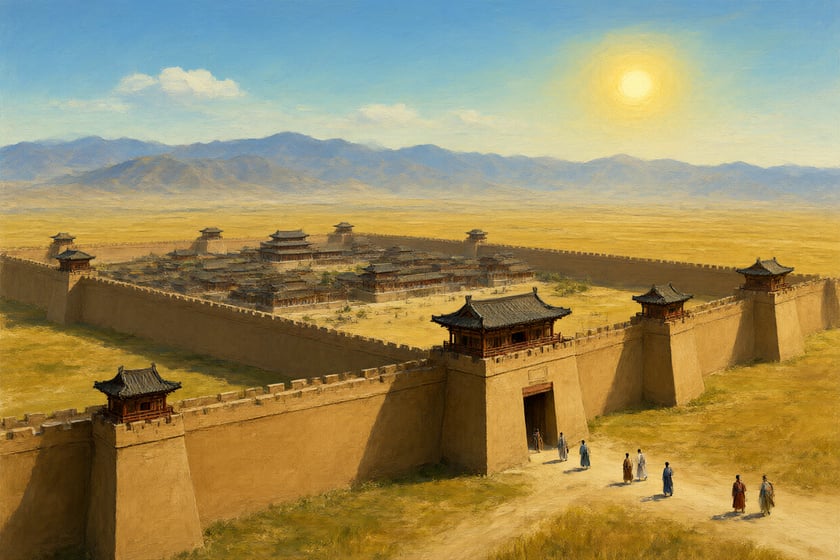
Chang'an was the old capital in the Guanzhong region, where Emperor Gaozu of the Western Han established his capital. When Emperor Xian made it his capital, Chang'an was also known as the Western Capital; its ruins lie northwest of present-day Xi'an, Shaanxi Province. In 190, Dong Zhuo forcibly moved the emperor and the capital to Chang'an. For the next several years, the Han court was based there. After Cao Cao pacified Guanzhong, Chang'an became an important stronghold from which Cao Wei could manage the western regions and resist Zhuge Liang's Northern Expeditions.
History
In 186, Zhang Wen, the Minister of Works, served as General of Chariots and Cavalry on a western campaign against Bian Zhang and Han Sui. Sun Jian accompanied the army as a military staff officer, and the main force was stationed at Chang'an.
In the second month of 190, as the warlords of the eastern provinces rose in arms, Dong Zhuo forcibly moved the emperor and the capital to Chang'an and burned the palaces at Luoyang. In the fourth month of the following year, Dong Zhuo himself also returned to Chang'an. In 192, Dong Zhuo entered the Weiyang Palace for a court audience and was killed by Lü Bu, Li Su, and others; the people of Chang'an celebrated among themselves. That same year, Dong Zhuo’s former subordinates Li Jue, Guo Si, and others followed Jia Xu’s plan, gathered a force of more than a hundred thousand, and besieged Chang'an. The city fell after ten days, and Lü Bu fled in defeat. The rebel troops slaughtered and plundered people of all ages in Chang'an, leaving the dead strewn everywhere, and the Minister over the Masses Wang Yun was killed. The Prefect of the Palace Treasury Lu Kui, the Grand Herald Zhou Huan, the Colonel of the City Gates Cui Lie, the Colonel of the Yue Cavalry Wang Qi, and others were also killed at the same time. Thereafter, Li Jue, Guo Si, and Fan Chou controlled the government. In 195, Li Jue and Guo Si grew suspicious of each other and fought inside Chang'an. Li Jue seized the emperor and took him to his camp, burning the palaces and city gates. Chang'an fell into chaos that year, and Emperor Xian moved east. Zhong Yao took part in the planning and helped the emperor escape Chang'an.
In the early Jian'an era, Cao Cao memorialized the court to appoint Zhong Yao as Attendant and Acting Colonel-Director of Sili Province, granting him authority to oversee the armies of Guanzhong. After arriving in Chang'an, Zhong Yao wrote to Ma Teng and Han Sui, explaining the consequences of their choices, and each sent a son to attend the emperor. In 211, after defeating Ma Chao and Han Sui, Cao Cao marched north from Chang'an to attack Yang Qiu. At the end of the year, he left Xiahou Yuan stationed at Chang'an. The following year, Xiahou Yuan, serving as Acting General Who Protects the Army, oversaw Zhu Ling, Lu Zhao, and others stationed there. After Zhang Lu surrendered in 215, Zhang Ji advised Cao Cao to relocate tens of thousands of households from Hanzhong to strengthen Chang'an and the Three Auxiliary Commanderies. In 219, Cao Cao returned east, leaving Cao Zhang at Chang'an as Acting General of the Yue Cavalry; he also appointed Du Xi as Chief Clerk of the Retinue Office to defend Chang'an.
In 221, Wei designated Chang'an, Qiao, Xu Chang, Ye, and Luoyang as its five capitals. During Zhuge Liang’s first Northern Expedition, the General Who Pacifies the West, Xiahou Mao, defended Chang'an. Wei Yan asked to lead five thousand elite troops through the Ziwu Valley in a surprise attack on Chang'an, but Zhuge Liang did not adopt the plan. In 231, Emperor Ming of Wei ordered Sima Yi to take up a position west at Chang'an and command Zhang He and others in resisting Zhuge Liang. During the Qinglong era, Sima Yi established a military market at Chang'an. In 237, Emperor Ming of Wei ordered the bells, chimes, camels, bronze statues, and dew-catching platform at Chang'an moved to Luoyang. The dew-catching platform broke, and the bronze statues were too heavy to transport, so they were left at Bacheng.
People
- Cai Yong and Wang Can: Cai Yong then served as General of the Left, and was esteemed for his talent and learning. When Wang Can followed Emperor Xian west to Chang'an, Cai Yong hurried out to welcome him, saying that he possessed exceptional talent. After Dong Zhuo’s death, Cai Yong was arrested and sent to the廷尉 for sighing while at Wang Yun’s seat, and died there (Pei Songzhi’s annotation cites Xie Cheng’s Book of the Later Han, though Pei Songzhi suspected the account was fabricated).
- Liu Yan’s sons: Liu Fan, Liu Dan, and Liu Zhang all accompanied Emperor Xian to Chang'an. Liu Zhang was ordered to go and inform his father, but Liu Yan kept him there and would not let him return. Liu Fan plotted with Ma Teng to attack Chang'an; when the plot was exposed, he was killed, and Liu Dan was also executed.
- Liu He: The son of Liu Yu, Liu He served as an Attendant in Chang'an. At Emperor Xian’s behest, he secretly left through Wu Pass to ask his father to send troops to escort the emperor.
- Prefects of Chang'an: Yuan Yi, Yuan Shao’s older cousin, once served as Prefect of Chang'an. Cang Ci served as Prefect of Chang'an at the end of the Huangchu era. He was upright and principled, and the officials and people both feared and loved him.
Differences in Historical Fiction
In Romance of the Three Kingdoms, Li Jue and Guo Si's Armed Conflict begins when the Grand Commandant Yang Biao, acting on a secret edict from Emperor Xian, has his wife go to Guo Si’s residence and falsely claim that Guo Si is having an affair with Li Jue’s wife. Guo Si’s wife then uses poisoned wine to sow discord between the two. By contrast, the Records of the Three Kingdoms, in a note citing the Dianlüe, says that Guo Si’s wife feared Li Jue would favor a maidservant or concubine over her, and devised the scheme herself. The novel says that Duan Wei killed Li Jue and Wu Xi killed Guo Si, and that both were enfeoffed and stationed at Chang'an. The Biography of Dong Zhuo in the Records of the Three Kingdoms instead records that in 197 Pei Mao, the Gentleman Attendant-Palace Aide, led the generals of the western passes in killing Li Jue, while Guo Si likewise died at the hands of his subordinate Wu Xi (at Mei); it does not say that either man was stationed at Chang'an. In chapter 58, the novel says that Ma Chao and Han Sui besieged Chang'an for ten days without taking it, then pretended to retreat on Pang De’s advice before capturing the city, while Zhong Yao withdrew to Tong Pass. This episode is not recorded in the Records of the Three Kingdoms. The novel also says that Ma Jun was ordered to Chang'an to dismantle the bronze statues on the Bailiang Terrace; tears flowed from the statues’ eyes, and the collapsing terrace crushed more than a thousand people. Both the statues and the dew-catching platform were then transported to Luoyang. The Wei lüe, cited in Pei Songzhi’s annotation, says the statues were too heavy and were left at Bacheng, while the Han-Jin Chunqiu also mentions that “the bronze figures wept”.
Present Day
The ruins of the Han capital of Chang'an lie in present-day Weiyang District, Xi'an. The ruins of Weiyang Palace, in the southwestern part of the city, are its most important palace remains.