Cao Wei · General Who Campaigns East
Hu Zhi
courtesy name 文德 · –250
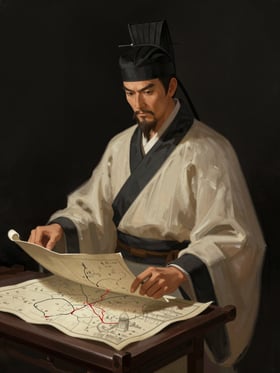
Hu Zhi, a Cao Wei general famed for aiding Fancheng and prudent rule, is shown in the Romance joining Jia Kui at Dongguan.
Life
In the novel: 1 chapter · In the Records: 4 volumes
Life?–250
Allegiance
Appearances
- Cao Wei
- Hatched: dated by chapter
On the boards
Compare with someone →Where this person ranks on each board.
Historical Record
Hu Zhi, courtesy name Wende, was from Shouchun in the State of Chu. In his youth, he was well known alongside Jiang Ji and Zhu Ji in the Jianghuai region. Cao Cao summoned him to serve as magistrate of Dunqiu. While investigating a case involving Guo Zheng’s illicit relationship with his younger female cousin and the murder of Cheng Ta, Hu Zhi realized that the commandery clerk Feng Liang had confessed under torture. He reopened the investigation, bringing the facts to light. Hu Zhi later held posts including aide to the Chancellor, Gentleman of the Ministry of Personnel, Administrator of Changshan, and Administrator of Dongguan. During his nine years in Dongguan, officials and commoners lived in contentment, and soldiers and officers served devotedly. He investigated cases with close attention to human nature. When Lu Xian was murdered, he reasoned that the victim had no enemies but did have a young wife, and questioned youths in the neighborhood. In the end, the clerk Li Ruo turned himself in. He often distributed military rewards among the men rather than taking them home.
When Hu Zhi was Inspector of Jing Province, the Wu general Zhu Ran besieged Fancheng. Despite opposition, Hu Zhi judged that the enemy was too strong to approach. Even so, he led a lightly equipped force to the city, pointing out that Fancheng stood on low ground and had few defenders, so troops had to be sent to support it from outside. When Wei forces drew near the besieged city, those inside were reassured. He was later promoted to General Who Conquers the East and given command of the troops in Qing and Xu. He established the Eastern Expedition Headquarters, opened up farmland and stored grain, cleared the waterways in the commanderies, and maintained strict defenses, ensuring peace along the coast. In the first year of the Jingchu era, when Zhu Ran besieged Jiangxia, the historical record says that Hu Zhi and others launched an attack and Zhu Ran withdrew. Another account says that Hu Zhi once went to reinforce Pu Zhong, but withdrew after Zhu Ran’s forces counterattacked. The accounts do not describe the battle in exactly the same way.
Hu Zhi was steady and reserved, and capable of examining himself inwardly. He did not hold others to the same exacting standards he applied to his own conduct, and was fondly remembered wherever he served. He died in the second year of the Jiaping era, leaving no wealth at home, only bestowed clothing and book cases. The court posthumously promoted him to Marquis of Yanglingting and gave him the posthumous title Zhenhou. In the sixth year of the Jiaping era, it commended his integrity and bestowed money and grain on his family. His son Hu Wei inherited his title and was also known for his integrity.
In the Novel
In Chapter 96 of Romance of the Three Kingdoms, Hu Zhi is called “Administrator of Dongwan” and is assigned to advance on Yangcheng with Jia Kui and Man Chong, heading straight for Dongguan. The novel places him among the Wei forces advancing along separate routes, establishing the direction of Jia Kui’s march. This title is similar to the post of Administrator of Dongguan that Hu Zhi held according to his biography, but the specific title and actions given here belong to the novel’s narrative. The passage provided does not portray his judgment, words, or military achievements; it focuses instead on the movements of Cao Xiu, Jia Kui, and Sima Yi’s forces.
Another historical account records that Hu Zhi served as Administrator of Dongguan. It also says that in the second year of the Taihe era, Jia Kui led the troops of Man Chong, General of the Van, Hu Zhi, Administrator of Dongguan, and others toward Dongguan. Jia Kui saw that Cao Xiu might run into trouble after advancing too far, and then came to his rescue at Jiashi. Thus, the novel’s placement of Hu Zhi among the troops advancing toward Dongguan under Jia Kui echoes the historical background, but the novel’s specific arrangement of “taking Yangcheng” should not be treated as a direct record of historical events.
Key Relationships
Hu Zhi and Jiang Ji were contemporaries who had been well known in the Jianghuai region since their youth. Jiang Ji once recommended Hu Zhi to Cao Cao and relayed his father Hu Min’s assessment: Hu Zhi was inferior to his father in breadth of vision and general strategy, but surpassed him in meticulous handling of affairs. An episode involving Hu Zhi and Zhang Liao also shows that he did not wish to be drawn into personal grievances out of friendship. After Zhang Liao fell out with the army supervisor Wu Zhou, he asked Wen Hui to appoint Hu Zhi. Hu Zhi declined and advised Zhang Liao not to distance himself from Wu Zhou, whom he had once praised, over a passing disagreement. Zhang Liao listened and reconciled with Wu Zhou.
Hu Zhi and his son Hu Wei shared a tradition of integrity and prudence. Hu Wei once rode a donkey alone to visit his father. Hu Zhi gave him only one bolt of silk for travel expenses, explaining that it was left over from his salary. When he heard that the commander of his tented guard had secretly given his son financial help, Hu Zhi had the commander beaten with a staff and struck from the rolls of office. Later, when Hu Wei met Emperor Wu of Jin, he said that his father was “so honest he feared people might find out,” while he himself was “so honest he feared people might not find out,” thereby acknowledging that he was not as good as his father. This episode appears in Pei Songzhi’s annotation, quoting the Jinyang Qiu. Together with the account that Hu Zhi left no wealth at home, it portrays his family’s tradition of integrity and frugality.
Signature Scene
When Zhu Ran besieged Fancheng, people thought the Wu army was too strong to approach. Hu Zhi, however, judged that the city was low-lying and short of troops, and would be in danger without outside support. He therefore led his forces to the siege. The historical record briefly notes that “the city was then at ease.” This episode encapsulates his sound judgment and decisiveness, and echoes the account of Hu Zhi and others driving back Zhu Ran in the first year of the Jingchu era.
Another episode, though not set on a battlefield, reveals how he handled affairs. Hu Zhi declined Zhang Liao’s request to recruit him—not because he feared involvement, but because he worried that his own abilities were limited and he could not ensure lasting harmony with Zhang Liao. Invoking the principles of friendship upheld by the ancients, he pointed out that one should not take part in a grievance against Wu Zhou merely out of momentary closeness. Zhang Liao consequently restored his relationship with Wu Zhou, and Hu Zhi resolved a personal dispute between commanders through frank words.
The novel’s account of the march toward Dongguan offers a different image: Hu Zhi appears as a Wei general advancing with Jia Kui’s force toward Yangcheng and Dongguan. But the passage does not present his personal words or actions; he is chiefly a figure within the military narrative.
Quotes
3 lines in the books · 2 featured
「古人之交也,取多知其不貪,奔北知其不怯,聞流言而不信,故可終也。武伯南身爲雅士,往者將軍稱之不容於口,今以睚眦之恨,乃成嫌隙。況質才薄,豈能終好?是以不願也。」
This line expounds the ancients' way of friendship, reflecting Hu Zhi's discernment of people and his noble, upright character.
「此士無讎而有少妻,所以死乎!」
This remark incisively lays bare the tragedy of a scholar dying because of his wife, full of insight.
- Family
- Friends
- Other
Who is Hu Zhi connected to?
Pick someone to see how many steps lie between them and Hu Zhi.
History vs. novel
7 points · 1 novel-only
| History | Novel |
|---|---|
| The Dunqiu CaseHistory only | |
When Hu Zhi was serving as magistrate of Dunqiu, he established that Guo Zheng had committed adultery with his younger female cousin and murdered Cheng Ta. He saw through the fact that the commandery clerk Feng Liang had falsely accused himself after being tortured, and ultimately uncovered the truth of the case. vol. 27 | — |
| Mediating Between Zhang Liao and Wu ZhouHistory only | |
Zhang Liao had fallen out with his military supervisor, Wu Zhou, and asked Hu Zhi to intervene. Hu Zhi initially declined, but later persuaded Zhang Liao by appealing to the principles of friendship, and the two were eventually reconciled. vol. 27 | — |
| The Dongguan CaseHistory only | |
While serving as Dongguan's governor, Hu Zhi deduced that Lu Xian had been murdered because he had a young wife, and noticed something suspicious in Li Ruo's expression. Li Ruo eventually turned himself in. vol. 27 | — |
| Lifting the Siege of FanchengHistory only | |
When Zhu Ran besieged Fancheng, Hu Zhi judged that the city was low and its garrison small, so troops had to be sent to its aid. He therefore led a light force to the besieged city, steadying the morale of its defenders. vol. 27 | — |
| Farming and Guarding the FrontierHistory only | |
While serving as General Who Conquers the East and commander of the forces in Qing and Xu provinces, Hu Zhi greatly expanded farmland and grain stores, established the Eastern Expedition Command, cleared waterways, and strengthened defenses, bringing peace to the coastal region. vol. 27 | — |
| No Surplus Wealth in His HouseholdHistory only | |
When Hu Zhi died, his household had no surplus wealth, only clothes and a book chest bestowed by the emperor. The court posthumously enfeoffed him as Marquis of Yangling Pavilion and gave him the posthumous title Marquis Zhen. vol. 27 | — |
| Joining Jia Kui in Attacking WuNovel only | |
| — | The novel describes Jia Kui leading Man Chong and Hu Zhi to capture Yangcheng and advance straight toward Dongguan. Hu Zhi takes part in Cao Wei's plans for the campaign against Wu as the governor of Dongwan. ch. 96 |
- The Dunqiu CaseHistory only
- History
When Hu Zhi was serving as magistrate of Dunqiu, he established that Guo Zheng had committed adultery with his younger female cousin and murdered Cheng Ta. He saw through the fact that the commandery clerk Feng Liang had falsely accused himself after being tortured, and ultimately uncovered the truth of the case.
vol. 27
- Mediating Between Zhang Liao and Wu ZhouHistory only
- History
Zhang Liao had fallen out with his military supervisor, Wu Zhou, and asked Hu Zhi to intervene. Hu Zhi initially declined, but later persuaded Zhang Liao by appealing to the principles of friendship, and the two were eventually reconciled.
vol. 27
- The Dongguan CaseHistory only
- History
While serving as Dongguan's governor, Hu Zhi deduced that Lu Xian had been murdered because he had a young wife, and noticed something suspicious in Li Ruo's expression. Li Ruo eventually turned himself in.
vol. 27
- Lifting the Siege of FanchengHistory only
- History
When Zhu Ran besieged Fancheng, Hu Zhi judged that the city was low and its garrison small, so troops had to be sent to its aid. He therefore led a light force to the besieged city, steadying the morale of its defenders.
vol. 27
- Farming and Guarding the FrontierHistory only
- History
While serving as General Who Conquers the East and commander of the forces in Qing and Xu provinces, Hu Zhi greatly expanded farmland and grain stores, established the Eastern Expedition Command, cleared waterways, and strengthened defenses, bringing peace to the coastal region.
vol. 27
- No Surplus Wealth in His HouseholdHistory only
- History
When Hu Zhi died, his household had no surplus wealth, only clothes and a book chest bestowed by the emperor. The court posthumously enfeoffed him as Marquis of Yangling Pavilion and gave him the posthumous title Marquis Zhen.
vol. 27
Places
- Native of
- ShouchunRecords
- Governed
- Jing ProvinceRecords
- Changshan StateRecords
Continue
Hu Wei
Child
Relationship timeline2 entries ▸
Inner monologues · AI-generated1 monologue ▸
- I am Hu Zhi, courtesy name Wende, from Shouchun in Chu. In my youth, I was known alongside Jiang Ji and Zhu Ji in the Hu