Overview
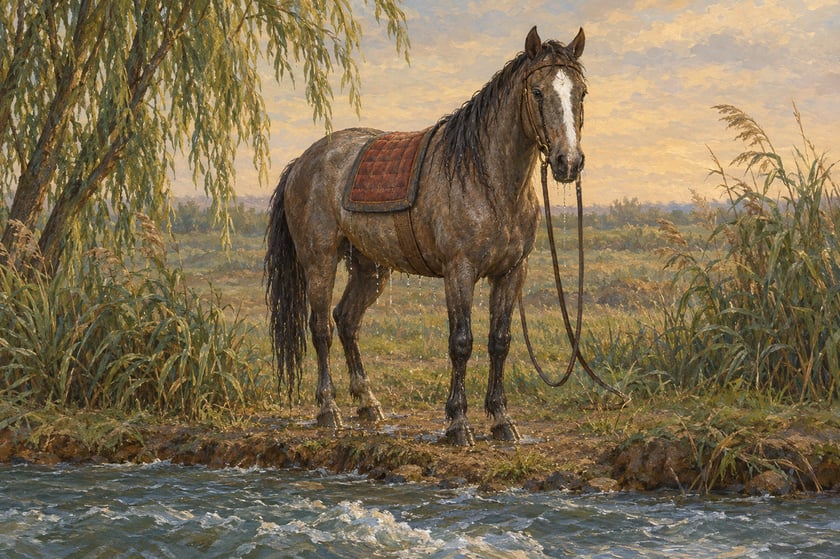
Dilu is the horse ridden by Liu Bei. It appears in both books: in Records of the Three Kingdoms, it is mentioned in Shiyu, quoted in Pei Songzhi's commentary on the biography of the Former Lord, while Romance of the Three Kingdoms gives a fuller account in chapters 34 and 35. The Romance also calls it “the Dilu horse”; works on judging horses write its name as Dilu (的颅), while both books use Dilu (的卢). The novel describes the horse as having tear grooves beneath its eyes and white spots beside its forehead, features that judges of horses regard as signs that it will bring misfortune to its rider.
Origins
Shiyu, quoted in Pei Songzhi's commentary, said only that “the horse he rode was named Dilu,” without saying where Liu Bei acquired it.
In chapter 34 of Romance of the Three Kingdoms, the surrendered generals Zhang Wu and Chen Sun rebel in Jiangxia. Liu Bei leads troops to suppress them and, seeing Zhang Wu's exceptionally magnificent horse before the battle lines, says, “This must be a thousand-li horse”. Zhao Yun rides out and, in fewer than three exchanges, knocks Zhang Wu from his horse with a single spear thrust, then seizes the reins and leads the horse back to his own lines.
The novel then describes the horse's reputation for bringing misfortune to its master. Liu Biao sees the splendid horse Liu Bei is riding and praises it repeatedly, so Liu Bei gives it to him, and Liu Biao rides it back into the city. When Kuai Yue sees it, he says that his late elder brother Kuai Liang was particularly skilled at judging horses and that he himself also knows something of the art. He identifies the horse as Dilu and says that it brings misfortune to its rider. He adds that Zhang Wu died precisely because of this horse and urges Liu Biao not to ride it. The next day, Liu Biao holds a banquet for Liu Bei and returns the horse on the grounds that his worthy younger brother often goes on campaign and will have use for it. He also has Liu Bei lead his own troops to garrison Xinye. As Liu Bei leaves the city, Yi Ji, a member of the Jing Province staff, stops him in front of his horse. He repeats Kuai Yue's warning that “riding it brings misfortune to its master” and urges him not to ride it again. Liu Bei replies, “Life and death are decreed by fate; how can a horse bring misfortune?”
In chapter 35 of the Romance, Xu Shu, called “Shan Fu” in this chapter, asks to examine Liu Bei's horse. He recognizes it as Dilu and says that although it is a thousand-li horse, it will bring misfortune to its master. After hearing Liu Bei recount his leap across Tanxi, he says that this was saving its master rather than harming him, but that it is bound to bring misfortune to one master eventually. He proposes a method: give the horse to someone against whom Liu Bei bears a grudge, then ride it again after it has brought misfortune to that person. Liu Bei's expression changes, and he refuses. Shan Fu laughs and says that he has long heard of Liu Bei's benevolence and virtue and offered these words to test him.
Notable Episodes
The episode of Liu Bei's Horse Leaps the Tan Stream appears in both Pei Songzhi's commentary to Records of the Three Kingdoms and Romance of the Three Kingdoms. It takes place at Tanxi, west of Xiangyang. Shiyu, quoted in Pei Songzhi's commentary, said that Liu Bei fled on Dilu and fell into the stream; Dilu leaped three zhang in a single bound, enabling him to cross.
In chapter 34 of Romance of the Three Kingdoms, Liu Bei is pursued to the stream, where his horse becomes mired in the water. The horse leaps three zhang out of the water and flies onto the western bank.
In the episode of the Death of Pang Tong at Luofengpo in chapter 63 of the Romance, Liu Bei exchanges “the white horse he rides” for Pang Tong's mount. The ambushers then aim their arrows solely at the rider on the white horse, and Pang Tong dies in the hail of arrows. These two passages call the horse only a “white horse,” not Dilu.
History and the Romance
Dilu is not recorded in Liu Bei's biography in Records of the Three Kingdoms; it appears in Shiyu, quoted in Pei Songzhi's commentary. The same annotation immediately quoted Sun Sheng's rebuttal: Liu Bei was then living as a guest in Jing Province, and had such an incident occurred, he could not have remained there peacefully for the rest of Liu Biao's life. Sun Sheng dismissed the account as follows: “These are all unfounded popular tales, not facts.” The two views were presented side by side. Records of the Three Kingdoms does not record Zhao Yun's seizure of the horse, Kuai Yue's and Yi Ji's warnings that it would bring misfortune to its master, or Shan Fu's test involving a method of averting that misfortune.
Scholarship
According to the Xiangma jing, as quoted by later writers, “A horse whose white forehead marking extends into its mouth as far as its teeth is called Yuyan, also known as Dilu.” It also says, “If a slave rides it, he dies away from home; if its master rides it, he is executed in the marketplace,” treating Dilu as an ill-omened horse. The name Dilu (的颅) means “white head.”