Cao Wei · King of the Xianbei Who Submit to Righteousness
Kebineng
–235
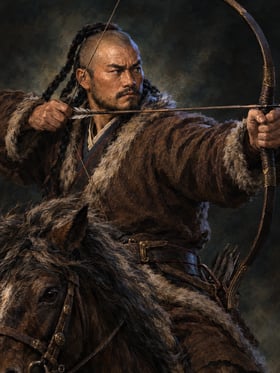
Kebineng, a Xianbei leader once titled King Who Aided Righteousness by Cao Wei, later fought Wei and was assassinated by Han Long.

Life
In the novel: 1 chapter · In the Records: 6 volumes
Life?–235
213 CE (Jian'an 18)
218 CE (Jian'an 23)
220 CE (Huangchu 1)
1 more event
223 CE (Huangchu 4)
228 CE (Taihe 2)
235 CE (Qinglong 3)
Appearances
By chapter (7)
Novel
- 85
Records
- 2
- 3
- 14
- 19
- 26
- 30
- Cao Wei· Undated
- Life event
- Death
On the boards
Compare with someone →Where this person ranks on each board.
Historical Record
Kebineng was a Xianbei leader from the “Minor Xianbei” branch. Historical records describe him as brave and strong, fair in making decisions, and uninterested in wealth; as a result, his people chose him as their chieftain. He ruled tribes near the frontier and maintained strict discipline. When his people went out to hunt, he used banners and drums to direct their movements. Among his followers were people who had fled from the Central Plains; he taught them to make weapons, armor, and shields, and also introduced writing to the tribes. By distributing spoils equally and keeping no wealth for himself, he won his people’s loyalty. His power gradually grew, and he came to command more than one hundred thousand mounted archers.
During the Jian’an era, Kebineng paid tribute to Cao Cao through Yan Rou, the Wuhuan Commandant. He once led more than three thousand horsemen alongside Yan Rou to defeat Tian Yin. When Cao Zhang's Northern Campaign Against the Wuhuan of Daijun was launched, Kebineng briefly crossed beyond the frontier, but later resumed sending tribute. After Cao Pi took the throne, Kebineng sent envoys with horses and was enfeoffed as the King Who Adheres to Righteousness. He later returned more than five hundred Wei households living among the Xianbei, and joined tribal leaders in bringing horses and cattle to trade at the frontier markets. When conflict broke out between him and the eastern Xianbei leaders Suli and Budugen, Tian Yu attempted to mediate, but the fighting continued.
Kebineng’s expansion of power was accompanied by repeated wars and shifting alliances. At a meeting of tribal leaders at Sanggan, he killed Fuluohan and absorbed Fuluohan’s son Xie Guini and his followers. Later, Budugen established relations with him and eventually submitted with his people. In the first year of the Qinglong era, Kebineng enticed Budugen to join him and cemented their alliance through marriage. He led horsemen to meet Budugen’s followers, then went on to fight Wei forces. At Loufan, cavalry led by his son clashed with Su Shang and Dong Bi, and both generals were killed. The Wei court then sent Han Long to assassinate Kebineng and installed his younger brother in his place. The Xianbei tribes thereby lost a powerful leader.
In the Novel
The Romance of the Three Kingdoms does not mention Kebineng by name. Instead, it depicts the Western Fan troops as one of the five armies Cao Pi sent against Wu: seeking to unify the realm, Cao Pi ordered armies to advance along several routes, and the Western Fan forces were said to be led by the king of the Liaodong Xianbei, who commanded one hundred thousand Qiang troops in an attack on Xiping Pass. The novel places this army within the context of Zhuge Liang’s coordinated attacks along several routes. Its advance was quickly halted, and a later report says that the Western Fan troops saw Ma Chao and withdrew without fighting.
This literary account cannot be directly equated with the historical record of Kebineng. The novel calls its leader the “King of the Liaodong Xianbei” without naming Kebineng; its account of “one hundred thousand Qiang troops” taking part in the Five-Route Invasion of Shu has no corresponding record in the historical sources. The historical record describes Kebineng’s dealings with Cao Wei, his enfeoffment as the King Who Adheres to Righteousness, his wars with Wei forces, and his eventual assassination, but does not portray him as the Western Fan commander in Cao Pi’s campaign against Shu.
Key Relationships
Kebineng’s relationship with Cao Wei included tribute, enfeoffment, frontier trade, and warfare. He paid tribute through Yan Rou, was enfeoffed by Cao Pi as the King Who Adheres to Righteousness, and returned Wei people to Daijun; but as his power grew, he repeatedly clashed with frontier tribes and Wei forces. His relationship with Budugen progressed from friendly relations and a marriage alliance to unification. After Budugen submitted with his people, the two later raided Bingzhou together; when Wei forces campaigned against them, Xie Guini instead led his people to surrender, and Budugen was eventually killed by Kebineng. Kebineng’s dealings with Tian Yu, Qian Zhao, and other Wei frontier generals involved both warfare and negotiation: Tian Yu once mediated his dispute with Suli, while Qian Zhao inflicted a major defeat on his forces at Yunzhong. Later, Han Long assassinated Kebineng on Wang Xiong’s orders.
Signature Scenes
An important turning point in the struggle for power came at the meeting of tribal leaders at Sanggan. Nengchendi of the Daijun Wuhuan had initially sought to submit to Fuluohan, but changed course on the way and summoned Kebineng instead. Kebineng arrived with more than ten thousand horsemen and killed Fuluohan at the meeting. Fuluohan’s son Xie Guini and his followers then joined Kebineng. This act demonstrated Kebineng’s methods of expansion and sowed the seeds of his later enmity with Budugen.
Another signature scene is the Battle of Loufan. As Kebineng went to meet Budugen’s followers, Bi Gui sent Su Shang and Dong Bi in pursuit. Kebineng dispatched his son with more than a thousand horsemen, and they encountered the Wei forces; in the ensuing battle, both Su Shang and Dong Bi were killed. Afterward, Qin Lang led an army against them, and the Xianbei withdrew north of the desert. Kebineng, however, continued to build alliances and was eventually assassinated by Han Long in the third year of the Qinglong era. Xiping Pass in the novel is a different kind of portrayal: the story of a Xianbei king leading one hundred thousand Qiang troops in an attack on the pass, then seeing Ma Chao and retreating without a fight, is unique to the novel. The Records of the Three Kingdoms does not attribute this episode to Kebineng.
Lines
- 史 ch.30 §18→ Xianyu Fu
「夷狄不識文字,故校尉閻柔保我於天子。我與素利爲讎,往年攻擊之,而田校尉助素利。我臨陣使瑣奴往,聞使君來,即便引軍退。步度根數數鈔盜,又殺我弟,而誣我以鈔盜。我夷狄雖不知禮義,兄弟子孫受天子印綬,牛馬尚知美水草,況我有人心邪!將軍當保明我於天子。」
- Family
- Lord & vassal
- Friends
- Enemies
- Other
Who is Kebineng connected to?
Pick someone to see how many steps lie between them and Kebineng.
Combat
On the field
Duels, kills and executions as the texts tell them, counted separately for the Records and the Romance.
Records
- Duels
- 0W 0L 0D
By their troops 1
DeathKilled by an unnamed handAssassination · Juan 30
- RecordsJuan 3Struck downSu ShangDong BiWon「與尚、弼相遇,戰於樓煩,二將敗沒」
- RecordsJuan 30AssassinationFuluohanWon「比能便於會上殺扶羅韓」
- RecordsJuan 30Struck downBudugenWon「步度根爲比能所殺」
- RecordsJuan 30AssassinationHan LongLost「雄遣勇士韓龍刺殺比能」
Battles in command
Battles this person commanded in, with the outcome as each text tells it.
- Romance
- 0W 2L 0D 0 undecided
- Romance223Five-Route Invasion of ShuLostvs Shu armyCh. 86「曹真屯兵於斜谷道,不能取勝而回」
- Romance223Zhuge Liang Repels the Five ArmiesLostvs Shu armyCh. 86「見了馬超,不戰自退;南蠻孟獲起兵攻四郡,皆被魏延用疑兵計殺退回洞去了」
Stratagems
Plans this person devised or saw through, as the texts tell them.
- Records
- 1 carried out · 1 worked · 0 turned down · 0 seen through
- RecordsLure Budugen into SurrenderingPersuasionWorkedagainst Bing ProvinceJuan 30「比能誘步度根深結和親,於是步度根將泄歸泥及部衆悉保比能」
Events
Events (6)
Battles and events the texts place this person in, by date.
Battles
- 223Five-Route Invasion of ShuWarrior
Other events
Places
- Was at
- Monan (south of the Gobi)Records

Continue
Five-Route Invasion of Shu
Relationship timeline2 entries ▸
History · vol. 19
Lord
The Xianbei chieftain watched with tens of thousands of cavalry; seeing Zhang fight fiercely and break everything in his path, he then asked to submit
History · vol. 30
- Budugen§14
Enemy
They repeatedly attacked each other; in the first year of the Qinglong era, Bineng lured Budugen into rebelling against Bingzhou and eventually killed Budugen
Inner monologues · AI-generated1 monologue ▸
- My name is Kebineng; my courtesy name is not recorded in the Records of the Three Kingdoms. If asked why I am now the on