Bi Gui
–249
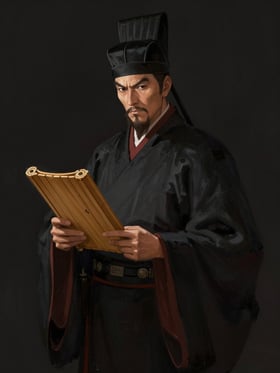
Bi Gui, Cao Wei's Bing inspector and Cao Shuang ally, was executed after a failed Xianbei campaign and the Gaopingling Incident.
Life
In the novel: 2 chapters · In the Records: 7 volumes
Life?–249
Appearances
By chapter (9)
Novel
- 106
- 107
Records
- 3
- 4
- 9
- 22
- 25
- 26
- 30
On the boards
Compare with someone →Where this person ranks on each board.
Historical Record
Bi Gui, courtesy name Zhaoxian, was from Dongping. He gained a reputation for his abilities at a young age. When Emperor Ming was still crown prince, Bi Gui served as a literary attendant. Toward the end of the Huangchu era, he was sent out to serve as a senior administrator. After Emperor Ming ascended the throne, he entered the capital as a Gentleman of the Yellow Gate and was later promoted to Inspector of Bing Province. His son married a princess, and Bi Gui lived in great wealth; while serving in Bing Province, he was known for his arrogance and ostentation. In response to Xianbei incursions, he once led troops against Kebineng but was defeated.
Budugen was in secret contact with Kebineng. Bi Gui submitted a memorial requesting troops, believing that he could intimidate Kebineng from without and pacify Budugen from within. Emperor Ming judged that Budugen was already wary and fearful, and that sending troops would instead drive the two groups to unite; he therefore ordered Bi Gui not to cross the Juzhu Pass. Before the edict arrived, Bi Gui had already advanced and encamped at Yinguan, and had sent Su Shang and Dong Bi to pursue the Xianbei. Kebineng’s son led more than a thousand cavalrymen to meet Budugen’s tribesmen, and they fought the Wei army at Loufan, where Su Shang and Dong Bi were defeated and killed. Budugen’s tribesmen rebelled and crossed beyond the frontier, joining forces with Kebineng to raid the border. Later, Qin Lang led an army against them, and the Xianbei retreated north of the desert. The Records of the Three Kingdoms, juan 30, also lists Bi Gui among those defeated during Kebineng’s border incursions, summarizing the episode as “Bi Gui suffered a defeat north of the Xing Pass.”
Bi Gui was on good terms with Cao Shuang. After Cao Shuang's Regency began, Bi Gui left Bing Province for the court, serving in succession as Palace Military Commandant and Gentleman of the Palace and Minister, before becoming Sili Province’s Commandant of Sili. He often offered advice to Cao Shuang, who frequently accepted his views. After the Gaoping Mausoleum Incident in the first year of the Jiaping era, Bi Gui was named as one of those who had conspired with Cao Shuang. Zhang Dang was imprisoned and testified that Cao Shuang and the others had plotted rebellion. The court officials agreed to arrest Cao Shuang and his faction, and Bi Gui was executed alongside He Yan, Deng Yang, Ding Mi, Li Sheng, and others; his three clans were exterminated.
In the Novel
Romance of the Three Kingdoms portrays Bi Gui as an effete man of letters trusted by Cao Shuang. When Cao Fang ascended the throne and Cao Shuang and Sima Yi jointly took charge of the government, the novel includes Bi Gui among Cao Shuang’s trusted guests, naming him alongside He Yan, Deng Yang, Li Sheng, and Ding Mi. It links the group’s prominence to Cao Shuang’s gradual monopolization of power. The novel then has Cao Shuang appoint Bi Gui Commandant of Sili, making him one of the confidants who took part in Cao Shuang’s deliberations day and night. This specific depiction is more dramatic than the historical accounts; the banquets and lavish lifestyle associated with it are also part of the novel’s portrayal of Cao Shuang’s faction.
In its account of the Gaoping Mausoleum Incident, the novel describes Sima Yi launching a coup while Cao Shuang is outside the capital accompanying the emperor to pay respects at the mausoleum. It then uses Zhang Dang’s testimony to implicate Bi Gui and others, and has them beheaded and their clans exterminated alongside Cao Shuang and his brothers. The historical accounts confirm that Bi Gui belonged to Cao Shuang’s faction and was executed, but the novel presents the coup, interrogation, and executions as a continuous series of scenes. The list of characters in the relevant passage gives his name as “Bi Fan”; the source notes that this is an alternate name in the Mao edition, corresponding to the historical Bi Gui.
Key Relationships
- Cao Shuang: Bi Gui was on good terms with Cao Shuang, who appointed him Commandant of Sili after taking power. After the Gaoping Mausoleum Incident, they were both among the members of Cao Shuang’s faction who were arrested and executed.
- Kebineng and Budugen: As Inspector of Bing Province, Bi Gui dealt with the two Xianbei powers. He advocated sending troops to pacify them, but his rash advance and dispatch of officers in pursuit ended in defeat, and Budugen’s tribesmen ultimately joined forces with Kebineng to raid the border.
- Qian Zhao: Qian Zhao once discussed defenses against Kebineng with Bi Gui. He proposed stationing the two garrisons of Xinxing and Yanmen north of the Xing Pass, combining the deployment with farming and grain storage, then waiting until the horses were fat in autumn and winter before seizing an opportunity to campaign. The plan had not yet been implemented when Qian Zhao died of illness.
- Sima Yi: Historical accounts state that after Sima Yi launched the Gaoping Mausoleum Incident, Bi Gui was executed for conspiring with Cao Shuang. The novel, by contrast, emphasizes Sima Yi’s seizure of control over Luoyang and his purge of Cao Shuang’s faction.
Signature Scenes
- The advance on Yinguan and the defeat at Loufan: The emperor had warned Bi Gui not to cross the frontier, but Bi Gui still advanced to Yinguan and sent Su Shang and Dong Bi to pursue the Xianbei. The two forces fought at Loufan, where the Wei army was defeated and killed, and Budugen’s followers then joined Kebineng. The episode highlights Bi Gui’s poor border decisions and their immediate consequences.
- The purge of Cao Shuang’s faction: After the Gaoping Mausoleum Incident, Bi Gui was named as a member of Cao Shuang’s faction. Zhang Dang’s testimony led to the interrogation and punishment of Cao Shuang and the others, and Bi Gui was ultimately executed, with his three clans exterminated. The historical accounts give a concise record of his fate, while the novel adds Zhang Dang’s confession, the imprisonment of the accused, and their execution at the marketplace.
- Deliberations among Cao Shuang’s circle: The novel has Bi Gui and He Yan and the others frequenting the heart of Cao Shuang’s power, as members of his trusted circle. This is a dramatized expansion of the historical record that Bi Gui was on good terms with Cao Shuang and served as Commandant of Sili.
Lines
- 史 ch.25 §8→ Cao Rui
「尚書僕射王思精勤舊吏,忠亮計略不如辛毗,毗宜代思。」
- Lord & vassal
- Enemies
- Other
Who is Bi Gui connected to?
Pick someone to see how many steps lie between them and Bi Gui.
History vs. novel
6 points · 2 novel-only
| History | Novel |
|---|---|
| Troops Sent from BingzhouHistory only | |
When Bi Gui was serving as Inspector of Bingzhou, he submitted a memorial requesting troops be sent because Budugen and Kebineng were secretly in league. Emperor Ming feared this would drive the two groups to unite in alarm, and warned him not to cross the frontier or go beyond Juzhu Mountain. vol. 3 | — |
| Defeat at LoufanHistory only | |
Before the imperial edict arrived, Bi Gui had already stationed troops at Yinguan and sent Su Shang and Dong Bi to pursue the Xianbei. The two armies clashed at Loufan, where Su Shang and Dong Bi were defeated and killed. vol. 3 | — |
| Budugen Joins ForcesHistory only | |
After the defeat at Loufan, Budugen’s tribes rebelled beyond the frontier and joined forces with Kebineng to raid the border. Qin Lang led the central army in a punitive campaign, and the Xianbei withdrew to the northern desert. vol. 3 | — |
| Recommendation of Xin PiHistory only | |
Bi Gui submitted a memorial arguing that Wang Si’s loyalty and strategic ability were inferior to Xin Pi’s, and recommended that Xin Pi replace him as Vice Director of the Secretariat. After consulting Liu Fang and Sun Zi, Emperor Ming did not accept the recommendation, and Xin Pi was reassigned as Commandant of the Guards. vol. 25 | — |
| Sili Province InspectorNovel only | |
| — | The novel says that Cao Shuang appointed He Yan, Deng Yang, and Ding Mi as Secretariat officials, and appointed Bi Gui as Inspector of Sili Province and Li Sheng as Governor of Henan. The five spent their days and nights discussing affairs with Cao Shuang. ch. 106 |
| Cao Shuang’s ExtravaganceNovel only | |
| — | The novel portrays Cao Shuang and He Yan and the others drinking and carousing. They first took the finest of the tribute’s rare treasures, then filled their mansions with beautiful women, formed musical troupes, and undertook extensive construction. Bi Gui is depicted as part of the background of Cao Shuang’s inner circle. ch. 106 |
- Troops Sent from BingzhouHistory only
- History
When Bi Gui was serving as Inspector of Bingzhou, he submitted a memorial requesting troops be sent because Budugen and Kebineng were secretly in league. Emperor Ming feared this would drive the two groups to unite in alarm, and warned him not to cross the frontier or go beyond Juzhu Mountain.
vol. 3
- Defeat at LoufanHistory only
- History
Before the imperial edict arrived, Bi Gui had already stationed troops at Yinguan and sent Su Shang and Dong Bi to pursue the Xianbei. The two armies clashed at Loufan, where Su Shang and Dong Bi were defeated and killed.
vol. 3
- Budugen Joins ForcesHistory only
- History
After the defeat at Loufan, Budugen’s tribes rebelled beyond the frontier and joined forces with Kebineng to raid the border. Qin Lang led the central army in a punitive campaign, and the Xianbei withdrew to the northern desert.
vol. 3
- Recommendation of Xin PiHistory only
- History
Bi Gui submitted a memorial arguing that Wang Si’s loyalty and strategic ability were inferior to Xin Pi’s, and recommended that Xin Pi replace him as Vice Director of the Secretariat. After consulting Liu Fang and Sun Zi, Emperor Ming did not accept the recommendation, and Xin Pi was reassigned as Commandant of the Guards.
vol. 25
- Sili Province InspectorNovel only
- Novel
The novel says that Cao Shuang appointed He Yan, Deng Yang, and Ding Mi as Secretariat officials, and appointed Bi Gui as Inspector of Sili Province and Li Sheng as Governor of Henan. The five spent their days and nights discussing affairs with Cao Shuang.
ch. 106
- Cao Shuang’s ExtravaganceNovel only
- Novel
The novel portrays Cao Shuang and He Yan and the others drinking and carousing. They first took the finest of the tribute’s rare treasures, then filled their mansions with beautiful women, formed musical troupes, and undertook extensive construction. Bi Gui is depicted as part of the background of Cao Shuang’s inner circle.
ch. 106
Combat
On the field
Duels, kills and executions as the texts tell them, counted separately for the Records and the Romance.
- RecordsJuan 9ExecutionLost「於是收爽、羲、訓、晏、颺、謐、軌、勝、範、當等,皆伏誅,夷三族」
Events
Events (2)
Battles and events the texts place this person in, by date.
Other events
Places
- Governed
- Sili ProvinceRecords
- BingzhouRecords
Continue
Dong Bi
Serves
Relationship timeline3 entries ▸
History · vol. 3
- Kebineng§17
Rival
The Inspector of Bingzhou, Bi Gui, submitted a memorial that troops should immediately be sent out to intimidate Bi Neng and internally hold Budugen in check.
History · vol. 25
- Xin Pi§8
Advised
Memorialized a request that Xin Pi replace Wang Si as Palace Assistant, but it did not succeed
Novel · ch. 106
- Cao Shuang§13
Advised
a retainer; served as Colonel Director of Retainers in Sili Province
Inner monologues · AI-generated1 monologue ▸
- I am Bi Gui; the records here do not give my courtesy name. I lived in the final years of the Han, carrying out the cour