Cao Wei · Inspector of You Province
Du Shu
198–252
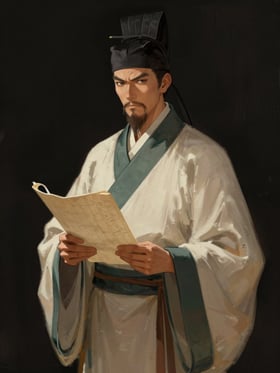
Cao Wei official Du Shu was known for frank counsel, pragmatism, frugality, and his works Ti Lun and Xingxing Lun.
On the boards
Compare with someone →Where this person ranks on each board.
Historical Record
Du Shu, whose courtesy name was Wubo, was the son of Du Ji, an official of Cao Wei. During the Taihe era, he first served as a Gentleman Attendant of the Palace and, several months later, was transferred to the post of Gentleman of the Yellow Gate. The historical account describes him as sincere and plainspoken, without affectation, and as having earned a reputation at a young age. After entering the court, he neither cultivated connections nor sought patrons, but devoted himself to public affairs. Whenever he saw gains or failings in government, he spoke frankly, guided by principle and law. For this, he was valued by the Palace Attendant Xin Pi and others. Materials from the Du family cited in Pei’s commentary also record that, when young, he became acquainted with Li Feng. The two later came to have different aims: Li Feng pursued fame, while Du Shu let things take their natural course and made no effort to conform to current fashions.
Du Shu was concerned with local governance and the state’s finances. When the court debated whether provincial inspectors should command troops, he argued that they should focus exclusively on civil administration. After seeing Lü Zhao hold concurrent authority in Jizhou, he submitted a memorial noting that Jizhou had a large population and extensive cultivated land, making it an important source of state revenue; its governor should not be distracted by military affairs as well. He summed up his approach to governance with the words, “The way to bring peace to the people lies in increasing wealth.” He stressed farming and frugality, opposed provincial and commandery governors neglecting the people’s livelihood in pursuit of military expansion, and worried that heavier taxes and labor obligations would leave the state treasuries empty. When the court deliberated on a system for evaluating officials, he also argued that appointments should allow people to make the fullest use of their abilities, and that officials should be assessed according to their duties and achievements. This system of evaluation, however, was never implemented. He also once submitted a strongly worded remonstrance to Lian Zhao; the historical account summarizes these arguments as forthright and uncompromising.
Du Shu later became Administrator of Hongnong. Several years afterward, he was transferred to serve as Chancellor of Zhao, but left office due to illness. He then served as Administrator of Hedong and as Commandant of the Huai-North Command, leaving that post on account of illness as well. Later, he was appointed Palace Censor-in-Chief. The historical account says that wherever he served, he focused on the larger picture, benefited the people, and won their favor, though he did not equal his father, Du Ji.
Du Shu later became Inspector of You Province, with the added titles of General Who Establishes Might, Commissioner with Authority, and Protector of the Wuhuan Colonel. Cheng Xi, General Who Conquers the North, was stationed at Jixian. Yuan Kan and others once advised Du Shu to deal cautiously with him, but Du Shu paid them no heed. Before he had been in office a full year, the Xianbei chief Erjing arrived directly at the provincial seat with several dozen horsemen. Du Shu killed one of his attendants, but did not submit a memorial to report the incident. Cheng Xi impeached him on this basis. Du Shu was taken into the custody of the Court of廷尉 and was originally sentenced to death. Remembering that his father, Du Ji, had died in the line of duty during a flood, the court spared his life, stripped him of his status as a commoner, and exiled him to Zhangwu Commandery. The historical account describes him as free-spirited and wilful, and as failing to guard against danger in his deliberations, which ultimately led to this setback.
During his time in Zhangwu, Du Shu took Ruan Wu’s advice and completed eight chapters of the Treatise on the Essence of Things, as well as a single chapter entitled Treatise on the Arousal of Nature. In the fourth year of Jiaping, he died at the place of his exile.
In the Novel
This person does not appear in the novel.
Key Relationships
Du Shu inherited his father Du Ji’s title. While testing the construction of tower ships on the Tao River, Du Ji was caught in a storm and drowned when the ships capsized. Emperor Wen of Wei wept for him and posthumously bestowed on him the title Grand Master of the Palace and the posthumous name Marquis Dai. After Du Shu was convicted, his father’s death in the line of duty during a flood became an important reason for sparing him from execution. In the second year of Ganlu, Yue Xiang of Hedong submitted a memorial recounting Du Ji’s contributions, and the court thereupon enfeoffed Du Shu’s son, Du Yu, as Marquis of Fengleting.
Du Shu was not known for forming factional ties with court officials: the historical account explicitly says that he neither cultivated connections nor sought patrons, while Xin Pi and others valued him for speaking frankly. When Du Shu was assigned to You Province, Yuan Kan warned him to beware of Cheng Xi; Cheng Xi later impeached Du Shu over the Xianbei party’s arrival in the province. After Du Shu was exiled, Ruan Wu urged him to devote himself to writing, prompting him to compose the Treatise on the Essence of Things.
Signature Episodes
The first is his memorial during the court debate over Jizhou’s military and civil administration. Du Shu did not confine himself to generals and troop numbers; instead, he grounded his argument in population, farming, taxes and labor obligations, and the state treasury. He pointed out that Jizhou was a major source of state revenue and that its governor should be free to focus on civil administration. Linking the people’s livelihood to the state’s capacity to sustain military forces, he argued that the state needed to conserve the people’s strength and secure its heartland, rather than expand its armies without restraint.
The second is his handling of affairs and subsequent impeachment during his tenure in You Province. When a Xianbei leader led cavalry through the passes and arrived directly at the provincial seat, Du Shu killed one attendant but did not submit a memorial explaining what had happened. Cheng Xi promptly impeached him, and the earlier warnings from Yuan Kan and the others proved prescient. Du Shu did not try to defend himself by yielding. A letter cited in Pei’s commentary depicts him as willing to bear the consequences of the dispute while still insisting on acting as he saw fit. This reveals his unwillingness to bend to others’ wishes, and also accords with the historical account’s assessment that he “failed to guard against danger in his thinking.”
The third is his writing in Zhangwu. After being stripped of office and exiled, Du Shu turned his political setback into written arguments, completing eight chapters of the Treatise on the Essence of Things and one chapter of the Treatise on the Arousal of Nature. The works addressed relations between ruler and subject, words and conduct, government and law, and the use of military force, showing that political order and the governance of the people remained at the center of his thought.
In the sources
Where the books name Du Shu
History · vol. 16Records of the Three Kingdoms
恕字务伯,太和中为散骑黄门侍郎。〈杜氏新书曰:恕少与冯翊李丰俱为父任,总角相善。…
Read the whole paragraph
恕字务伯,太和中为散骑黄门侍郎。〈杜氏新书曰:恕少与冯翊李丰俱为父任,总角相善。及各成人,丰砥砺名行以要世誉,而恕诞节直意,与丰殊趣。丰竟驰名一时,京师之士多为之游说。而当路者或以丰名过其实,而恕被褐怀玉也。由此为丰所不善。恕亦任其自然,不力行以合时。丰以显仕朝廷,恕犹居家自若。明帝以恕大臣子,擢拜散骑侍郎,数月,转补黄门侍郎。〉恕推诚以质,不治饰,少无名誉。及在朝,不结交援,专心向公。每政有得失,常引纲维以正言,於是侍中辛毗等器重之。
History · vol. 16Records of the Three Kingdoms
时公卿以下大议损益,恕以为“古之刺史,奉宣六条,以清静为名,威风著称,今可勿令领兵,以专民事。”…
Read the whole paragraph
时公卿以下大议损益,恕以为“古之刺史,奉宣六条,以清静为名,威风著称,今可勿令领兵,以专民事。”俄而镇北将军吕昭又领冀州,〈《世语》曰:昭字子展,东平人。长子巽,字长悌,为相国掾,有宠於司马文王。次子安,字仲悌,与嵇康善,与康俱被诛。次子粹,字季悌,河南尹。粹子预,字景虞,御史中丞。〉乃上疏曰:
History · vol. 16Records of the Three Kingdoms
帝王之道,莫尚乎安民;安民之术,在於丰财。丰财者,务本而节用也。…
Read the whole paragraph
帝王之道,莫尚乎安民;安民之术,在於丰财。丰财者,务本而节用也。方今二贼未灭。戎车亟驾,此自熊虎之士展力之秋也。然搢绅之儒,横加荣慕,搤腕抗论,以孙、吴为首,州郡牧守,咸共忽恤民之术,脩将率之事。农桑之民,竞干戈之业,不可谓务本。帑藏岁虚而制度岁广,民力岁衰而赋役岁兴,不可谓节用。今大魏奄有十州之地,而承丧乱之弊,计其户口不如往昔一州之民,然而二方僭逆,北虏未宾,三边遘难,绕天略匝;所以统一州之民,经营九州之地,其为艰难,譬策羸马以取道里,岂可不加意爱惜其力哉?以武皇帝之节俭,府藏充实,犹不能十州拥兵;郡且二十也。今荆、扬、青、徐、幽、并、雍、凉缘边诸州皆有兵矣,其所恃内充府库外制四夷者,惟兗、豫、司、冀而已。臣前以州郡典兵,则专心军功,不勤民事,宜别置将守,以尽治理之务;而陛下复以冀州宠秩吕昭。冀州户口最多,田多垦辟,又有桑枣之饶,国家徵求之府,诚不当复任以兵事也。若以北方当须镇守,自可专置大将以镇安之。计所置吏士之费,与兼官无异。然昭於人才尚复易;中朝苟乏人,兼才者势不独多。以此推之,知国家以人择官,不为官择人也。官得其人,则政平讼理;政平故民富贵,讼理故囹圄空虚。陛下践阼,天下断狱百数十人,岁岁增多,至五百餘人矣。民不益多,法不益峻。以此推之,非政教陵迟,牧守不称之明效欤?往年牛死,通率天下十能损二;麦不半收,秋种未下。若二贼游魂於疆埸,飞刍輓粟,千里不及。究此之术,岂在强兵乎?武士劲卒愈多,愈多愈病耳。夫天下犹人之体,腹心充实,四支虽病,终无大患;今兗、豫、司、冀亦天下之腹心也。是以愚臣慺慺,实原四州之牧守,独脩务本之业,以堪四支之重。然孤论难持,犯欲难成,众怨难积,疑似难分,故累载不为明主所察。凡言此者,类皆疏贱;疏贱之言,实未易听。若使善策必出於亲贵,亲贵固不犯四难以求忠爱,此古今之所常患也。
Lines
- 史 ch.16 §26→ Cao Rui
“古之刺史,奉宣六条,以清静为名,威风著称,今可勿令领兵,以专民事。”
- Family
- Friends
- Enemies
- Teacher & student
- Other
Who is Du Shu connected to?
Pick someone to see how many steps lie between them and Du Shu.
Places
- Governed
- You ProvinceRecords
- Hedong CommanderyRecords
- Hongnong CommanderyRecords
Continue
Du Yu
Child
Relationship timeline2 entries ▸
Inner monologues · AI-generated1 monologue ▸
- I am Du Shu, courtesy name Wubo. I recall that when we were young, Li Feng of Fufeng and I both served under our fathers