
Background
The Emperor's Return to the East was not a relocation of the capital independently initiated by the court and carried out along a predetermined route. Rather, it was a process in which the emperor was repeatedly forced to flee amid the rival warlords after Li Jue and Guo Si took control of the court. Romance of the Three Kingdoms presents the crisis as beginning with Li Jue, even after his defeat, still commanding Xiliang troops and Qiang soldiers, while Guo Si intercepts the imperial carriage along the way. Jia Xu secretly induces the Qiang soldiers to leave, and Huangfu Li sows discord among the Xiliang Army, showing that the rulers’ military advantage was beginning to weaken—but this did not restore the court’s independence.
After setting out from the Chang'an area, the imperial carriage is first stopped and searched by Guo Si’s subordinates. Yang Feng then leads troops to rescue the emperor, and Dong Cheng joins the escort. The emperor advances eastward for a time through Huayin and Hongnong, but at Dongjian, Li Jue and Guo Si pursue him. In the fighting, officials, palace attendants, and books are abandoned, and the imperial carriage and the bureaucracy collapse almost at the same time. The “return to the east” is thus both a geographical journey and a precarious struggle for survival, as the court passes from the control of one army to that of another.
Major Figures
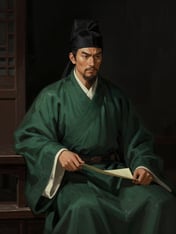
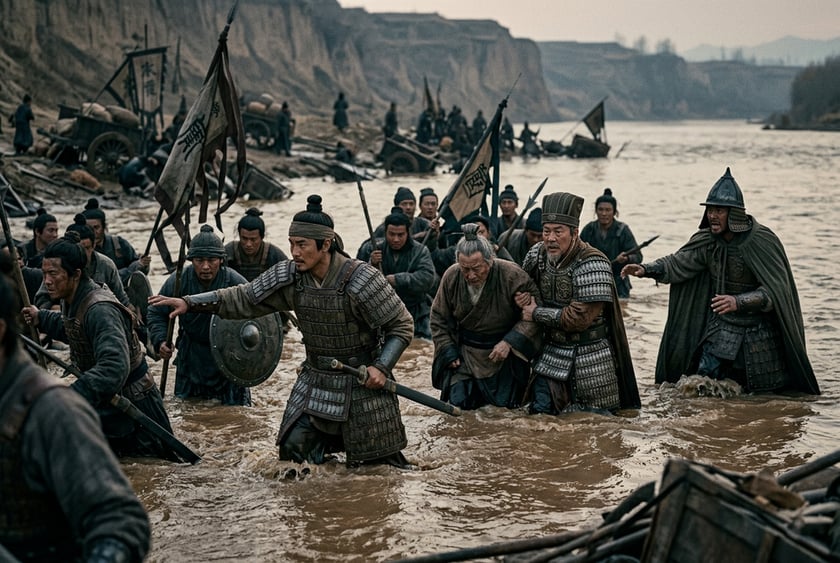
Emperor Xian of Han is the nominal center of the events, yet he lacks an army capable of directing events and a stable source of revenue. The novel repeatedly depicts him asking his ministers for advice when surrounded and refusing to abandon the officials while crossing the river. This portrays a ruler still trying to preserve the bonds between sovereign and ministers, but in practice dependent on those escorting him. Empress Fu is likewise directly threatened by military violence: after the defeat at Dongjian, she and Emperor Xian are forced to walk to the Yellow River, then use silk and ropes to descend the bank and board a ferry. In the face of bodily danger and the need to survive, the dignity of the imperial house is reduced to its barest minimum.
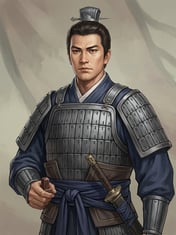
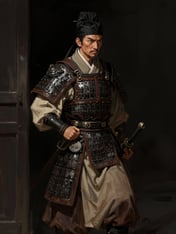
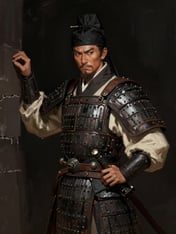
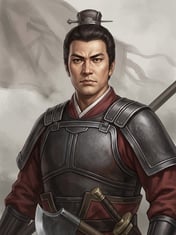
Dong Cheng and Yang Feng are responsible for escorting the emperor and coordinating military efforts, but their roles differ. Yang Feng rescues the emperor with his troops; Xu Huang, serving under him, defeats one of Guo Si’s officers and later kills Li Le, who is pursuing the imperial carriage. Dong Cheng, meanwhile, gathers reinforcements in his capacity as an imperial relative and presses for a departure from Anyi and a return to Luoyang. Han Xian, Li Le, Hu Cai, and other White Wave Army leaders are summoned by imperial decree. They replenish the court’s military forces, but also bring new military strongmen into the center of power. Hu Cai dies in the fighting, while Li Le later tries to stop the imperial carriage—showing that “escorting the emperor” did not mean unwavering loyalty.
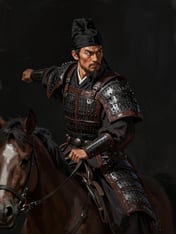
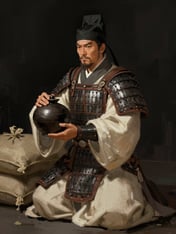
Li Jue and Guo Si are the old power holders: they join forces to pursue the emperor, while sustaining their armies through plunder. Cao Cao enters the crisis as a new outside force. When Luoyang is threatened again, Cao Cao’s troops drive off Li Jue and Guo Si. Yang Feng and Han Xian then worry that Cao Cao, having “achieved great merit,” will gain too much power, and withdraw their forces. The novel thus portrays Cao Cao as both a rescuer and a potential political successor.
Central Issues
The first issue is the divide between the nominal legitimacy of imperial authority and its actual coercive power. Every faction needs the emperor: Li Jue and Guo Si try to seize him again; Yang Feng and Dong Cheng gain political legitimacy by escorting him; and the local official Zhang Yang welcomes the emperor with grain and silk and receives a title in return. Imperial edicts can still grant offices and titles and summon reinforcements, but they can scarcely control those who receive them. Li Le and Han Xian even recommend large numbers of their troops, shamans, physicians, and menials for official posts. Military interests have commandeered appointments, a sign that the court’s institutions have become largely hollow.
The second issue is the dual nature of the forces escorting the emperor. Yang Feng, Dong Cheng, and the White Wave Army do indeed save him from danger at crucial moments, but the rescuers also control his route, his place of residence, and his security. During the stay in Anyi, the emperor lives in a thatched hut and eats coarse food, while the generals use force to exert pressure around the palace. On the way to Luoyang, Li Le even frightens the emperor by falsely claiming that pursuers are approaching. Escorting the emperor is therefore not a neutral security service, but a political resource in the contest to gain access to him, control his edicts, and distribute official posts.
Political Consequences
The return to the east does not bring an immediate restoration of order. When Emperor Xian enters Luoyang, the palaces have been burned and the streets lie desolate. The officials can only stand among the brambles to pay their respects. Famine forces residents to leave the city to strip bark from trees and dig up roots, while officials must gather firewood themselves. Returning to the old capital restores the court’s symbolic space, but not its administrative capacity, fiscal base, or a dependable central army. In Luoyang, the emperor still has to rely on Yang Feng and others. When Li Jue and Guo Si attack again, the court is once more forced to consider taking refuge to the east of the mountains.
After Cao Cao’s army drives off Li Jue and Guo Si, conditions emerge for a new transfer of power. Yang Feng and Han Xian leave because they fear Cao Cao will gain still greater power, showing that the alliance escorting the emperor can no longer hold together. For Emperor Xian, escaping the old warlords’ control does not necessarily mean regaining independence; instead, he may come under the protection of a more organized force with greater military strength. The later episode of Cao Cao Escorts the Emperor and Moves the Capital to Xu unfolds against the backdrop of Luoyang’s inability to defend itself and the mutual suspicion among the various forces escorting the emperor. In the cited passages from the novel, however, the narrative reaches only Cao Cao’s defeat of the pursuers and the withdrawal of Yang Feng and Han Xian; the subsequent move to Xu is not fully depicted in those passages.
Counterfactual Analysis
If Yang Feng and Dong Cheng had not come to the emperor’s aid around Huayin and Dongjian, Emperor Xian would likely have fallen into Li Jue and Guo Si’s hands sooner, or lost the officials accompanying him and the empress during the flight. Yet even if this alliance had been more united, short-term military victories alone could hardly have solved the problems of military supply, city defenses, and the collapse of bureaucratic order. Anyi lacked adequate palaces and provisions, while Luoyang had become almost a ruin. The real crossroads, then, was not simply whether the emperor could be rescued, but whether a system of revenue and military power independent of any single warlord could be established. The conditions presented in the text were plainly extremely unfavorable.
If Cao Cao had not intervened during the crisis in Luoyang, Emperor Xian might have continued moving among the forces of Yang Feng, Han Xian, and Dong Cheng, but such an arrangement offered little stability. If Cao Cao had succeeded in welcoming the emperor, security and administrative integration might have improved, while the emperor would have become still more dependent on a protector with independent military and political resources. This counterfactual does not mean that the move to Xu was necessarily the only possible outcome. Rather, it reveals the structural paradox of the return to the east: imperial authority had to rely on warlords to survive, and each successful escort placed the power to determine the emperor’s destination and the force of his decrees in the hands of a new military strongman.