Strategic Background
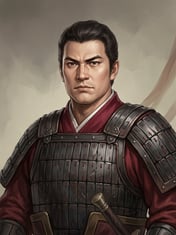
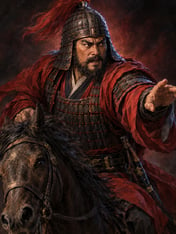
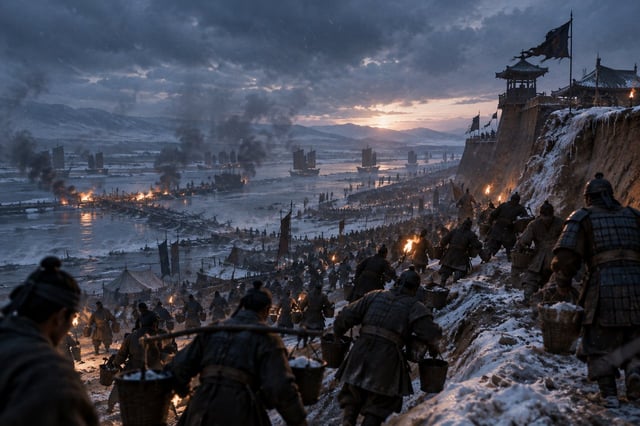
From the perspective of a military-history analyst, “Xu Chu Fights Ma Chao Bare-Chested” is a series of deliberately crafted scenes of heroic martial virtue in the novel’s account of the Battle of Tong Pass. Their function in the strategic narrative far outweighs their military significance. The Battle of Tong Pass in the sixteenth year of Jian’an was the central engagement in Cao Cao’s western campaign against the Guanzhong coalition, which included Ma Chao, Han Sui, Yang Qiu, Hou Xuan, Cheng Yin, Li Kan, and six other commanders. Cao Cao’s true strategic aim was to use his campaign against Zhang Lu as a pretext to draw out Ma Chao and the other powerful warlords west of the passes and eliminate them in battle. This was crucial to rebuilding his prestige and restoring unity in the north within two years of his defeat at Chibi. But to give the novel’s roster of warriors greater depth, the author sets a parallel thread of contrasting martial virtue alongside the strategic narrative: Xu Chu embodies the Cao army’s fierce, loyal courage, while Ma Chao embodies the Xiliang Army’s passionate courage. Their several clashes around Tong Pass are both personal duels and a head-on collision between the martial ethos of Cao Wei’s central guards and that of the frontier armies of Guanzhong.
The Forces’ Deployment
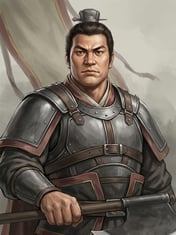
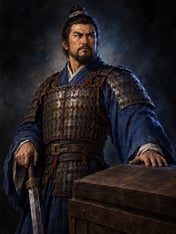
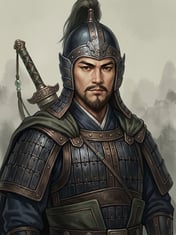
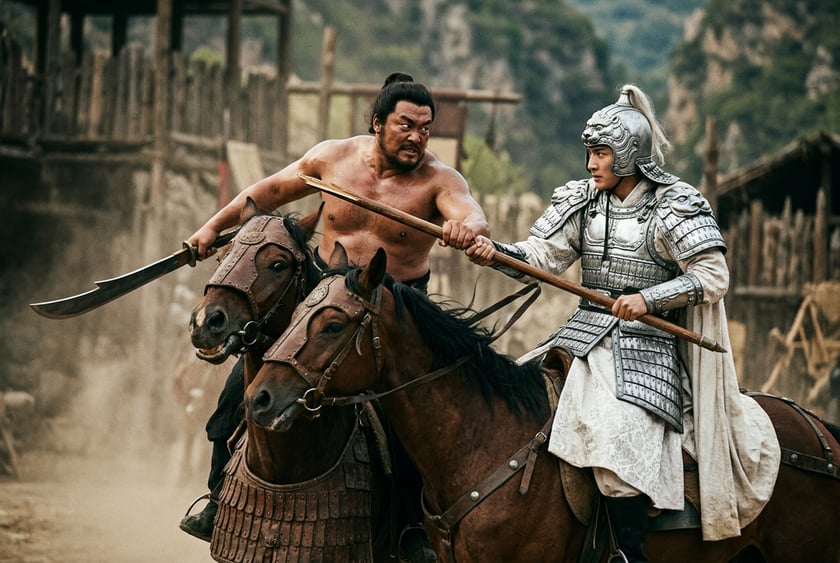
In the novel, the episode unfolds in three successive scenes. The first is “Guarding Cao Cao as He Crosses at the Wei River Crossing”: Cao Cao sits on the south bank with a hundred personal attendants, hand on sword, watching his troops cross the river. Ma Chao launches a surprise attack. Xu Chu drags Cao Cao onto a boat, leaps aboard from horseback, raises a saddle with his left hand to shield him from arrows, braces himself at the rudder with his legs, and uses one hand to steady the boat while holding up the saddle to protect Cao Cao. The second is “A Lone Rider Intimidates Ma Chao”: Cao Cao rides alone out of camp, whip in hand, to speak with Ma Chao, while Xu Chu stands behind him by himself. Ma Chao considers charging forward to seize Cao Cao, but glances back at Xu Chu, whose eyes flash with power and whose presence is formidable; he “dared not move, and reined in his horse and turned back”. The third is “Bare-Chested, They Fight Furiously”: before the two armies’ main ranks, Xu Chu and Ma Chao fight for more than a hundred bouts without a victor. They change horses and fight for another hundred bouts, again without a victor. Xu Chu then strips off his armor and fights bare-chested for more than thirty bouts, seizing a spear and snapping its shaft. The three scenes build in intensity—from “protecting” to “intimidating” to “fighting”—unfolding Xu Chu’s fierce loyalty and martial prowess in three stages.
Key Decision Points
From the perspective of the martial-virtue narrative, there are three key decision points. First, Cao Cao allows Xu Chu to drag him aboard the boat, abandoning command of the river crossing. The novel uses this to create an extreme situation in which “the ruler’s life rests in the hands of one general,” strengthening the narrative of trust between ruler and subject. Second, during their “lone-rider exchange,” Ma Chao chooses to “rein in his horse and turn back” rather than attack. The novel makes Ma Chao psychologically “lose” to Xu Chu’s gaze first. This effectively draws him back from being an “unbeatable warrior” and recasts him as a real man capable of awe, laying the psychological groundwork for his repeated defeats later on. Third, Xu Chu voluntarily strips off his armor and fights bare-chested. In the novel, this is an extraordinary act of martial virtue: he puts his safety entirely aside, using “I am not afraid to die” to meet Ma Chao’s “I will not be outdone.” Cao Cao fears that Xu Chu may come to harm and orders Xiahou Yuan and Cao Hong to attack from both sides. This acknowledges that the duel could cost him a trusted senior general, and that the fight must be checked by a collective assault. Together, these three decisions create the novel’s unique bond of interdependence between ruler and warrior.
Outcome and Legacy
In military terms, Cao Cao’s army did not win a decisive victory. Xu Chu was struck in the arm by two arrows, the generals panicked and withdrew into camp, Ma Chao fought his way all the way to the riverbank, and more than half of Cao Cao’s troops were killed or wounded. Afterward, Cao Cao ordered his men to “keep the gates firmly shut and not go out,” effectively acknowledging that a direct contest of force was to his disadvantage. He instead used Jia Xu’s scheme of sowing discord to divide Han Sui and Ma Chao; that was the true turning point in the Battle of Tong Pass. But in terms of the novel’s martial-virtue narrative, the battle became Xu Chu’s apotheosis: from then on, “the whole army called Xu Chu Tiger Marquis,” a byword comparable to Zhang Fei as “the Fierce Zhang Fei” and Guan Yu as “the Lord with the Magnificent Beard.” After the battle, Ma Chao sighed to Han Sui, “Of all those I have seen fight fiercely, none compares with Xu Chu. He truly is Tiger Fool”. This line is the novel’s official endorsement of its ranking of warriors: it raises Xu Chu to the same tier as Lü Bu and Zhang Fei, while hinting at a martial pairing of “Tiger Marquis and Brocade Ma Chao.” Together with “Lord with the Magnificent Beard and Foe of Ten Thousand Men”—Guan Yu and Ma Chao’s later exchange in Xiliang—this helps form the network of heroic narratives in the latter half of the novel.
Counterfactual Analysis
If we return to the possibilities of actual warfare, could Xu Chu really have stopped Ma Chao had Ma Chao persisted in trying to seize Cao Cao during their lone-rider exchange? Historical records describe Xu Chu as powerfully built and strong enough to subdue a charging ox. When he faced Ma Chao, Ma Chao had indeed “long heard of Xu Chu’s courage, and asked Cao Cao’s attendants, ‘Where is the Tiger Marquis your lord has?’” This detail is consistent between the historical record and the novel, but the Records of the Three Kingdoms contains no episode of a “bare-chested, furious battle.” The novel’s invention supplies a scene almost impossible on a real battlefield: two senior generals risking their lives in a one-on-one test of martial prowess. In tactical reality, a commander-in-chief’s senior officers would fight bare-chested duels before the ranks only in narrative literature, because no rational commander would expose his most valuable guards to a storm of arrows for thirty rounds. The choice to write something “known to be untrue, yet still worth writing” shows Luo Guanzhong’s precise understanding of what readers expected from the novel: they wanted not a “military record,” but “the presence of heroes.” Xu Chu Fights Ma Chao Bare-Chested has endured because it fulfills a cultural imagination about whether a person can bare his chest and take the field for his convictions. That imaginative power matters more than any specific victory or defeat.