Background
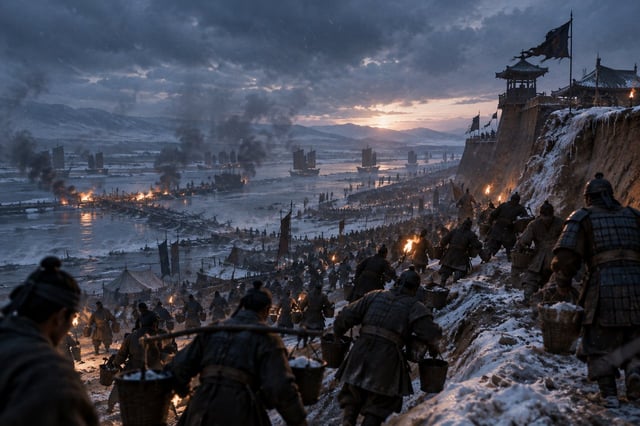
In 211 (the sixteenth year of Jian’an), Cao Cao sent Zhong Yao to prepare for a western campaign against Zhang Lu in Hanzhong. The generals of Guanzhong suspected that the expedition was really aimed at them, so Ma Chao joined Han Sui, Yang Qiu, Li Kan, Cheng Yi, and others in raising troops and garrisoning Tong Pass. Cao Cao ordered his generals to hold fast and avoid battle. In the seventh month, he personally led the western campaign: first facing the allied forces across the pass, then sending Xu Huang and Zhu Ling to cross the Pu Ban Ford by night and seize the west bank of the Yellow River. Cao Cao himself crossed the river farther north, advanced south along its banks, and established a camp south of the Wei River. The allies had lost the natural defenses of Tong Pass and were pinned down by the Cao army’s fortified camps, so they began seeking peace in exchange for territory. It was in this stalemate that the plan to sow discord emerged.
Chapter 58 of Romance of the Three Kingdoms gives a different account of why the rebellion began: Ma Chao rose in revenge for his father’s death, and Han Sui showed him a letter in which Cao Cao promised to make Han Sui the Marquis of Xiliang and asked him to capture and deliver Ma Chao. Han Sui said he would not harm Ma Chao and was willing to help him instead. In this version, Ma Teng’s death comes before the rebellion. According to the Records of the Three Kingdoms, Ma Teng was then serving as Commandant of the Palace Guard at Ye, and his three clans were exterminated only after Ma Chao’s uprising. The Annals of Emperor Xian in the Book of the Later Han dates the event to the seventeenth year of Jian’an. The novel reverses the order of cause and effect.
Main Figures
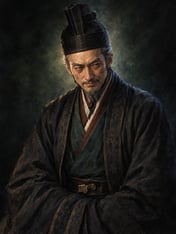
Jia Xu proposed the stratagem. In his early years, he served Zhang Xiu. After Zhang Xiu submitted to Cao Cao, Jia Xu first served as Commandant of the Capital and was later promoted to Grand Master of the Palace. In 208, after Cao Cao pacified Jing Province, he planned to advance east down the Yangtze. Jia Xu advised him to first win over Jing-Chu and not rush into war. Cao Cao did not take his advice and was defeated at Chibi. Pei Songzhi disagreed with that counsel, arguing that with Han Sui, Ma Chao, and the others in the west watching like tigers ready to pounce, Cao Cao could not have sat securely in Jing Province. Curiously, three years later it was another of Jia Xu’s stratagems that resolved the problem of Han and Ma.
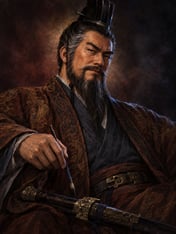
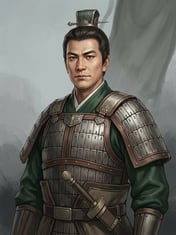
Han Sui was the most senior of the western generals and had a personal connection with Cao Cao: Cao Cao and Han Sui’s father had both been recommended as Filial and Incorrupt in the same year, and Cao Cao and Han Sui were old acquaintances of the same generation. Ma Chao was young and fierce, the sharp edge of the allied forces. Cao Cao himself took charge of carrying out the stratagem, appearing in person both to reminisce with Han Sui on the battlefield and to write him a letter afterward.
The Central Issue
The stratagem worked because of the structure of the Guanzhong alliance itself. After the battle, Cao Cao explained to his generals that the Guanzhong commanders each acted independently: though they had many troops, they were not subject to one another, and there was no true commander-in-chief. An alliance like this was especially vulnerable to mutual suspicion.
Jia Xu’s stratagem had two steps. The first was to feign acceptance of peace. Cao Cao later explained his reasoning: agree with what the other side proposed, putting them at ease and lowering their guard, while he rested and replenished his strength, waiting for an opportunity to strike. The second step was to sow discord. Jia Xu’s reply to Cao Cao had just one point: divide the enemy. Cao Cao immediately understood. The method involved creating an information imbalance twice. First, he spoke with Han Sui about old times in front of the battle lines, leaving Han Sui unable to offer his allies a convincing explanation. Then he sent a letter that had been altered, making it seem that Han Sui had removed important passages. Neither ploy required any evidence to be fabricated; each simply made ordinary dealings seem suspicious.
Romance of the Three Kingdoms presents the episode in more distinct stages. Jia Xu personally proposed combining feigned peace with a scheme to sow discord, while Ma Chao and Han Sui agreed to take turns guarding against Cao Cao and Xu Huang. When Cao Cao learned that Han Sui would face him the next day, he arranged their conversation on the battlefield. He also drew on the Book of Wei, which relates that Cao Cao told the soldiers watching that he was an ordinary man, no different from them, except that he had a little more wisdom. Jia Xu later devised the plan to deface a letter and secretly win over Han Sui’s officers.
Political Consequences
After sowing discord, Cao Cao set a date for a decisive battle. He first sent light troops to challenge the enemy, then launched a flanking cavalry attack and routed the allied forces. Cheng Yi and Li Kan were killed; Han Sui and Ma Chao fled to Liang Province, while Yang Qiu escaped to Anding. Guanzhong was pacified. The biography of Jia Xu concludes that Jia Xu had devised the plan that defeated Han and Ma.
In the longer term, this battle broke up the western commanders’ alliance. Ma Chao repeatedly rebelled in Longyou, but after his defeats he sought refuge with Zhang Lu and eventually submitted to Liu Bei. Han Sui held out in the northwest for several more years, until he was killed by his own subordinates in 215. After Ma Chao’s rebellion, Cao Cao executed Ma Teng and his family, making the feud between the Ma and Cao families permanent.
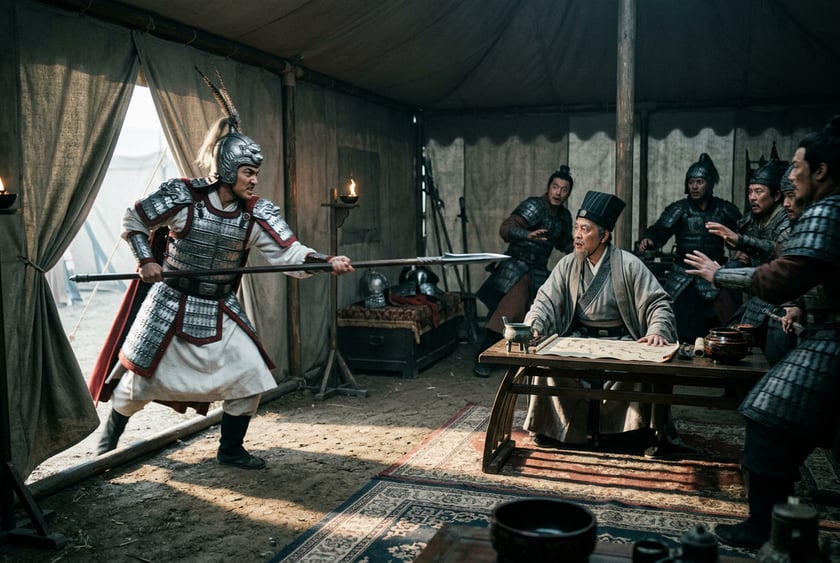
Romance of the Three Kingdoms makes the outcome of the discord plot more dramatic. Ma Chao catches sight of Han Sui secretly conferring with Yang Qiu and other generals, rushes into the tent, and swings his sword. Han Sui raises his hand to block the blow, and his left hand is cut off. Ma Chao then strikes down Ma Wan and Liang Xing, but is ultimately defeated at Wei Bridge when Cao Cao’s army surrounds him on all sides. The Records of the Three Kingdoms does not mention the severed hand. According to the historical records, Han Sui and Ma Chao fled together to Liang Province after their defeat.
Counterfactual Analysis
If Cao Cao had genuinely accepted peace in exchange for territory, Guanzhong would have remained semi-independent for a long time, constraining Cao Cao’s later campaigns against Sun Quan in the south and his westward advance into Hanzhong. The value of Jia Xu’s stratagem lay in compressing a pacification campaign that might have dragged on for a year or two into a single decisive battle. Cao Cao later said that Guanzhong was vast, and if the generals had each occupied defensible positions, it would have taken more than a year or two to pacify the region. Instead, they had all gathered in one place, making it possible to destroy them in a single stroke.
If Ma Chao and Han Sui had trusted each other more—for example, if Han Sui had handled negotiations with Cao Cao openly and disclosed everything—the stratagem would have been difficult to carry out. But the alliance’s problem lay not in any single meeting; it lacked unified command. Even without the altered letter, Cao Cao’s refusal to engage and his decision to drag the conflict into winter would eventually have exposed the allies’ internal divisions. Jia Xu’s brilliance lay in bringing that inevitable split to the fore at the moment the Cao army needed it most.