Records
Cao forces won
Vol. 1「擊紹倉亭軍,破之」
201 CE (Jian'an 6) · Cangting
According to Chapter 31 of the Romance of the Three Kingdoms, after his crushing defeat at Guandu in the sixth year of Jian'an (201), Yuan Shao gathered the troops of his four provinces—some two to three hundred thousand—and encamped at Cangting to confront Cao Cao once more. Cao Cao adopted the "Ten-Sided Ambush" stratagem proposed by his advisor Cheng Yu, arraying five squads of ambush troops on each flank, with Xu Chu as the vanguard feigning a raid on the camp to lure the enemy, drawing Yuan's army to the bank of the Yellow River to fight to the death with their backs to the water. The Cao army counterattacked from a position of no retreat; Xu Chu galloped to the fore and cut down more than a dozen generals in a row, throwing Yuan's army into chaos; Cao Hong and Xiahou Dun then cut off the line of retreat, and Yuan Shao led only the remnants in a breakout, his army and horses almost entirely destroyed. Yuan Shao vomited blood and collapsed, gravely weakened from then on; he withdrew to Jizhou to recover, ordering Yuan Shang, Shen Pei, and Feng Ji to take temporary charge of military affairs, and the power of Hebei went into steep decline.
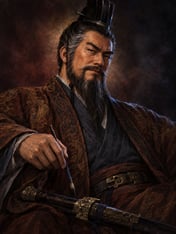 Cao CaoLivedCommanderTalk to me
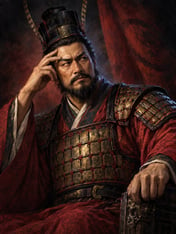 Yuan ShaoCommanderTalk to me
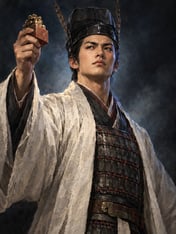 Yuan ShangWarriorTalk to me
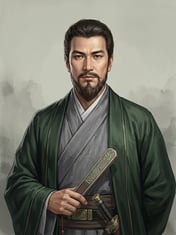 Cheng YuAdvisorTalk to me
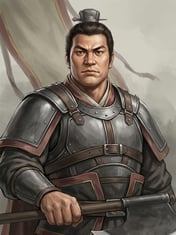 Xu ChuWarriorTalk to me
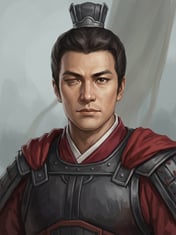 Xiahou DunWarriorTalk to me
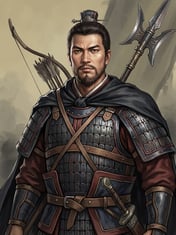 Zhang LiaoWarriorTalk to me
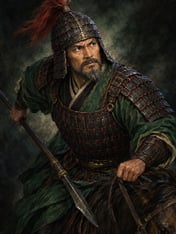 Zhang HeWarriorTalk to me
7 more: Xu HuangYu JinYue JinXiahou YuanCao HongLi DianGao Lan
Who won, as each book tells it; commanders as the text names them.
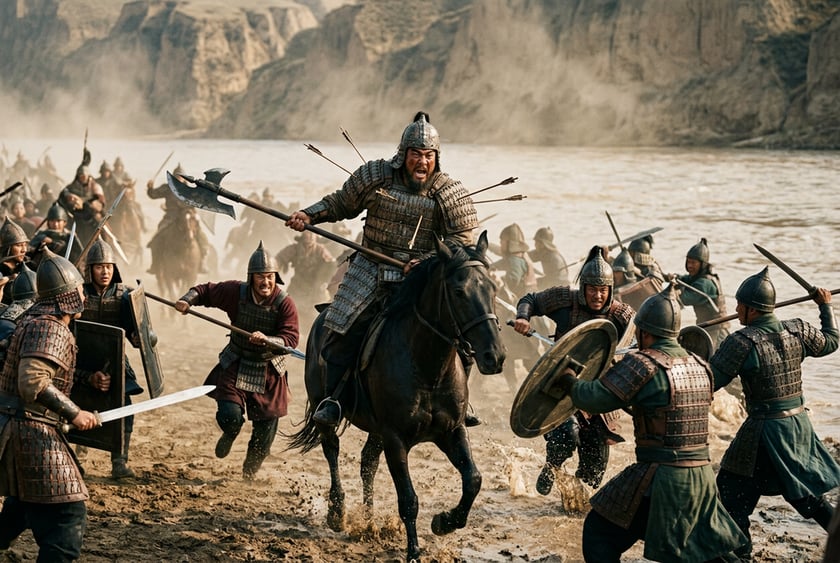
Scene
On the banks of the Yellow River, Xu Chu rides at the head of the charge, swinging his weapon, with Cao Cao's soldiers close behind as they engage Yuan Shao's troops in fierce close-quarters combat.
Featured people: Xu Chu
Continue
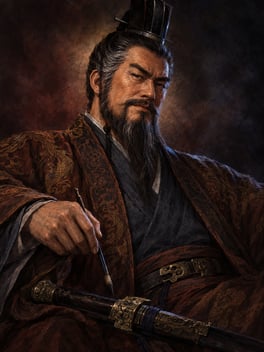
Cao Cao stood seven chi tall, with narrow eyes and a long beard, riding a white horse with a golden saddle, in a jade belt and brocade robe.
1898 people in common
2017 people in common
2106 people in common
2004 people in common
2074 people in common
2084 people in common
1944 people in common
1934 people in common
In Romance of the Three Kingdoms, the Battle of Cangting is cast as the “sequel” and conclusion to the Battle of Guandu. Although Yuan Shao’s main force was routed at Guandu, he still controlled the four provinces of Jizhou, Qingzhou, Youzhou, and Bingzhou, and could regroup two or three hundred thousand troops and return to the fray, setting up camp at Cangting. For Cao Cao, this was a crucial opportunity to destroy the Yuan clan’s war-making capacity before the enemy could recover. Geographically, Cangting Ford lay at a crossing on the Yellow River, and its terrain, with the river at one’s back, provided a natural stage for the decisive battle that followed. The novel presents this engagement as a campaign to “pursue and annihilate the enemy while riding the momentum of victory,” with a clear strategic aim: to give the Hebei forces no time to recover and rebuild.
Cao Cao’s deployment is the campaign’s main highlight. Cheng Yu proposed a “ten-sided ambush” stratagem, with five ambushing units on each flank of Cao Cao’s army: Xiahou Dun, Zhang Liao, Li Dian, Yue Jin, and Xiahou Yuan on the left; Cao Hong, Zhang He, Xu Huang, Yu Jin, and Gao Lan on the right; and Xu Chu as the vanguard in the central force. This was a carefully arranged, deep ambush designed to lure the enemy in: Xu Chu would first feign an attack on the camp, then pretend to retreat, drawing out the troops from all five of Yuan Shao’s camps and luring them all the way to the Yellow River, where they would be trapped with “no way forward”. Yuan Shao’s side, by contrast, had almost no meaningful tactical plan. Yuan Shang showed off his courage by brandishing his blade at the front of the formation, an episode that serves mainly to portray him as brave but lacking in wisdom. Once lured out, the entire army was left completely exposed to the ambush.
The decisive factor was Cao Cao’s willingness to put his own forces in the perilous position of having the river at their backs, to inspire them to fight to the death. When Yuan Shao’s army pursued them to the river and Cao Cao’s troops had nowhere left to retreat, Cao Cao shouted, “There is no way forward! Why don’t the troops fight to the death?” The entire army turned and counterattacked, and Xu Chu galloped ahead, killing more than ten officers in succession and turning the tide in an instant. The brilliance of this decision lay in the fact that the true killing stroke of the ten-sided ambush was not the number of ambushers, but the feigned retreat that dragged the enemy into a trap laid in advance, where the desperate situation forced Cao Cao’s troops to fight at their full strength. Yuan Shao’s fatal mistake was his blind pursuit. Despite having just suffered a major defeat at Guandu and having every reason to act cautiously, he still let himself be led by the bait and lost his regrouped forces all at once in the ambush.
Yuan Shao’s army fell into chaos. Cao Hong and Xiahou Dun cut off the retreat, Yuan Xi and Gao Gan were struck by arrows, and nearly all the troops and horses were killed. Yuan Shao escaped with only his three sons. The most symbolic scene is Yuan Shao embracing his three sons and weeping bitterly, blood pouring continuously from his mouth as he lamented, “Heaven has brought about my ruin”. This moment marks a turning point in the characters’ fortunes and also declares the beginning of the Hebei forces’ irreversible decline. Yuan Shao withdrew to Jizhou to recuperate, entrusting military affairs to Yuan Shang, Shen Pei, and Feng Ji. This laid the groundwork for the later infighting among his sons and Cao Cao’s gradual defeat of the Hebei forces. In the novel’s structure, the Battle of Cangting is a foundational engagement in the larger process of “Cao Cao Pacifies Hebei.”
It should be noted that the Records of the Three Kingdoms contains no account of a “decisive battle” at Cangting on the scale depicted in the novel. The “ten-sided ambush,” in particular, is a dramatized tactic devised in the novel to heighten Cao Cao’s image as a military strategist. Within the novel’s framework, one can speculate that if Yuan Shao had acted cautiously in this battle and refrained from pursuing the bait, he might have used the strength of his four provinces to hold Cao Cao at bay across the river, and Cao Cao might not have won quickly. Hebei’s manpower and resources could have sustained a prolonged war of attrition. But the novel’s central point is precisely the tragedy of Yuan Shao’s character: he was “out of stratagems and spent of strength,” yet still stubborn and bent on victory. It was this character that led him, even after Guandu, to stake the little capital he had left on a battle doomed to end in defeat, while greatly accelerating Cao Cao’s unification of the north.