Eastern Wu · General of the Left
Tang Zi
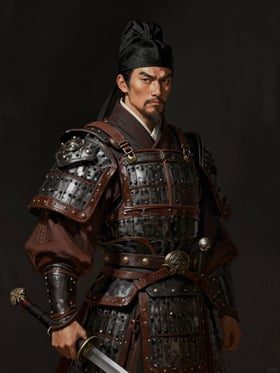
Tang Zi served Cao Wei and Eastern Wu, was captured and surrendered to Cao Wei at Shouchun, and is shown in the novel losing to Wang Ji.

Life
In the novel: 5 chapters · In the Records: 8 volumes
Life?–?
239 CE (Jingchu 3)
- Liao Shi's RebellionLinglingWarrior
252 CE (Jiaping 4)
- Battle of DongxingDongxingWarrior
257 CE (Ganlu 2)
Appearances
By chapter (13)
Novel
- 108
- 111
- 112
- 113
- 115
Records
- 27
- 28
- 47
- 48
- 55
- 56
- 60
- 64
- Eastern Wu
- Cao Wei
- Hatched: dated by chapter
- Life event
List all 3 stops
On the boards
Compare with someone →Where this person ranks on each board.
Historical Record
Tang Zi was originally from Licheng. During the Huangchu era, a rebellion broke out in Licheng Commandery. The rebels killed the Administrator Xu Ji and chose Tang Zi as their leader. Cao Pi sent troops to suppress them. After his forces were defeated, Tang Zi fled out to sea and then sought refuge with Eastern Wu. He later served Wu as General of the Left and was ennobled and granted a tally of authority. In the fifth year of Chiwu, he captured Luo Li and others. When Lü Dai was ordered to divide his forces and campaign against Li Huan, Lu He, Sui Chun, Luo Li, and others, Tang Zi was among the commanders under his authority. Later, after Lü Dai quelled Liao Shi's Rebellion, the Wu court sent Tang Zi and other generals to reinforce the campaign in succession.
In the first year of Taiping, Sun Jun sent Wen Qin, Lü Ju, Liu Zuan, Zhu Yi, Tang Zi, and others from Jiangdu into the Huai and Si regions, intending to seize Qing and Xu. The following year, the Wei general Zhuge Dan occupied Shouchun and rebelled. Eastern Wu sent Wen Qin, Tang Zi, Quan Duan, and others with troops to relieve him, drawing Tang Zi into the siege of Shouchun. Wei forces eventually captured the city, and Tang Zi was taken alive. Wei appointed him General Who Pacifies the Distant, while the other Wu commanders were also given suitable positions. After Tang Zi surrendered, Eastern Wu did not execute his family members. Sima Zhao initially considered recruiting the sons and younger brothers of those who had surrendered, but Wang Ji advised him not to press deep into enemy territory in the wake of a great victory. The Wei army later adopted a lenient policy: it did not massacre the Wu soldiers, but resettled them in commanderies near the Sanhe region.
Tang Zi’s career as recorded in the Records of the Three Kingdoms thus spanned Cao Wei and Eastern Wu: he went from leading the Licheng rebels to becoming a Wu general, taking part in campaigns against bandits and an expedition into the Huai-Si region, and ultimately being captured in the Battle of Shouchun and given an official post by Wei. The Records of the Three Kingdoms records his offices and the outcome of his surrender, but offers no inner monologue or details of personal military achievements; scenes from the novel should not be added as historical fact.
In the Novel
The Romance of the Three Kingdoms portrays Tang Zi as a general in the Eastern Wu army and has him appear in succession in two major battles, Dongxing and Shouchun. During the Battle of Dongxing, he and Lü Ju, Liu Zuan, and others followed Zhuge Ke’s arrangements and took separate routes to support Ding Feng. The novel places Tang Zi’s role within the deployment of the reinforcements, while focusing its account of the snowbound surprise attack and the rout of the Wei army chiefly on Ding Feng.
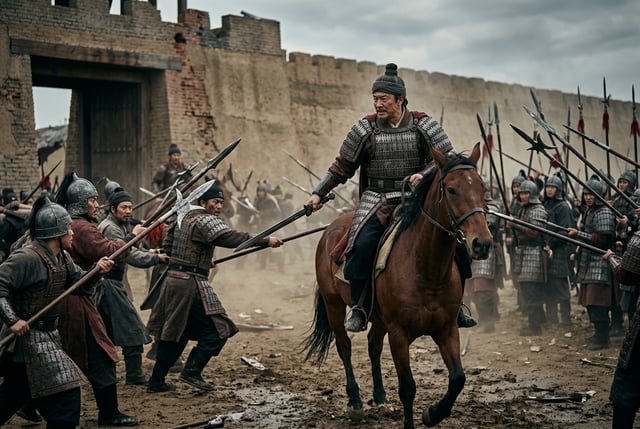
In the Battle of Shouchun, the novel lists Tang Zi as one of the vanguard commanders sent by Sun Chen, placing him at the front with Zhu Yi. He fought the Wei general Wang Ji for fewer than three bouts before fleeing in defeat. The Records of the Three Kingdoms says only that Wu sent Tang Zi and others to relieve Zhuge Dan; it does not record a separate encounter between Tang Zi and Wang Ji or such a swift defeat. This is therefore a specific detail added by the novel for its battlefield narrative.
The novel also says that after Shouchun fell, Tang Zi, afraid of Sun Chen, did not dare return to Wu and instead surrendered to Wei, where Sima Zhao settled him in the Sanhe region. This broadly accords with the historical account that Tang Zi was captured alive, appointed General Who Pacifies the Distant, and that the families of the Wu soldiers were spared. However, the motive that he “feared Sun Chen and dared not return home” comes from the novel; the Records of the Three Kingdoms gives no such psychological explanation.
The novel also places Tang Zi in Zhong Hui’s preparations for the campaign against Shu. Zhong Hui pretended to be preparing for an expedition against Wu, requisitioned ships along the coasts of Deng and Lai, and ordered Tang Zi to oversee the construction of seagoing vessels, to create a show of force, mislead Wu, and prepare for a future campaign. This is an episode invented by the novel. The material in the Records of the Three Kingdoms records Tang Zi’s appointment and resettlement after his capture, but contains no account of shipbuilding for the campaign against Shu.
Key Relationships
- With Cao Wei: from enemy to surrendering subject. In his early years, Tang Zi was chosen as the leader of the Licheng rebels. After Wei forces defeated him, he fled to Eastern Wu; during the siege of Shouchun, he was captured by Wei and appointed General Who Pacifies the Distant. The novel further says that he surrendered to Wei because he feared Sun Chen, a motive unique to the novel.
- With Eastern Wu: a long-serving general involved in repeated military campaigns. Tang Zi served as General of the Left. The historical account lists him among those involved in Lü Dai’s campaign against bandits, Sun Jun’s expedition into the Huai-Si region, and Wu’s relief effort at Shouchun.
- With Zhuge Dan: directly linked through Shouchun. After Zhuge Dan rebelled at Shouchun, Wu sent Tang Zi and others into the city to relieve him. Tang Zi was captured when the city fell. Wang Ji had advised the Wei army not to press its advantage too recklessly, and Wei brought the fighting to a close by refraining from killing the Wu soldiers and settling those who surrendered.
- With Sun Chen: the novel highlights a conflict between the defector and the powerful minister. The novel says Tang Zi did not dare return to Wu because he feared Sun Chen, and depicts Sun Chen executing the family members of Quan Duan, Tang Zi, and others who surrendered to Wei. The material in the Records of the Three Kingdoms confirms Tang Zi’s surrender to Wei and that the families of the Wu soldiers were not executed, but does not explain Tang Zi’s choice as stemming from fear of Sun Chen. (Unique to the novel)
Signature Scenes
- Fleeing to sea after defeat at Licheng, then joining Wu. Tang Zi went from being the leader of a rebellion to becoming a Wu general. His change of fortunes is traced to a clear account of his flight; he was later ennobled and served as General of the Left.
- The expedition into the Huai-Si region. Sun Jun sent Tang Zi with Wen Qin, Lü Ju, Liu Zuan, Zhu Yi, and others from Jiangdu into the Huai and Si regions, planning an expedition toward Qing and Xu. This shows that he had become one of Wu’s important generals.
- The fall of Shouchun and surrender. After taking part in the relief of Zhuge Dan, Tang Zi was captured alive and appointed General Who Pacifies the Distant by Wei. The Wei army did not bury the Wu soldiers alive, and Tang Zi’s family was not executed. This is a key moment in the historical account of his fate.
- Dongxing in the snow and defeat in three bouts. The novel has Tang Zi take part in the relief at Dongxing and later depicts him being swiftly defeated by Wang Ji on the Shouchun battlefield. Both episodes fill in specific actions absent from the historical account, and the details of their encounter in particular are the novel’s invention. (Unique to the novel)
- Ordered to requisition seagoing vessels. In its final episodes, the novel has Tang Zi, after surrendering to Wei, requisition seagoing vessels along the coasts of Deng and Lai for Zhong Hui, as part of a cover plan for the campaign against Shu. This episode does not appear in the historical material provided. (Unique to the novel)
- Enemies
Who is Tang Zi connected to?
Pick someone to see how many steps lie between them and Tang Zi.
History vs. novel
6 points · 2 novel-only
| History | Novel |
|---|---|
| The Uprising at LichengHistory only | |
Tang Zi was from Licheng. During the Huangchu era, Licheng Commandery rebelled, and its Administrator, Xu Ji, was killed. Tang Zi was chosen as their leader. After the Wei army put down the revolt, he fled to the sea and eventually sought refuge in Wu. vol. 28 | — |
| Vanguard at DongxingHistory only | |
During the Battle of Dongxing, Zhuge Ke appointed Liu Zan, Lü Ju, Tang Zi, and Ding Feng to lead the vanguard. When the Wei army retreated, the pontoon bridge collapsed, and tens of thousands died. vol. 64 | — |
| Reinforcing Zhuge DanNovel embellishes | |
The Records of the Three Kingdoms records that Tang Zi and the Wu generals Quan Yi, Quan Duan, and Wen Qin reinforced Zhuge Dan, but does not specify the vanguard’s composition or the number of troops sent. vol. 28 | The novel says that Sun Lin dispatched Quan Yi and Quan Duan as commanders, with Yu Quan bringing up the rear, Zhu Yi and Tang Zi in the vanguard, and Wen Qin serving as guide. They advanced in three columns with 70,000 men. ch. 111 |
| Capture and SurrenderNovel embellishes | |
After Zhuge Dan and Wen Qin were defeated and killed, Tang Zi was also captured alive. Sima Zhao appointed him General Who Pacifies the Distant Regions, and the other Wu commanders were also given official posts. vol. 28 | The novel says that Tang Zi, afraid of Sun Lin, dared not return to Wu and instead defected to Wei. Sima Zhao made good use of him and ordered him to garrison the Three Rivers region. ch. 112 |
| Releasing the Wu SoldiersNovel only | |
| — | Zhong Hui advised Sima Zhao not to bury the Wu soldiers who had surrendered to Wei alive, but to release them to return south of the Yangtze, thereby demonstrating leniency. Sima Zhao took his advice and sent the Wu soldiers back to their own state. ch. 112 |
| Fearing Sun Lin, He Surrenders to WeiNovel only | |
| — | The novel explicitly states that Tang Zi did not dare return to Wu because he feared Sun Lin, and therefore chose to surrender to Wei. ch. 112 |
- The Uprising at LichengHistory only
- History
Tang Zi was from Licheng. During the Huangchu era, Licheng Commandery rebelled, and its Administrator, Xu Ji, was killed. Tang Zi was chosen as their leader. After the Wei army put down the revolt, he fled to the sea and eventually sought refuge in Wu.
vol. 28
- Vanguard at DongxingHistory only
- History
During the Battle of Dongxing, Zhuge Ke appointed Liu Zan, Lü Ju, Tang Zi, and Ding Feng to lead the vanguard. When the Wei army retreated, the pontoon bridge collapsed, and tens of thousands died.
vol. 64
- Reinforcing Zhuge DanNovel embellishes
- History
The Records of the Three Kingdoms records that Tang Zi and the Wu generals Quan Yi, Quan Duan, and Wen Qin reinforced Zhuge Dan, but does not specify the vanguard’s composition or the number of troops sent.
vol. 28
- Novel
The novel says that Sun Lin dispatched Quan Yi and Quan Duan as commanders, with Yu Quan bringing up the rear, Zhu Yi and Tang Zi in the vanguard, and Wen Qin serving as guide. They advanced in three columns with 70,000 men.
ch. 111
- Capture and SurrenderNovel embellishes
- History
After Zhuge Dan and Wen Qin were defeated and killed, Tang Zi was also captured alive. Sima Zhao appointed him General Who Pacifies the Distant Regions, and the other Wu commanders were also given official posts.
vol. 28
- Novel
The novel says that Tang Zi, afraid of Sun Lin, dared not return to Wu and instead defected to Wei. Sima Zhao made good use of him and ordered him to garrison the Three Rivers region.
ch. 112
- Releasing the Wu SoldiersNovel only
- Novel
Zhong Hui advised Sima Zhao not to bury the Wu soldiers who had surrendered to Wei alive, but to release them to return south of the Yangtze, thereby demonstrating leniency. Sima Zhao took his advice and sent the Wu soldiers back to their own state.
ch. 112
- Fearing Sun Lin, He Surrenders to WeiNovel only
- Novel
The novel explicitly states that Tang Zi did not dare return to Wu because he feared Sun Lin, and therefore chose to surrender to Wei.
ch. 112
Combat
On the field
Duels, kills and executions as the texts tell them, counted separately for the Records and the Romance.
- RomanceCh. 111DuelWang JiLost「唐咨出馬,戰不三合,亦大敗而走」
Events
Events (5)
Battles and events the texts place this person in, by date.
Battles
- 252Battle of DongxingWarrior
- 257Battle of Shouchun (Wu Aids Zhuge Dan)Warrior
Other events
- 239Liao Shi's RebellionWarrior
- 249The Sima Clan's Seizure of Power
- 257Zhuge Dan's RebellionWarrior
Famous objects
Those who met it

Continue
Zhuge Dan's Rebellion
Inner monologues · AI-generated1 monologue ▸
- I was a native of Licheng. During the Huangchu era, an uprising broke out in the commandery. The administrator, Xu Ji, w