Overview
Xiakou was a strategically important military site in Jiangxia Commandery, Jing Province, during the Eastern Han. It lay where the Mian River (Han River) flowed into the Yangtze, in what is now Wuhan, Hubei Province. The mouth of the Mian River was also called Miankou. In the late Han, Liu Biao’s subordinate general Huang Zu was stationed there. In the thirteenth year of Jian’an (208), after Liu Bei was defeated at Dangyang, he retreated to Xiakou and sent Zhuge Liang to form an alliance with Sun Quan, linking Xiakou with the Battle of Red Cliffs. Xiakou thereafter belonged to Eastern Wu and remained a strategic stronghold defended by a regional military commander until Wu fell. The Wu official Hua He called Xiakou a vital point for enemy incursions and said that a renowned general must be chosen to defend it.
History
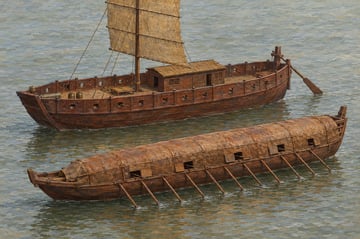
In the late Han, Liu Biao held Jing Province and stationed Huang Zu at Xiakou to guard the Jiang and Han rivers. After Sun Quan took command of the army, he launched an attack on Jiangxia. When his subordinate Ling Cao broke into Xiakou, he led the charge, pressing ahead alone in a light boat, and was killed by a stray arrow. In the spring of the thirteenth year of Jian’an (208), Sun Quan again attacked Huang Zu. Huang Zu blocked Miankou with two mengchong warships, anchoring them with large ropes tied to stones. A thousand men aboard fired crossbow bolts in volleys, preventing the Wu army from advancing. Dong Xi and Ling Tong each led a hundred volunteers into the gap between the warships. Dong Xi personally cut the ropes, allowing the main army to advance. Huang Zu abandoned the city and fled, but the cavalryman Feng Ze caught up with him and beheaded him.
That same year, Liu Biao, governor of Jing Province, died, and his son Liu Cong surrendered to Cao Cao. Cao Cao’s forces caught up with Liu Bei at Changban, Dangyang. After crossing the Mian River, Liu Bei reached Xiakou with more than ten thousand men under Liu Qi, the Administrator of Jiangxia, and sent Zhuge Liang to meet Sun Quan. Zhou Yu strongly advocated resisting Cao Cao and requested thirty thousand elite troops to be stationed at Xiakou. Thereafter, the allied forces of Sun and Liu decisively defeated Cao Cao at Chibi.
After Chibi, Xiakou became Sun Quan’s major stronghold on the western front. When Sun Quan planned to seize Shu, he once sent Sun Yu to station a naval force at Xiakou. Liu Bei refused to let Wu’s army cross his territory, so Sun Quan had no choice but to recall Sun Yu. Cheng Pu was the first to oversee the defense of Xiakou, and Sun Jiao later replaced him. After Rui Xuan died, Pan Jun also took charge of his troops and stationed them at Xiakou. In the fourth month of the first year of Huanglong (229), Xiakou and Wuchang both reported the appearance of a yellow dragon and a phoenix. Sun Quan thereupon assumed the imperial title at the southern suburbs. Before Sun Quan moved back to Jianye from Wuchang, he once held a grand assembly of officials at a fort in Xiakou to discuss defense along the river. Some advocated building a palisade at Xiakou; others proposed installing an iron chain. The young officer Zhang Liang instead recommended enforcing clear rewards and punishments and sending a general into the Mian River to compete with Wei for strategic advantage. Sun Quan considered this the best plan.
During the middle and late period of Eastern Wu, Xiakou repeatedly had a regional military commander appointed to oversee it. Sun Lin served as Commander of the Mian River region at Xiakou and died in the twelfth year of Chiwu (249). Wang Ji, the Inspector of Jing Province under Wei, built a city at Shangchang and moved the seat of Jiangxia Commandery there, bringing it closer to Xiakou. From then on, Wu forces dared not cross the river lightly. In the second year of Taiping (257), Sun Chen sent Zhu Yi to launch a surprise attack on Xiakou. Sun Yi, the Commander of Xiakou, defected to Cao Wei with more than a thousand of his personal troops. In the second year of Jianheng (270), Sun Hao sent He Ding to Xiakou with five thousand men to hunt. Suspecting that Sun Hao meant to plot against him, Sun Xiu, the Commander of Xiakou, took his family and personal guards and defected to Jin under cover of night. In the first year of Tianji (277), Sun Shen led troops into Jiangxia and Runan, burning and pillaging among the inhabitants. In the winter of the third year of Tianji (279), Jin launched a major campaign against Wu, and the General Who Pacifies the South, Hu Fen, advanced directly toward Xiakou.
Figures
- Huang Zu: A subordinate general of Liu Biao, he was stationed at Xiakou for a long time, where he killed Mi Heng; he ultimately died after being defeated.
- Mi Heng: A literary figure famed for his arrogance, he came to Xiakou with Huang She, son of Huang Zu, and was executed on Huang Zu’s orders for giving an insolent reply.
- Ling Cao: Father of Ling Tong, he was killed by an arrow while accompanying Sun Quan in the attack on Xiakou.
- Liu Bei and Liu Qi: The two armies joined forces at Xiakou before the Battle of Red Cliffs, and Liu Bei sent an envoy from there to ally with Wu.
- Cheng Pu and Sun Jiao: They successively oversaw the defense of Xiakou under Sun Quan. Sun Jiao repeatedly repelled Cao Cao at Ruxu and was renowned for his elite troops; later, he also took command of the forces of Huang Gai and his elder brother Sun Yu.
- Wang Fan: A native of Lujiang, he served as an envoy to Shu Han during Sun Xiu’s reign and became military supervisor at Xiakou after returning.
- Lu Shu: The posthumous son of Lu Su, he was promoted to Commander of Xiakou during the Jianheng era and maintained strict military discipline.
- Sun Yi and Sun Xiu: These two members of the imperial clan served as Commanders of Xiakou and, fearing the consequences of internal strife, defected to Wei and fled to Jin, respectively.
Differences Between Historical Records and Fiction
According to the Records of the Three Kingdoms, Liu Bei and Liu Qi reached Xiakou together. In Romance of the Three Kingdoms, however, Zhuge Liang argues that Xiakou has strong defenses and ample provisions, and advises Liu Bei to station himself there while Liu Qi returns to Jiangxia, so that they can support each other. In the end, Liu Bei leaves Guan Yu with five thousand men to defend Xiakou and goes to Jiangxia with Liu Qi. The novel also says that after Sun Quan defeated Huang Zu, he ordered Gan Ning to take five thousand troops and garrison Xiakou so that Gan Ning and Ling Tong, who wanted to avenge his father, would not cross paths. Pei Songzhi’s annotation to the “Biography of Gan Ning” in the Records of the Three Kingdoms, quoting the Wu Shu, also records that Sun Quan had Gan Ning move his troops for this reason, but the destination was Banzhou, not Xiakou. Gan Ning had originally served under Huang Zu and brought up the rear as Huang Zu retreated, shooting and killing Ling Cao as he pursued him. This, too, is recorded in the same passage of the Wu Shu, and was not invented by the novel.
Today
The site of ancient Xiakou lies in the area where the Han River meets the Yangtze in present-day Wuhan, Hubei Province. In the late Han, Xiakou was on the Hanyang side. Eastern Wu later built Xiakou City on the south bank of the Yangtze, on Huanghu Mountain—now Snake Hill in Wuchang. The Yellow Crane Tower stands on this hill.