Mi Heng
courtesy name 正平
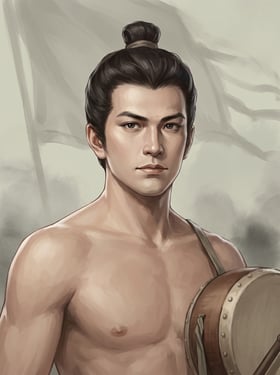
He stood stark naked, his whole body wholly exposed.

Life
In the novel: 3 chapters · In the Records: 1 volume
Life?–?
198 CE (Jian'an 3)
208 CE (Jian'an 13)
- Execution of Kong RongXuchangParticipant
Appearances
- Life event
- Death
List all 4 stops
- PingyuanBirthplace
- Xiakou198Huang Zu's Execution of Mi Heng
- Xuchang198–208Mi Heng Beats the Drum and Reviles Cao Cao+1 more
- XiakouDied here
On the boards
Compare with someone →Where this person ranks on each board.
Who they were
Character profile
- Appearance
- He stood stark naked, his whole body wholly exposed.
- Character
- Wildly arrogant and presuming on his talent, with no one in his eyes, cursing without cease even unto death.
- Manner of speech
- His speech was cutting parallelism, disparaging others in matched couplets, and he boasted of himself: "Of astronomy and geography, there is nothing I do not fathom; of the Three Teachings and Nine Schools, there is nothing I do not know".
- Life
- Styled Zhengping, a man of Pingyuan. At twenty-four he was recommended by Kong Rong, who called him "ten times my equal in talent".
- Anecdotes
- A recluse-gentleman of Pingyuan, he was once humiliated by Cao Cao and made a drum-clerk, later dispatched as an envoy to Jing Province, and finally killed by Huang Zu; an old friend of Kong Rong, he once insulted Cao Cao, and Xi Lü used this to frame Kong Rong; Yang Xiu once likened Mi Heng to Zhang Song, urging Cao Cao to be tolerant of him.
Historical Record
The Records of the Three Kingdoms makes no mention of him. The available materials contain no historical biography of Mi Heng, so they cannot be used to supply details of his native place, experiences, or fate; accounts of his life appear only in the relevant chapters of Romance of the Three Kingdoms.
In the Novel
Romance of the Three Kingdoms portrays Mi Heng as a gifted man who is arrogant about his abilities, sharp-tongued, and unwilling to submit to power. Kong Rong recommends him to the court, saying that Mi Heng’s talent is ten times his own; through this recommendation and Mi Heng’s own account of his extensive learning, the novel develops his reputation for talent and self-confidence. The novel does not portray his sharpness as a tactful means of advancement: when Cao Cao summons him but does not invite him to sit, Mi Heng laments that there is no one of worth in the world. Cao Cao lists the Wen Wu under his command, and Mi Heng disparages them one by one, even calling them “coat racks and food bags.” Unwilling to earn a reputation for killing a celebrated man of letters and being unable to tolerate criticism, Cao Cao orders him to serve as a drummer, intending to humiliate him.
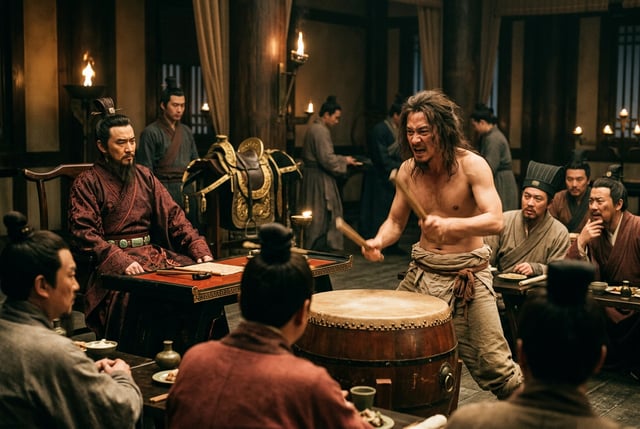
The novel brings the conflict to a climax with a drumming scene. At a banquet, Mi Heng performs “Three Drummings at Yuyang,” strips off his clothes, and then denounces Cao Cao as “Sixfold Impure,” accusing him of failing to distinguish the worthy from the foolish, rejecting loyal advice, and harboring usurping ambitions; Cao Cao, in turn, reproaches him for behaving improperly in the court. This confrontation is not merely a comic exchange of insults. It depicts a celebrated man of letters who claims moral purity and challenges power with words, set against power’s attempt to retaliate through humiliation. Mi Heng is then sent to Jing Province to persuade Liu Biao. On the way, he mocks Cao Cao’s subordinates as “dead coffins”; after reaching Jing Province, he praises Liu Biao’s virtue, but the novel depicts his words as still carrying a barbed edge, so Liu Biao orders him to go on to Jiangxia to meet Huang Zu.
In Jiangxia, while drunk, Mi Heng mocks Huang Zu as “a temple god” who receives sacrifices but has no divine power. Enraged, Huang Zu has him executed; the novel says Mi Heng continues to curse until his death, and Liu Biao orders him buried by Parrot Islet. All these events belong to the novel’s narrative and should not be confused with what is recorded in the Records of the Three Kingdoms: according to the materials provided here, that work makes no mention of him.
Key Relationships
Kong Rong is Mi Heng’s patron and friend in the novel. Kong Rong praises Mi Heng’s talent and submits a recommendation on his behalf. Later, Xi Lü exploits the close friendship between Kong Rong and Mi Heng, and the mutual esteem they express for each other, to frame Kong Rong before Cao Cao; in this way, the novel links Mi Heng’s reputation with Kong Rong’s downfall. Cao Cao is Mi Heng’s principal adversary: he humiliates him by appointing him a drummer and then sends him on a mission to Jing Province. The novel also states explicitly that Cao Cao intends to use Liu Biao to get rid of Mi Heng. Liu Biao sees through this intention. Rather than kill Mi Heng himself, he sends him to Huang Zu, who ultimately kills him after being insulted. These relationships—recommendation, enmity, dispatching him on a mission to have another man do the killing, and his execution—belong exclusively to the novel; the only historical basis in the materials cited here is the statement that the Records of the Three Kingdoms makes no mention of him.
Signature Scenes
The most representative scene comes when Mi Heng hears Cao Cao list the court’s Wen Wu officials. He disparages them one by one with cutting comparisons, then claims to have mastered astronomy, geography, and the Three Teachings and Nine Schools. Cao Cao does not kill him but orders him to serve as a drummer, showing how the two sides contend through reputation, power, and humiliation in the novel. The banquet drumming and the denunciation of Cao Cao while naked then take the conflict from words into public performance: Mi Heng strips to assert his own purity and condemns Cao Cao as “Sixfold Impure,” making his physical posture itself a challenge to the order of power. Another scene that brings the character’s story to its close takes place in Jiangxia: Mi Heng compares Huang Zu to a temple god who receives sacrifices but has no divine power; Huang Zu, enraged, executes him, and Mi Heng does not stop cursing even as he dies. These scenes belong exclusively to the novel. They depict a literary figure who takes pride in his talent and reputation, resists through mockery, and meets a tragic end because he refuses to temper his sharpness.
Quotes
9 lines in the books · 2 featured
「公言差矣。此等人物,吾盡識之:荀彧可使弔喪問疾,荀攸可使看墳守墓,程昱可使關門閉戶,郭嘉可使白詞念賦,張遼可使擊鼓鳴金,許褚可使牧牛放馬,樂進可使取狀讀詔,李典可使傳書送檄,呂虔可使磨刀鑄劍,滿寵可使飲酒食糟,于禁可使負版築牆,徐晃可使屠豬殺狗。夏侯惇稱為『完體將軍』,曹子孝呼為『要錢太守』。其餘皆是衣架飯囊,酒桶肉袋耳!」
This passage appraises Cao Cao's generals with sharp sarcasm, displaying Mi Heng's wildly arrogant and unrestrained character.
「汝不識賢愚,是眼濁也;不讀詩書,是口濁也;不納忠言,是耳濁也;不通古今,是身濁也;不容諸侯,是腹濁也;常懷篡逆,是心濁也!吾乃天下名士,用為鼓吏,是猶陽貨輕仲尼、臧倉毀孟子耳!欲成霸王之業,而如此輕人耶?」
Mi Heng bitterly denounces Cao Cao's 'six turbidities' with cutting words, a classic embodiment of his image as a wild scholar.
- Friends
- Enemies
Who is Mi Heng connected to?
Pick someone to see how many steps lie between them and Mi Heng.
Combat
On the field
Duels, kills and executions as the texts tell them, counted separately for the Records and the Romance.
- RomanceCh. 23ExecutionHuang ZuLost「人報黃祖斬了禰衡」
Events
Events (3)
Battles and events the texts place this person in, by date.
Other events
Places
Continue
Mi Heng Beats the Drum and Reviles Cao Cao
Relationship timeline1 entry ▸
Novel · ch. 23
- Cao Cao§8
Enemy
three times reviled the court (the drum official’s naked insults, mourning at the eastern gate, and abuse in the capital); Cao Cao had Liu Biao and Huang Zu kill him
Inner monologues · AI-generated1 monologue ▸
- I stood in the hall and saw Cao Cao summon me. After the formalities, he did not ask me to sit. The men at the gathering