Cao Wei · Minister of Works
Lu Yu
courtesy name 子家 · 183–257
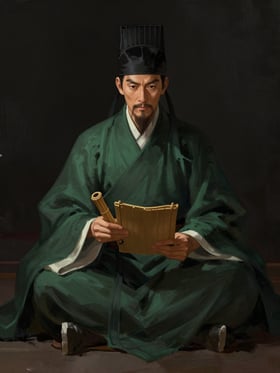
Lu Yu was a Cao Wei official known for clear-minded rulings, character-based recommendations, and service as Minister of Works.
Life
In the Records: 6 volumes
Life183–257
- Cao Wei· Undated
On the boards
Compare with someone →Where this person ranks on each board.
Historical Record
Lu Yu, courtesy name Zijia, was from Zhuo County, Zhuo Commandery, and was the youngest son of the renowned scholar Lu Zhi. His father died when he was ten, and warfare soon struck his home region; both his elder brothers died in battle. He cared for his widowed sisters-in-law and his brothers’ orphaned children, and became known for his learning and conduct amid famine in You and Jizhou. Cui Yan praised him as “clear-minded and perceptive, his character undiminished by a hundred trials,” and regarded him as a talent fit for great responsibility. When Emperor Wen of Wei was serving as General of the Center, he summoned Lu Yu to serve as a Gate Attendant and Criminal Registrar. Cui Yan later recommended him for the post of Chief Clerk of Jizhou.
Early in his career, Lu Yu drew notice for his careful judgments in criminal cases. At the time, the wives of deserters, including Bai, had only been married into their husbands’ families for a few days and had not yet met their husbands, yet the Minister of Justice requested that they be executed by public beheading. Lu Yu argued against the proposal on legal grounds, citing the Book of Songs and the Rites, and held that they could be punished but should not be put to death. This episode shows that he did not rigidly adhere to precedents imposing harsh penalties, but instead gave weight to the specific circumstances and the proper measure of the law.
After the establishment of Wei, Lu Yu served as a Gentleman of the Ministry of Personnel. Following Emperor Wen’s accession, he successively held the posts of Palace Attendant, Chancellor of Jiyin, and Administrator of Liang and Qiao commanderies. Qiao was barren and its people impoverished, so he submitted a memorial requesting that the people who had been resettled there be moved to the fertile lands of Liang. Though his request was approved, it displeased the emperor, and he was transferred to be Agricultural Commandant of Suiyang. He nevertheless inspected the fields in person and selected good farmland for the people to settle on. He later served as Administrator of Anping and Guangping, where his governance benefited the people. During Emperor Ming’s reign, he became an Attendant and argued that laws and ordinances should follow consistent standards to prevent officials enforcing them from acting out of favoritism. He also spoke on behalf of Gaotang Long, who dared to remonstrate frankly, asking the emperor to accept his views.
When Lu Yu served as Minister of Personnel, he put character before ability. In recommending candidates, he looked not merely at what they could do, but at whether they would use their abilities for good. He recommended Zheng Chong, Ruan Wu, and Sun Yong, among others. When the position of Minister over the Masses fell vacant, he also recommended Guan Ning. The emperor did not appoint Guan Ning, so Lu Yu cited the strengths of Han Ji, Cui Lin, and Chang Lin; Han Ji was ultimately appointed. Lu Yu explained to Li Feng that someone with ability who could not act virtuously had abilities unsuited to the purpose.
After Cao Shuang took power, Lu Yu was transferred out of the Ministry of Personnel and subsequently appointed Minister of Justice. Members of Cao Shuang’s faction seized on a minor fault by one of his subordinates and exaggerated it into a case, arranging for the official to have his seal and ribbons taken away before reporting the matter. After Cao Shuang was executed, Lu Yu was ordered to take part in the judicial proceedings. He resumed his post as Minister of Personnel and continued to oversee appointments. After the accession of the Prince of Gaogui, he was enfeoffed as Marquis of Daliang Township. In the third year of Zhengyuan, illness led him to relinquish office; he was later appointed Minister over the Masses, but firmly declined and recommended Wang Chang, Wang Guan, and Wang Xiang instead. He died in the second year of Ganlu and was posthumously given the title Marquis Cheng.
In the Novel
The materials provided contain no portrayal of Lu Yu in novels such as Romance of the Three Kingdoms, so they cannot be used to construct his fictional character, words, or experiences; the novel does not mention him. The account available from the Records of the Three Kingdoms and Pei Songzhi’s annotations presents him as known for clear-minded judgments in criminal cases, concern for the people, care in selecting worthy officials, and willingness to argue his position.
Key Relationships
Lu Zhi was Lu Yu’s father. Lu Zhi was renowned for his Confucian learning and integrity. After losing his father in childhood, Lu Yu nevertheless took responsibility for caring for his widowed sisters-in-law and nephews; his life was thus marked by a family tested by disorder yet steadfast in learning and conduct.
Cui Yan was both Lu Yu’s early patron and a judge of talent. When Lu Yu first entered service at the military headquarters, Cui Yan praised him as clear-minded and perceptive, with a character that would not change under trial, and predicted that he had the ability to serve among the highest ministers. Lu Yu later did indeed hold important posts in Wei.
Cao Shuang and Lu Yu, by contrast, were caught up in a conflict over power. After falling out with Lu Yu, then Minister of Justice, Cao Shuang’s faction seized on a minor fault by one of his subordinates and made a case of it, leading to the confiscation of Lu Yu’s seal and ribbons. After Cao Shuang lost power, Lu Yu was ordered to take part in handling his case. Their relationship shows how, amid shifts in power at the Wei court, Lu Yu was both pushed aside and entrusted with judicial responsibilities.
Signature Episodes
Arguing against the execution of Bai and the others. Bai and the other wives of deserters had never met their husbands, yet their execution by public beheading was requested. Lu Yu did not let their status as deserters’ wives replace judgment of their individual cases. Citing the Book of Songs and the Rites in a memorial, he argued that they could be punished but not killed. This episode vividly shows his practice of judging cases through the classics and his caution in applying the law.
Resettling the people of Qiao while keeping their welfare in mind. Emperor Wen of Wei resettled people to replenish his home region of Qiao. Seeing that the land was barren and the people were suffering, Lu Yu requested that they be moved to fertile Liang. Though the request was approved, he was transferred for having displeased the emperor. In Suiyang, he personally surveyed the land and selected good fields so that the people could benefit.
Assessing talent by character. When the emperor ordered Lu Yu to recommend candidates for a successor, he named people with different strengths of character. In a discussion of “ability,” he pointed out that ability should be used to do good, and that candidates should not be chosen on the strength of their reputation for talent alone. Thereafter, in overseeing appointments, he consistently considered character first and ability second. This became the clearest principle of his tenure as Minister of Personnel.
Relinquishing office and recommending worthy successors. When illness struck, Lu Yu resigned his post. After being appointed Minister over the Masses, he continued to decline firmly and recommended Wang Chang, Wang Guan, and Wang Xiang. The court ultimately bestowed the seal and ribbons and advanced him to a marquisate. After his death, he was posthumously given the title Marquis Cheng. Thus ended the career of a Wei official renowned for clear judgment of people and prudent administration of the law, whose service extended from local office to the highest ranks of government.
Quotes
4 lines in the books · 2 featured
「臣聞君明則臣直,古之圣王恐不聞其过,故有敢諫之鼓。近臣尽規,此乃臣等所以不及隆。隆諸生,名爲狂直,陛下宜容之。」
This line embodies Lu Yu's character as a loyal minister unafraid of frank remonstrance, and carries historical significance.
「才所以爲善也,故大才成大善,小才成小善。今称之有才而不能爲善,是才不中器也。」
This line expounds the relationship between talent and virtue, the core of Lu Yu's thinking on judging men and appraising ability, and is philosophically reflective.
- Family
- Lord & vassal
- Friends
- Enemies
Who is Lu Yu connected to?
Pick someone to see how many steps lie between them and Lu Yu.
Places
- Native of
- Zhuo CountyRecords
- Was at
- Ji ProvinceRecords
- Governed
- Jiyin CommanderyRecords
Continue
Lu Zhi
Kin
Relationship timeline2 entries ▸
Inner monologues · AI-generated1 monologue ▸
- I am Lu Yu, courtesy name Zijia. I lost my father when I was young. Our family was caught up in the turmoil of war, and