Cao Wei · General
Wang Shuang
–229
Not to be confused with Wang Shuang (王双) — Wang Shuang, a Wei general, was captured by Zhu Huan after attacking Zhongzhou; the novel depicts him joining Chang Diao in attacking Ruxu.
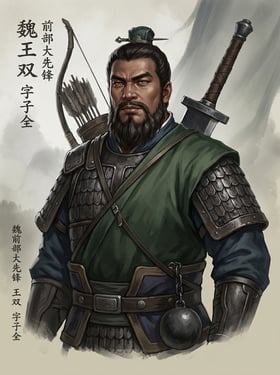
Nine chi tall, with a dark face and yellow eyes, and the waist of a bear and back of a tiger.

Life
In the novel: 3 chapters · In the Records: 2 volumes
Life?–229
228 CE (Taihe 2)
- Zhuge Liang's Second Northern ExpeditionChencangKilled in action
- Battle for ChencangChencangKilled in action
Allegiance
Appearances
By chapter (5)
Novel
- 97
- 98
- 99
Records
- 33
- 35
- Cao Wei
- Hatched: dated by chapter
- Life event
- Death
List all 2 stops
- DidaoBirthplace
- Chencang228Zhuge Liang's Second Northern Expedition+1 more
On the boards
Compare with someone →Where this person ranks on each board.
Who they were
Character profile
- Appearance
- Nine chi tall, with a dark face and yellow eyes, and the waist of a bear and back of a tiger.
- Character
- He possessed the courage to stand against ten thousand men and never missed his mark.
- Weapons
- He wielded a sixty-jin broadsword and an iron-limbed bow, and secretly carried three meteoric hammers.
- Anecdotes
- He was a Wei general and was slain in the Battle of Sanguan. In the Romance, he once guarded the entrance to the Chencang road; while urgently pursuing Shu troops, he fell into an ambush and Wei Yan cut him from his horse with a single stroke. An imperial edict later recounted that he had been slain.
Historical Record
Wang Shuang was a Cao Wei general. Historical accounts state that when Zhuge Liang withdrew after advancing from San Pass to besiege Chencang, his supplies exhausted, Wang Shuang led troops in pursuit. Zhuge Liang engaged him, routed the Wei forces, and killed Wang Shuang before returning to Hanzhong. The Records of the Three Kingdoms gives no information about Wang Shuang’s courtesy name, native place, appearance, weapons, or specific official post, nor does it describe the battle in detail. It therefore confirms only that he pursued the Shu army and was killed by Zhuge Liang in the fighting.
Another relevant passage in the Records of the Three Kingdoms calls Wang Shuang a “Wei general” and places his defeat and death after Zhuge Liang’s retreat. The subsequent account of Chen Shi’s capture of Wudu and Yinping and Guo Huai’s withdrawal describes the military situation that followed and should not be conflated with the battle involving Wang Shuang. The work also recalls Zhuge Liang’s “beheading of Wang Shuang” in an imperial edict, as one of his achievements. Thus, historical accounts portray Wang Shuang chiefly as a Wei commander who pursued the Shu army and was routed and killed by Zhuge Liang; they provide no further details of his personal life.
In the Novel
Romance of the Three Kingdoms portrays Wang Shuang as a valiant Cao Wei vanguard general skilled with unusual weapons. The novel says Cao Zhen recommended him to lead the vanguard and describes him as nine chi tall, with a bear-like waist and a tiger’s back. He wields a sixty-jin broadsword and also carries an iron-limbed bow and three meteor hammers. He is appointed General of Tiger Might and Grand Vanguard of the Front Division. These descriptions of his appearance, weapons, titles, and prowess are all inventions of the novel and have no corresponding basis in the historical record.
The novel further has Wang Shuang lead troops to relieve Chencang. He first kills the Shu generals Xie Xiong and Gong Qi, then feigns defeat and wounds Zhang Ni with a meteor hammer, throwing the Shu army into disarray. Kongming then withdraws, and Wei Yan follows a secret plan to lure Wang Shuang into pursuit. A fire in the camp draws Wang Shuang’s attention; cavalry lying in ambush rush out of the woods, and Wei Yan cuts him down from his horse. The novel thus depicts Wang Shuang as a formidable enemy who repeatedly routs the Shu army early on, only to die after falling for a trap while pursuing them. This differs markedly from the historical account that “Zhuge Liang engaged him, routed him, and killed Shuang”: the killer, events, and course of the battle are all different.
Key Relationships
- Zhuge Liang: Historical accounts say Zhuge Liang led the Shu army against Wang Shuang as he pursued them, routing and killing him. In the novel, Kongming devises a plan for the retreat, and Wang Shuang is ultimately killed in an ambush by Wei Yan.
- Cao Zhen and Cao Wei: Historical accounts call Wang Shuang a Wei general. The novel goes further, saying Cao Zhen recommended him as vanguard. Both are on the Wei side, and the novel says Wang Shuang was appointed General of Tiger Might and Grand Vanguard of the Front Division. (Novel only)
- The Shu generals Xie Xiong, Gong Qi, and Zhang Ni: In the novel, Wang Shuang kills Xie Xiong and Gong Qi in succession, while Zhang Ni is wounded by a meteor hammer during their encounter. These specific duels and casualties are all part of the novel’s story. (Novel only)
- Wei Yan: The cited material from the Records of the Three Kingdoms does not say that Wei Yan killed Wang Shuang. In the novel, Wei Yan carries out Kongming’s secret plan, luring Wang Shuang into pursuit before ambushing and killing him. (Novel only)
Signature Scene
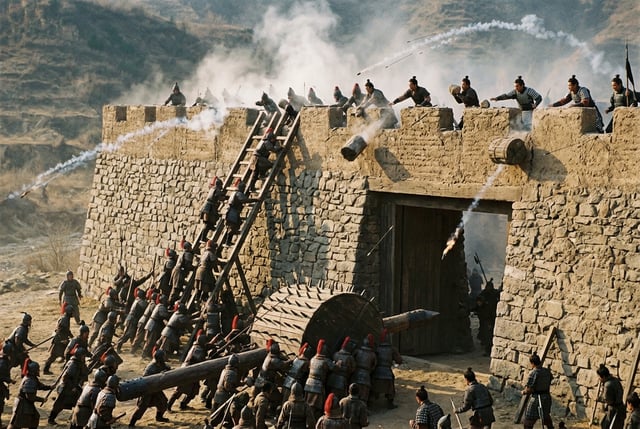
The brief but pivotal scene in the historical account is Zhuge Liang’s siege of Chencang, his withdrawal when supplies run out, and Wang Shuang’s pursuit. Zhuge Liang meets him in battle, routs his forces, and kills him. The account gives no details about the size of either army, the precise location of the battle, or Wang Shuang’s conduct in the field, so the novel’s duel should not be inserted into the historical narrative.
The novel, by contrast, expands Wang Shuang’s death into an ambush: as he pursues the retreating Shu army, he hears that the Wei camp is on fire and reins in his horse to look back. Hidden troops then burst from the woods, and Wei Yan cuts him from his horse with a single stroke. The Wei troops scatter, suspecting another ambush. This scene depicts Wang Shuang’s pursuit while highlighting Kongming’s stratagem and Wei Yan’s execution of it; it is not the same sequence of events as the direct engagement described in the historical record. (Novel only)
Lines
- 演 ch.98 §10
「魏延休走!」
- Lord & vassal
- Enemies
- Other
Who is Wang Shuang connected to?
Pick someone to see how many steps lie between them and Wang Shuang.
History vs. novel
6 points · 5 novel-only
| History | Novel |
|---|---|
| Pursuit and BeheadingNovel embellishes | |
After supplies ran out at Chencang, Wang Shuang led his troops in pursuit of Zhuge Liang. Zhuge Liang engaged him, routed his army, and beheaded him. vol. 33 | After Zhuge Liang withdrew, Wei Yan lured Wang Shuang into pursuit. Wang Shuang fell into an ambush and was cut down from his horse by Wei Yan; the novel turns the historically recorded engagement and beheading into a specific account of luring the enemy into an ambush. ch. 98 |
| Wang Shuang's Courtesy Name and Native PlaceNovel only | |
| — | The novel says that Wang Shuang's courtesy name was Ziquan and that he was from Didao in Longxi; these details about his identity do not appear in the historical sources provided. ch. 97 |
| Image of a Brave GeneralNovel only | |
| — | The novel describes Wang Shuang as nine chi tall, with the waist of a bear and the back of a tiger, and calls him a warrior who could face ten thousand men alone. The Wei ruler was delighted when he saw him. ch. 97 |
| Weapons and MountNovel only | |
| — | The novel equips Wang Shuang with a sixty-jin saber, a swift horse, a two-dan iron-limbed bow, and three meteor hammers, and also says that he never missed his mark; the Records of the Three Kingdoms does not record this equipment. ch. 97 |
| Appointment as VanguardNovel only | |
| — | Cao Zhen recommended Wang Shuang to the Wei ruler as a vanguard. The ruler bestowed on him a brocade robe and golden armor and appointed him General of Tiger Might and Grand Vanguard of the Front Division. ch. 97 |
| Defense of ChencangNovel only | |
| — | The novel says that Wang Shuang and Hao Zhao jointly guarded the Chencang area as part of the Wei army's defensive deployment; the Records of the Three Kingdoms provided here contains no such arrangement. ch. 98 |
- Pursuit and BeheadingNovel embellishes
- History
After supplies ran out at Chencang, Wang Shuang led his troops in pursuit of Zhuge Liang. Zhuge Liang engaged him, routed his army, and beheaded him.
vol. 33
- Novel
After Zhuge Liang withdrew, Wei Yan lured Wang Shuang into pursuit. Wang Shuang fell into an ambush and was cut down from his horse by Wei Yan; the novel turns the historically recorded engagement and beheading into a specific account of luring the enemy into an ambush.
ch. 98
- Wang Shuang's Courtesy Name and Native PlaceNovel only
- Novel
The novel says that Wang Shuang's courtesy name was Ziquan and that he was from Didao in Longxi; these details about his identity do not appear in the historical sources provided.
ch. 97
- Image of a Brave GeneralNovel only
- Novel
The novel describes Wang Shuang as nine chi tall, with the waist of a bear and the back of a tiger, and calls him a warrior who could face ten thousand men alone. The Wei ruler was delighted when he saw him.
ch. 97
- Weapons and MountNovel only
- Novel
The novel equips Wang Shuang with a sixty-jin saber, a swift horse, a two-dan iron-limbed bow, and three meteor hammers, and also says that he never missed his mark; the Records of the Three Kingdoms does not record this equipment.
ch. 97
- Appointment as VanguardNovel only
- Novel
Cao Zhen recommended Wang Shuang to the Wei ruler as a vanguard. The ruler bestowed on him a brocade robe and golden armor and appointed him General of Tiger Might and Grand Vanguard of the Front Division.
ch. 97
Combat
On the field
Duels, kills and executions as the texts tell them, counted separately for the Records and the Romance.
Duel themRecords
- Duels
- 0W 0L 0D
DeathKilled by Zhuge LiangStruck down · Juan 33
Romance
- Duels
- 2W 0L 0D
DeathKilled by Wei YanStruck down · Ch. 98
- RecordsJuan 33Struck downZhuge LiangLost「亮與戰,破之,斬雙」
- RomanceCh. 97DuelXie XiongWon「戰不三合,被雙一刀劈死」
- RomanceCh. 97DuelGong QiWon3 bouts「交馬只三合,亦被雙所斬」
- RomanceCh. 97DuelZhang NiBroken off「來與張嶷交馬數合,不分勝負」
- RomanceCh. 98Struck downWei YanLost「王雙大驚,措手不及,被延一刀砍於馬下」
Battles in command
Battles this person commanded in, with the outcome as each text tells it.
- Records
- 0W 0L 0D 1 undecided
- Records228Zhuge Liang's Second Northern ExpeditionUndecidedvs Shu armyJuan 35「冬,亮復出散關,圍陳倉,曹真拒之,亮糧盡而還」
Stratagems
Plans this person devised or saw through, as the texts tell them.
- Romance
- 1 carried out · 1 worked · 0 turned down · 0 seen through
- RomanceLure the EnemyLureWorkedagainst Shu troopsCh. 97「雙詐敗便走,嶷隨後趕去。王平見張嶷中計」
Events
Events (2)
Battles and events the texts place this person in, by date.
Battles
- 228Zhuge Liang's Second Northern ExpeditionKilled in action
Other events
- 228Battle for ChencangKilled in action
Places
- Native of
- DidaoRomance
Continue
Last scene: Battle for Chencang
Relationship timeline2 entries ▸
History · vol. 33
Slayer
Wang Shuang led troops in pursuit of Liang; Liang fought and defeated him, and beheaded Shuang
Novel · ch. 97
- Cao Zhen§19
Lord
Recommended by Cao Zhen as vanguard; served under the command of Cao Zhen, the Grand Commander-in-Chief
Inner monologues · AI-generated1 monologue ▸
- I am Wang Shuang, courtesy name Ziquan. When I think back on this campaign, I was ordered to hold Chencang. The Shu army