Background
In the second year of Wufeng (255), Eastern Wu was in practice ruled by a powerful member of the imperial clan exercising imperial authority on the throne’s behalf. Two years earlier, Sun Jun had ambushed and killed Zhuge Ke at a palace banquet. Thereafter, as chancellor and grand general, he took charge of military and civil affairs at home and abroad, while the young ruler was sovereign in name only. After seizing power, Sun Jun was eager to win military glory. That year, when Guanqiu Jian and Wen Qin of Wei rebelled in Huainan, he personally led Lü Ju and Liu Zan in an attack on Shouchun, hoping to reap the benefits. But before Wu’s army arrived, Wen Qin had already been defeated and could only flee to Wu; the Wu army returned empty-handed. Liu Zan, a veteran general who had distinguished himself in the Battle of Dongxing, fell gravely ill during the retreat and was caught and killed by the Wei general Jiang Ban. This fruitless northern campaign had exhausted the troops and cost the life of a veteran commander, dealing a blow to Sun Jun’s prestige. It was at this moment that the failed assassination attempt took place.
Key Figures
The target of the plot was Sun Jun himself. His blood ties to Sun Quan’s line were distant; he had risen to power by killing Zhuge Ke, and his authority rested mainly on the palace guards and his personal influence, without broad support among the gentry clans. The plot was initiated by three generals: Sun Yi, Zhang Yi, and Lin Xun. The Records of the Three Kingdoms says little about the lives of these three, but the fact that several officers plotted together shows that dissatisfaction with Sun Jun had spread through the military. Another important figure in the incident was Princess Zhu, Sun Luyu. She was Sun Quan’s daughter. The Records of the Three Kingdoms does not say that she actually took part in the plot, yet she too was executed. This shows that in this purge Sun Jun dealt not only with the assassins, but also with people at court whom he thought might oppose him.
Central Issue
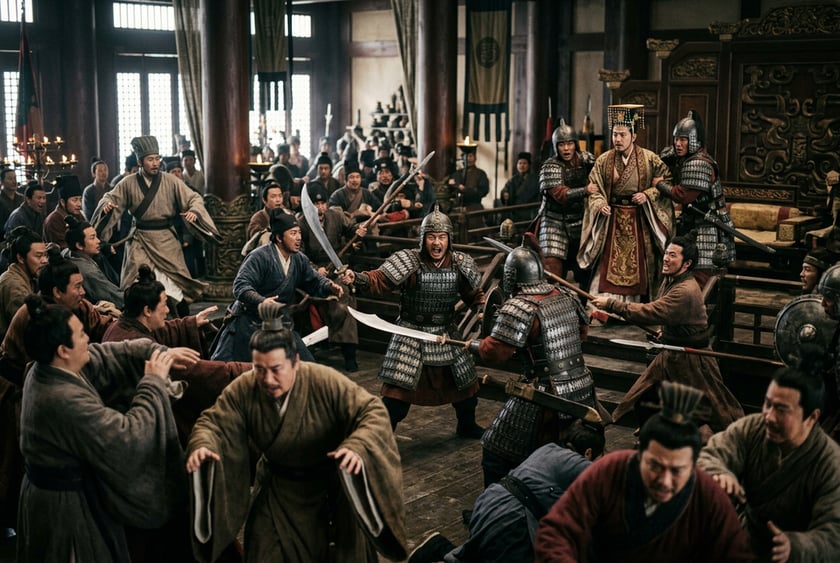
The central question is this: under the rule of a powerful imperial-clan regent, did opponents have any legitimate way to express their discontent? At the time, Eastern Wu had no independent force capable of checking Sun Jun. The young ruler had not yet taken up the reins of government, and after Zhuge Ke’s death there were few senior ministers left who could stand against Sun Jun. Generals such as Lü Ju, meanwhile, were accompanying Sun Jun on campaign. Ordinary remonstrance and impeachment were ineffective, leaving the opposition with assassination as its only recourse. Sun Yi and the others chose to act during a visit by a Shu Han envoy, when Sun Jun was attending a court assembly. Their intention was clear: Sun Jun might have fewer guards around him at a ceremonial gathering, and with a foreign envoy present, the outcome could be announced in the name of the court if the plot succeeded. This approach was exactly like Sun Jun’s own killing of Zhuge Ke at a banquet years earlier, showing that Eastern Wu’s leadership had fallen into a cycle in which banquets and court assemblies repeatedly became traps for coups. The plan’s weakness was just as clear: with so many participants, it was difficult to keep the news secret, and if the target caught wind of it, the whole plot would fail. The “Biography of Sun Liang” in the Records of the Three Kingdoms records that the plot was exposed in the seventh month of that year; Sun Yi killed himself, while Lin Xun and the others were convicted and executed, in agreement with the account in Sun Jun’s biography.
Political Consequences
After the plot failed, the immediate result was a purge in which dozens of people died. In the short term, Sun Jun used it to eliminate opponents among the imperial clan and the military, further consolidating his position. In the long term, the purge further narrowed the ruling circle of Eastern Wu and deepened enmity within the imperial clan. The death of Sun Luyu is particularly revealing: if even a daughter of the late emperor could be implicated and executed, it is easy to imagine how unsafe everyone at court must have felt. Sun Jun died of illness the following year, handing government affairs to his cousin Sun Chen. Sun Chen continued the same style of rule, and the conflicts between powerful members of the imperial clan, court officials, and the ruler grew ever more intense. The failure of Sun Yi and the others did not break this pattern. Instead, it showed later opponents that a conspiracy by a handful of generals was unlikely to succeed: to bring down a powerful regent, they needed to control the military or secure the ruler’s explicit support.
Counterfactual
Had Sun Yi and the others succeeded, the balance of power in Eastern Wu might have shifted earlier. With Sun Jun dead, Sun Chen might not have been able to take over immediately, and government might well have passed into the hands of the imperial clan and senior ministers acting jointly, allowing the young ruler to take the reins sooner. But a new group that came to power through assassination would likewise have lacked legitimacy, and mutual suspicion within the imperial clan might not have subsided; the cycle of successive power grabs might simply have continued under a different cast of characters. On the other hand, if the Shu Han envoy had witnessed the assassination of Wu’s regent, diplomatic trust between Wu and Shu might have suffered a temporary blow, but the two states’ shared interest in resisting Cao Wei would not have changed. On the whole, Sun Yi and the others failed not so much by chance as because of the political structure: when a powerful regent firmly controls the palace guards and the ruler is unable to lend support, a small-scale conspiracy has little chance of success.