

Background
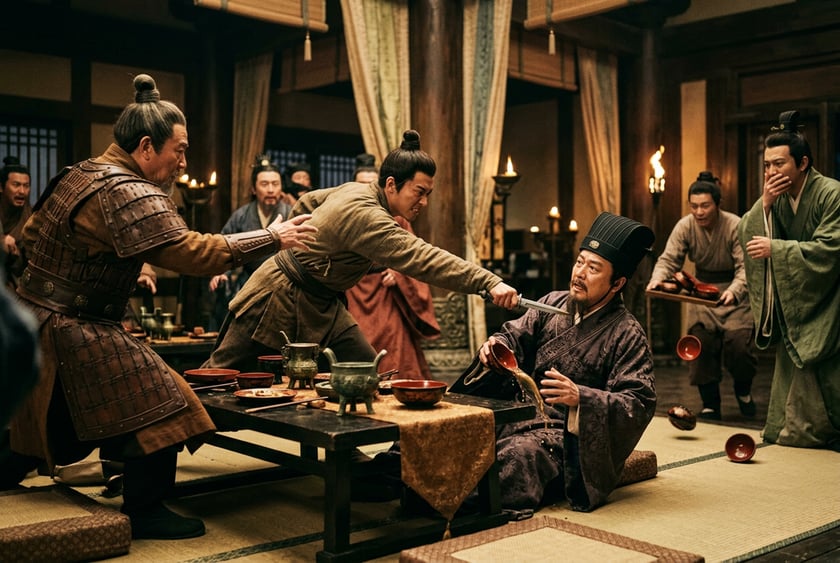
Guo Xiu Assassinates Fei Yi took place at the beginning of the sixteenth year of Yanxi, or 253 CE. The surviving account places the incident at a New Year gathering: Fei Yi feasted with others, and Guo Xun, a man who had surrendered from Wei, was also present. After Fei Yi drank until he was drunk, Guo Xun killed him with a blade. This shows that the assassination did not occur on a battlefield or in an open confrontation, but erupted at a banquet attended by figures of Shu Han’s ruling elite. The Records of the Three Kingdoms does not specify the venue, security arrangements, or details of the attack, nor does it explain how Guo Xun got close to Fei Yi. These gaps should not be filled in as though they were established facts.
The year before the incident, Fei Yi was ordered to “establish an official residence.” This sequence of events offers a clue to the assassination’s political significance. The establishment of an official residence marks a change in Fei Yi’s status and the way he conducted political affairs, but this passage alone cannot reconstruct the composition of his staff or the scope of his actual authority. Nor can it prove that the assassination was planned in response to this arrangement. The more cautious conclusion is that the victim was no ordinary official mentioned incidentally in the historical record. The assassination therefore dealt a direct blow, at the very least, to Shu Han’s high-level political order. How that blow affected specific decisions, however, can only be established with additional evidence.
Main Figures
Fei Yi was the victim of the attack. The original text first records that he was “ordered to establish an official residence,” then recounts the New Year gathering and his death, placing a milestone in his career alongside his eventual fate. This arrangement shows readers his status and his end, but offers no complete account of his character, governing principles, or conduct that day. In particular, “drank merrily until drunk” is important information for explaining how the attack succeeded; it should not be expanded into a judgment about Fei Yi’s overall political ability or personal habits. The Records of the Three Kingdoms describes his condition at the time, not how he usually behaved at banquets.
The account identifies Guo Xun as “a man who had surrendered from Wei,” rather than introducing him by office, family background, or political affiliation. This label indicates that he had once surrendered from Wei, giving the attack an inherently cross-regime dimension. But the text does not say why he surrendered to Shu Han, how long he had been there, whether he was under surveillance, or what he said or what became of him before and after the assassination. It is reasonable to ask whether his status as a former surrenderer affected Shu Han’s assessment of security and trust, but the label alone cannot establish that he was acting on Wei’s orders, belonged to an organized spy network, or represented a political faction.
Key Issues
The first key issue is the distinction between certainty about what happened and uncertainty about why. The text clearly states that Guo Xun killed Fei Yi at a banquet, establishing both the assassination and its outcome. But it gives no account of motive, planning, accomplices, or a mastermind. “A man who had surrendered from Wei” provides background on his identity, not evidence of motive. Any analysis should therefore treat “who killed whom, and in what setting” separately from “why he did it, and whether he was acting on orders,” rather than letting the event’s political significance stand in for missing causal evidence.
The second issue is how the banquet setting exposed a vulnerability in the security of those in power. Fei Yi was drunk, and Guo Xun was among those gathered with him; this shows that the attacker could strike while in close proximity to his target. It suggests that the security of high-ranking figures depended not only on office, institutions, and public authority, but also on control of access and personal vigilance in everyday social settings. However, the original text does not say that there were no guards, screening, or warnings, nor does it record that security arrangements were reviewed as a result. “The banquet offered an opportunity” fits the circumstances; “Shu Han’s security system had failed across the board” goes beyond the evidence.
The third issue is the political status of surrendered people and its institutional implications. Identifying Guo Xun as a man who had surrendered from Wei invites consideration of the risks Shu Han faced in accepting defectors: doing so might bring additional population, talent, or intelligence, but could also create security concerns when their loyalties were uncertain. Yet this passage records only one case. It cannot prove that Shu Han generally trusted defectors, nor that the incident prompted a policy shift toward excluding them. Rather than treating the label as an answer in itself, more useful questions concern what the account leaves unanswered: Did Guo Xun have an identifiable political motive? Did Shu Han investigate his network of connections? Did it change how it managed defectors afterward?
Political Consequences
As for the direct consequences, the historical record explicitly states that Fei Yi was killed and posthumously titled Marquis Jing. His son succeeded him and served as a Palace Attendant; his younger brother Gong had also served as a Gentleman of the Secretariat; and Fei Yi’s eldest daughter was married to the Crown Prince Xuan as his consort. These details show that Fei Yi’s family had ties to the palace and bureaucracy, and that the narrative continued after reporting his death to describe his family’s succession and the status of his relatives. But these records alone cannot prove who succeeded Fei Yi in office, that a particular political line ended with him, or that the Fei family consequently lost influence. They provide information about people who came after him, not a complete record of political change.
Broader consequences should be described with restraint. The killing of a senior official at a public banquet could clearly have weakened confidence in political security and compelled the rulers to reconsider the protection of important figures and the management of defectors. But “could have prompted” does not mean the historical record confirms that any such reforms took place. The account provided here does not describe Guo Xun’s ultimate fate or whether he had accomplices, nor does it explain how the assassination affected the distribution of power at Shu Han’s court, military decisions, or policy toward Wei. The case’s political significance can be analyzed in light of the victim’s status and the circumstances of the attack; its specific institutional consequences remain unproven.
Counterfactual Scenarios
If Fei Yi had not been drunk at the banquet, or if Guo Xun had been unable to approach him, the assassination might not have succeeded in the same way. But this is only a limited counterfactual based on the circumstances described in the text; it cannot establish that Fei Yi would necessarily have been safe from other threats afterward. Had he survived, the composition of Shu Han’s senior leadership at the time might have remained intact, and Fei Yi might have continued to take part in political affairs after establishing his official residence. However, the Records of the Three Kingdoms provides too little information to infer his later policy choices, so no specific military or diplomatic outcome can be said to have “necessarily changed” as a result.
Another possibility is that, if the court had tightened scrutiny of defectors or security at banquets after the case, opportunities for similar close-range attacks might have decreased. Conversely, treating this single case as proof that all defectors were untrustworthy might have led to needless political exclusion. Both possibilities show why the key is not to derive a universal rule from one incident, but to distinguish among risk, evidence, and the limits of policy responses. Since the surviving account does not describe any post-incident investigation or institutional changes, the most reliable conclusion remains that Fei Yi was assassinated at a New Year gathering by Guo Xun, a man who had surrendered from Wei, while the specific motive, any connections behind the attack, and its broader political consequences remain unknown.