In the third year of Taiping (258), Sun Lin deposed Sun Liang, ruler of Wu, demoting him to King of Kuaiji. He then welcomed Sun Quan’s sixth son, Sun Xiu, King of Langya, to the throne. After ascending the throne, Sun Xiu issued a general amnesty, changed the reign title, and appointed Sun Lin as chancellor and governor of Jing Province. The Sun Lin clan continued to command the palace guard, and its power remained considerable. This change of rulers through deposition and enthronement did not immediately end the dominance of powerful ministers over state affairs.
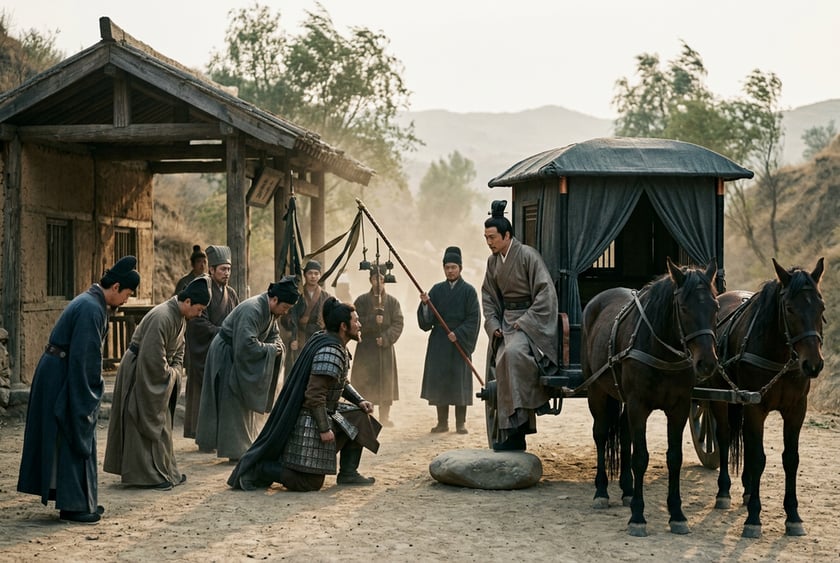
The Biography of Sun Xiu in the Book of Wu of the Records of the Three Kingdoms fully records Sun Xiu’s journey from Hulin, where he was escorted, to Jianye: on the way, he met the elderly Gan Xiu, who bowed and urged him to hurry; at Buse Ting, Sun En led the officials in welcoming him. In a side hall, Sun Xiu thrice declined the imperial seal and tally, and only after the assembled officials had thrice urged him did he mount the imperial carriage. Sun Chen led a thousand men to welcome him in the open country and dismounted to return his bow, presenting a legitimate accession marked by rigorous ceremony.
Romance
Chapter 113 of the novel simplifies the entire sequence: Sun Kai and Dong Chao come to invite Sun Xiu; on reaching Qu'e, Sun Xiu dreams at night that he is riding a dragon; he dares not ride in the imperial carriage, but enters the palace in a small carriage; and after ascending the throne and taking the position, he “repeatedly declines” before accepting the imperial seal. The novel also directly states that “five marquises from the Sun Chen family all command the palace guards, and their power surpasses that of the ruler,” while Sun Hao’s enfeoffment as Marquis of Wucheng foreshadows what comes later.
The carriage carrying Sun Xiu stops in front of Buse Pavilion. The Palace Guard General Sun En leads the officials, dressed in court robes and bearing the imperial carriage and ceremonial escort, to greet Sun Xiu respectfully.
After Sun Liang ascended the throne, Wu’s power was long constrained by powerful ministers and palace in-laws. Sun Chen inherited Sun Jun’s political resources, controlled the palace guard, and exerted influence over government affairs. Although Sun Liang occupied the throne, he was unable to independently control a military and bureaucratic network capable of checking the powerful ministers. The available historical sources suggest that Sun Chen’s deposition was not an ordinary court dispute, but a conflict in which the emperor tried to regain decision-making power while the powerful minister relied on his military advantage to preserve his de facto rule. Under these conditions, once a palace plot was exposed, the outcome quickly depended on who could first seize control of the palace gates and imperial guards.
The specific course of the plot is mainly found in the Romance of the Three Kingdoms: Sun Liang discussed raising troops to kill Sun Chen with Quan Ji, a Palace Attendant of the Yellow Gate; Quan Ji informed his father, Quan Shang, but Quan Shang’s wife leaked the secret to Sun Chen. Sun Chen immediately surrounded the palace, and arrested Quan Shang, Liu Cheng, and others. This account attributes the failure to the plan’s exposure and the delay in carrying it out, and presents the Quan family’s kinship ties as an intelligence channel. It should be noted that the biographies of the Quan family in the Records of the Three Kingdoms describe Quan Shang and Empress Quan’s relationship with the imperial house and the family’s former prominence, but do not recount the details of the plot above. The novel’s episodes therefore cannot be treated indiscriminately as established historical fact.
Key Figures
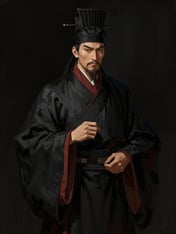
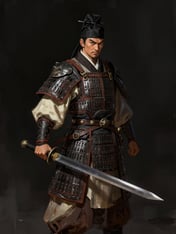
Sun Chen was the party that controlled coercive resources and the actual driving force behind the deposition. The novel depicts him mobilizing troops, taking control of the palace gates, summoning the officials to announce the emperor’s deposition, and using threats to force them to comply. The historical account, by contrast, records more briefly that after the Deposition of Sun Liang, Sun Chen sent Sun Kai and Dong Chao to welcome Sun Xiu. Together, the two accounts show Sun Chen’s central role, but the former emphasizes a dramatized palace conflict, while the latter focuses more on the transfer of power and the process of installing a new ruler.
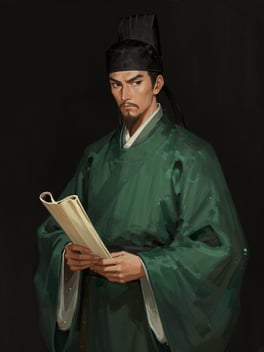
Sun Liang was the deposed emperor. The novel portrays him as actively plotting a counterstroke, only to lose the chance to act when his plan was exposed. This presents the young emperor’s political will while also highlighting his lack of a reliable chain of command. Quan Ji handled communications, while Liu Cheng is depicted as a participant in the operation who was executed; Quan Shang and Empress Quan were drawn into it through their family ties. The Quan family had once been prominent through the empress’s status and its position as imperial in-laws, but the family’s internal transmission of information also made it a vulnerable point in the power struggle. The details of these actions, however, should still be treated as part of the novel’s narrative, rather than as events directly confirmed by biographical sources.
Sun Xiu was the successor, but the sources focus not on how he plotted the emperor’s deposition, but on how he responded to the powerful minister’s invitation to take the throne. Sun Kai and Dong Chao were ordered to welcome Sun Xiu. At first he was hesitant, and only set out after hearing their explanation. Sun En then led the officials to greet him in his capacity as General of the Guard. Sun Xiu repeatedly declined when presented with the imperial seal, before ascending the throne and changing the reign title. The installation process shows that Sun Xiu’s accession depended on political arrangements controlled by Sun Chen, while also requiring the ceremonial recognition provided by the officials’ public welcome.
Core Issues
The first core issue is the separation of nominal imperial authority from actual coercive power. Sun Liang bore the title of emperor, but could neither protect those involved in the plot nor organize effective resistance after Sun Chen acted first. Sun Chen, by contrast, could use his troops to control the court and restructure supreme authority through “deposition and installation.” In the novel, the officials agree out of fear, while Huan Yi, who opposes the move, is killed. This illustrates how force can constrict the space for court deliberation. Even if the specific dialogue and episodes are not treated as a verbatim historical record, the power mechanism they express remains worth analyzing: when the army is not under the emperor’s stable control, armed action can render edicts and formal legitimacy ineffectual.
The second issue is whether kinship can be turned into a reliable political alliance. Sun Liang relied on Quan Ji and the Quan family’s marital ties to organize a counterstroke, but that same network also allowed information to reach Sun Chen’s side. The Quan family had once risen to prominence through the empress’s position, and the historical record also states that many members of the family were enfeoffed as marquises and commanded troops. Later, however, members of the family defected to Wei and Quan Xi was killed, and the family’s power gradually declined. An in-law network could offer access to the ruler, offices, and resources, but did not necessarily produce coordinated action. Once interests and loyalties within a family diverged, kinship ties could instead accelerate the exposure of a plan.
The third issue is the legitimizing rhetoric surrounding deposition. In the novel, Sun Chen announces Sun Liang’s deposition on the grounds that the emperor is “licentious, long ill, disordered, and without virtue,” and says that, out of regard for the late emperor, he will demote him to the King of Kuaiji. Such language recasts a seizure of power as the preservation of the ancestral temples and the correction of a ruler’s misconduct. The historical account of Sun Xiu’s accession, by contrast, emphasizes the welcoming ceremony, receipt of the imperial seal, the officials’ acknowledgment of him as their sovereign, and the general amnesty and change of reign title. This shows that coercive seizure of power and ritual recognition are not mutually exclusive: the former determines who can control the situation, while the latter helps give the new order a form that can be publicly accepted.
Political Consequences
The immediate consequence was that Sun Liang lost the throne and Sun Xiu ascended it through an installation process led by Sun Chen. Sun Chen did not automatically lose his power by installing a new ruler. The Romance of the Three Kingdoms says that he was appointed Chancellor and Governor of Jing Province, and that his family continued to control the palace guard; Sun Xiu appeared to show him favor while remaining wary of him. The historical account of Sun Chen arriving with a thousand men and bowing to Sun Xiu by the roadside also points to a complex ceremonial relationship between the new ruler and the powerful minister: Sun Xiu gained the throne, but Sun Chen remained a key figure capable of mobilizing force and taking part in political arrangements. The two texts emphasize different details and should not simply be merged into a single, undifferentiated list of facts.
For Wu’s institutions, this deposition exposed the succession order’s dependence on the military forces within the palace. The transfer of the throne could be completed quickly, but that did not mean supreme authority was secure. The new ruler had to deal with the military power, bureaucratic support, and family influence held by those who had installed him. Sun Xiu’s accession after the Deposition of Sun Liang was therefore both a change of regime and the beginning of a new round of relations between the powerful minister and the emperor. The available sources make it reasonably clear that Sun Xiu succeeded to the throne, but the true course of the plot, the precise motives of those involved, and the degree of their responsibility rely especially on the narrative constructed by the novel, and should still be treated with caution.
Counterfactual Analysis
If Quan Shang had not leaked the information, or if Sun Liang had been able to swiftly coordinate the palace guard, the city gates, and trusted attendants within the palace after issuing secret orders, Sun Chen might have faced a more difficult situation to control. But this does not mean that Sun Liang would necessarily have won. The weakness of the counterstroke was its reliance on a small number of trusted associates and on ad hoc mobilization. There is no evidence that Sun Liang had already secured a stable military command system, nor reliable proof that he had broad support among the officials. Even if his side had acted first, Sun Chen might still have used his existing military and political network to mount a counterattack, turning a swift deposition into a larger-scale palace civil war.
Conversely, if Sun Chen had not immediately deposed Sun Liang, but had instead stripped him of command over the troops, tightened surveillance, or forced him to yield through court procedures, open conflict might have been reduced in the short term, though mutual suspicion between ruler and minister could have persisted. After ascending the throne, Sun Xiu likewise faced the structural problem of his sponsors becoming too powerful. This shows that the situation was determined not by any one person’s character, but by the lack of stable checks and balances among imperial authority, the palace guard, and the network of imperial in-laws. Counterfactual analysis can reveal possible courses of action and institutional constraints, but cannot establish that history would inevitably have taken any particular path.