In 253 AD, the second year of Wu’s Jianxing era, during Sun Liang’s reign, after Zhuge Ke attacked Xincheng in Wei and withdrew his troops because of an epidemic in the army, Sun Jun, General of the Imperial Guard, ambushed and killed him in the palace hall. Sun Jun was subsequently appointed chancellor and enfeoffed as Marquis of Fuchun, entering the center of power in Wu and thereby altering the balance of power at court.
The Records of the Three Kingdoms records that Zhuge Ke’s northern campaign against Xincheng ended in defeat, and a major epidemic killed more than half the army, provoking resentment throughout the state. Sun Jun took advantage of the situation to falsely accuse him of plotting a rebellion, then conspired with Sun Liang to set an ambush during a banquet in the palace and execute him. Sun Jun was subsequently enfeoffed as Chancellor and Marquis of Fuchun. The narrative emphasizes popular resentment and the power vacuum.
Romance
The novel attributes the cause to two personal threads: “Zhuge Ke's seizure of command over the imperial guards angering Sun Jun” and “Teng Yin advising him out of an old grudge.” Sun Liang then personally takes part in arranging a banquet to lure Zhuge Ke to his death. This recasts an institutional coup as a palace intrigue and reinforces the idea that Zhuge Ke's personal arrogance caused it.
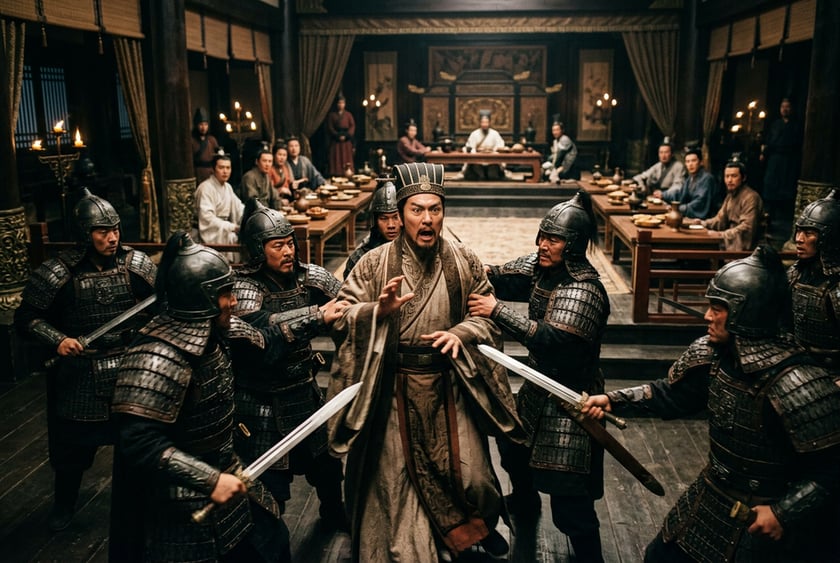
At a banquet in a Wu palace, warriors suddenly rush out from both sides of the hall and surround Zhuge Ke as he is about to take his seat, their swords drawn.
Zhuge Ke’s murder was not an isolated court clash; it came after a succession of military and political pressures. In 253, Ke led an army against Wei and besieged Xincheng, but withdrew after a severe epidemic killed more than half the troops. In the tenth month of that year, the Wu court held a grand banquet, where Sun Jun, General of the Guard, had troops lie in wait in the hall and killed Ke. The chronological accounts place the campaign, its disastrous outcome, and the assassination in succession, but do not explicitly state whether the defeat directly prompted Sun Jun’s action. The military setback can therefore be treated only as a backdrop to the weakening of Ke’s position, not as a single, proven cause.
Chapter 64 of the Records of the Three Kingdoms adds a more specific political assessment: Sun Jun “took advantage of the widespread resentment among the people and the hostility of the multitude” to frame Zhuge Ke as intending to rebel, then consulted with Sun Liang about inviting Ke to a banquet. This account suggests that Zhuge Ke’s position was described as constrained by both popular resentment and suspicion at court. But the cited passage does not elaborate on the scale of this “resentment” or which policies caused it, so public opinion cannot be treated as an undisputed fact on this basis.
Main Figures
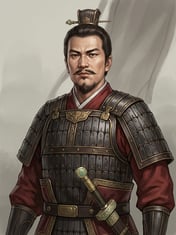
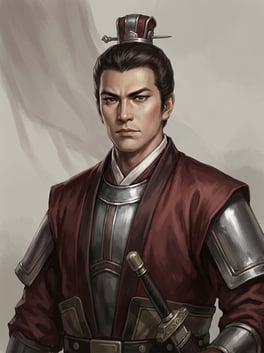
Sun Jun organized the operation and directly inherited power in its aftermath. Chapter 48 of the Records of the Three Kingdoms records that after ambushing and killing Ke, he was appointed chancellor and enfeoffed as Marquis of Fuchun, showing that the purge not only eliminated a political rival but also rapidly reshaped the distribution of power. Chapter 64 summarizes his strategy as framing his opponent by exploiting “the hostility of the multitude” and drawing Sun Liang into the plot. Sun Jun thus emerges as a political actor capable of wielding both military force and court intrigue, but the sources are insufficient to establish all his motives or any premeditated blueprint for power.
Zhuge Ke was the victim, but he should not be portrayed simply as a passive figure bearing no political responsibility. The available sources record, on the one hand, that he directed the campaign against Wei and suffered a major defeat at Xincheng, and, on the other, that Sun Jun used the accusation that Ke was “disloyal to the sovereign” to advance his execution. The former shows that Ke bore the consequences of his military decisions; the latter was an accusation made by an adversary, not a crime proven at trial in the cited passages. Distinguishing military defeat, political downfall, and actual rebellion is essential to assessing his character.
In the account in Chapter 64, Sun Liang took part in consultations with Sun Jun, making him a link in the court’s decision-making chain. Chapter 108 of Romance of the Three Kingdoms, in turn, portrays him as a ruler who actively agreed to hold the banquet, and adds episodes in which Teng Yin offers a plan and Zhang Yue and Zhu En command the imperial guards. The latter can be used to analyze how later accounts narrated the conspiracy, but it should not be given the same weight as the official history: the cited passage from the Records of the Three Kingdoms does not mention Zhang Yue, nor does it list Teng Yin as a planner of this murder.
Key Issues
The first issue is how court violence was carried out under the guise of legitimacy. The historical account describes not a public trial, but a killing carried out by troops lying in wait under cover of a banquet; the accusation that Ke was “plotting rebellion” provided a political pretext for the operation. This shows that, in a struggle for power, conspiracy and narratives of guilt may precede public scrutiny, and a ruler’s participation does not automatically make a process legitimate. The sources establish that an ambush killing and a frame-up were reported; they do not prove that Sun Jun’s accusation of rebellion was true.
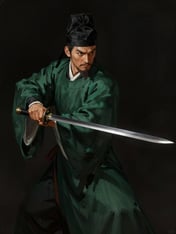
The second issue is the interdependence of the ruler, powerful ministers, and armed forces. Chapter 48 calls Sun Jun General of the Guard and records that he used troops lying in wait to kill Ke in the hall; Chapter 64 also says that he conferred with Sun Liang and arranged a banquet to invite Ke. Together, the accounts indicate that forces responsible for court security could be turned into instruments of political elimination, and that the authority of the ruler and the ability to carry out an operation were not one and the same. However, the passages do not explain how much actual control Sun Liang exercised over the operation, so it is unwise to declare simply that he was a puppet, or conversely that he directed it alone.
Chapter 64’s description of Zhuge Ke on the night before the banquet—his “spirit and composure in turmoil,” the foul smell of water and clothing, and a dog tugging at his clothes—casts the political event as a personal misfortune tinged with omens. It heightens the drama of the account and may lead readers to interpret the outcome as fated. In analysis, however, such details cannot substitute for an explanation of power relations, nor can the omens alone prove that any participant foresaw the murder.
Political Consequences
The immediate consequences are clearly recorded: after Sun Jun killed Ke, the Wu court issued a general amnesty and appointed Sun Jun chancellor, enfeoffing him as Marquis of Fuchun. The sequence of killing, amnesty, and promotion shows the regime quickly converting a fait accompli into formal authority. But the “general amnesty” alone does not prove that the court had won broad support; it may instead have been a conciliatory measure or a routine political act following a transfer of power. The available sources do not establish its precise function.
A deeper consequence is that resolving political conflict through conspiracy and violence could weaken trust within the court, leading officials to rely on alliances, preemption, or control of the imperial guard for their security. This is an institutional risk inferred from the mechanics of the event, not a widespread reaction directly recorded in the cited passages. The sources also provide no specific information about Sun Jun’s policies after taking power, the response of officials, or local order. Long-term effects should therefore be treated cautiously; one power transition alone cannot establish that the state of Wu immediately descended into comprehensive disorder.
Counterfactual Scenarios
If Zhuge Ke had seen through the trap before attending the banquet and refused to enter the palace, the immediate conditions for the ambush might have been disrupted. But that would not necessarily have secured his position: the popular resentment and suspicion mentioned in Chapter 64, together with the political burden of the defeat at Xincheng, might still have led Sun Jun to seek another opportunity or provoked open confrontation. This scenario only shows that changing the timing of an action might have changed the form of the conflict; it does not establish that Ke would certainly have escaped or would inevitably have been killed by some other means.
If Sun Jun had chosen to present evidence publicly and convene the ministers to judge the case, or if Sun Liang had refused to take part in arranging the banquet, the affair might not have ended in an ambush in the hall. Yet in an environment where armed force and court power were intertwined, public procedure might not have been enough to contain the conflict. Conversely, if Zhuge Ke had explained his responsibility, adjusted his decisions, and repaired relationships after the failed campaign against Wei, he might have been less isolated, but that could not have eliminated Sun Jun’s ambitions. The Records of the Three Kingdoms provides no evidence for these alternative courses, so the value of counterfactual analysis lies in clarifying the available institutional choices, not in claiming that any particular path would necessarily have succeeded.