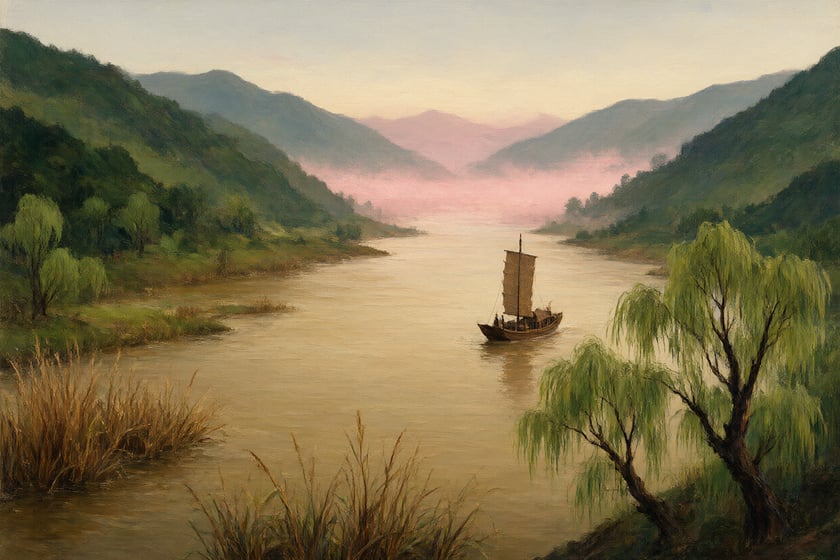
Overview
The Han River is a tributary of the Yangtze. In ancient times, its upper reaches and the river as a whole were also known as the Mian River, often abbreviated in texts to “Mian”; it is the present-day Han River. During the late Han and Three Kingdoms periods, it linked Hanzhong with northern Jing Province. The Hanzhong Campaign, Guan Yu’s siege of Fancheng, and numerous battles between Wei and Shu and between Wei and Wu all took place along its banks. During the standoff between Wei and Wu, the two states used the Han River as their boundary in the Jing Province region.
History
In the third year of Chuping (192), Sun Jian, acting on Yuan Shu’s orders, attacked Liu Biao of Jing Province. He defeated Huang Zu between Fan and Deng, crossed the Han River and laid siege to Xiangyang, then was shot and killed by Huang Zu’s men at Xianshan.
In the spring of the twenty-fourth year of Jian’an (219), Liu Bei crossed the Mian River south from Yangping Pass and advanced gradually along the mountains. He set up camp on Mount Dingjun and killed Xiahou Yuan. After Xiahou Yuan’s death, morale in the Wei army wavered, and Guo Huai put Zhang He forward as commander. Liu Bei intended to cross the Han River and attack, and the Wei generals proposed deploying along the water. Guo Huai, however, argued that they should draw back from the river, let the enemy cross halfway, and then strike. Seeing this, Liu Bei grew suspicious and did not cross. Cao Cao then came in person to Hanzhong to contest the area. Pei Songzhi’s commentary cites the “Supplementary Biography of Zhao Yun,” which says that Zhao Yun flung open the camp gates and lowered the banners and drums. Suspecting an ambush, Cao Cao’s army withdrew. Zhao Yun then beat the drums and fired crossbows at them from behind. The Wei troops panicked and trampled one another; many fell into the Han River and drowned. That same year, Liu Bei also sent Liu Feng downstream from Hanzhong along the Mian River to join Meng Da in an attack on Shangyong.
In the autumn of that year, Guan Yu besieged Fancheng. Continuous heavy rain caused the Han River to overflow, and the water on the flatlands rose several zhang deep. All seven armies Yu Jin had brought to relieve Cao Ren were inundated, and Yu Jin surrendered. Pang De, stationed north of Fancheng, escaped the flood by climbing onto an embankment and fought fiercely from morning until afternoon. After his boat capsized and he fell into the water, Guan Yu captured him; he refused to yield and was killed. After Xu Huang’s relief force arrived, Guan Yu lifted the siege, but his fleet still controlled the Mian River, and Xiangyang was for a time cut off from all outside contact. Later, when Shu Han officials urged Liu Bei to proclaim himself emperor, they also cited as an auspicious sign the jade seal that Zhang Jia and Wang Xiu, men of Xiangyang, had presented after Guan Yu’s siege of Fancheng, saying it had been hidden in the Han River.
During the reign of Emperor Wen of Wei, Xiahou Shang served as Inspector of Jing Province. At the time, Jing Province was devastated and desolate, and with the Han River marking the boundary between Wei and Wu, many of its former inhabitants had migrated south of the Yangtze. In the second year of Taihe (228), Wei attacked Wu on two fronts. Sima Yi led troops downstream along the Han River, while Cao Xiu commanded the other forces toward Xunyang. In the fourth year of Taihe (230), during Cao Zhen’s Invasion of Shu, Sima Yi led his troops upstream along the Han River, with plans to join forces at Nanzheng. In the ninth month of that year, heavy rain caused the Yi, Luo, Yellow, and Han rivers to flood, and Emperor Ming of Wei ordered Cao Zhen and the others to withdraw. In the seventh year of Zhengshi (246), the Wu general Zhu Ran invaded Zhazhong, and more than ten thousand local households of civilians and officials crossed the Mian River and fled north. Sima Yi proposed temporarily settling them north of the Mian River, but Cao Shuang refused and insisted they return south of it. They were then attacked and killed by Wu forces.
Differences Between the Historical Record and the Novel
In its account of the Hanzhong Campaign, Romance of the Three Kingdoms says that Xu Huang ignored Wang Ping’s warnings and camped with the Han River at his back. Huang Zhong and Zhao Yun attacked him from both sides and routed him, after which Wang Ping crossed the Han River and surrendered to Liu Bei. The Records of the Three Kingdoms: Biography of Wang Ping says only that Wang Ping surrendered to Liu Bei while accompanying Cao Cao on his campaign against Hanzhong; the Records of the Three Kingdoms does not mention Xu Huang camping with the river at his back. The novel also says that Zhuge Liang stationed an ambush upstream on the Han River, sounding drums each night to unsettle Cao Cao’s camp, and then urged Liu Bei to camp with the Han River at his back to lure the enemy.
Both works record the Flooding of the Seven Armies. The novel adds that Yu Jin was stationed in the low-lying Zengkou River valley and that Guan Yu had prepared rafts at the mouth of the Han River in advance. The Records of the Three Kingdoms says only that Guan Yu attacked in large ships. The novel also says that before Zhuge Liang’s final expedition, the Grand Astrologer Qiao Zhou tried to dissuade him, calling it an ill omen that tens of thousands of birds had flown in from the south and fallen dead into the Han River. Zhuge Liang did not listen.
Today
The Han River, now known as the Han River, rises in Ningqiang County, Hanzhong City, Shaanxi Province. It flows through Hanzhong, Ankang, Shiyan, and Xiangyang, and joins the Yangtze in Wuhan, Hubei Province.