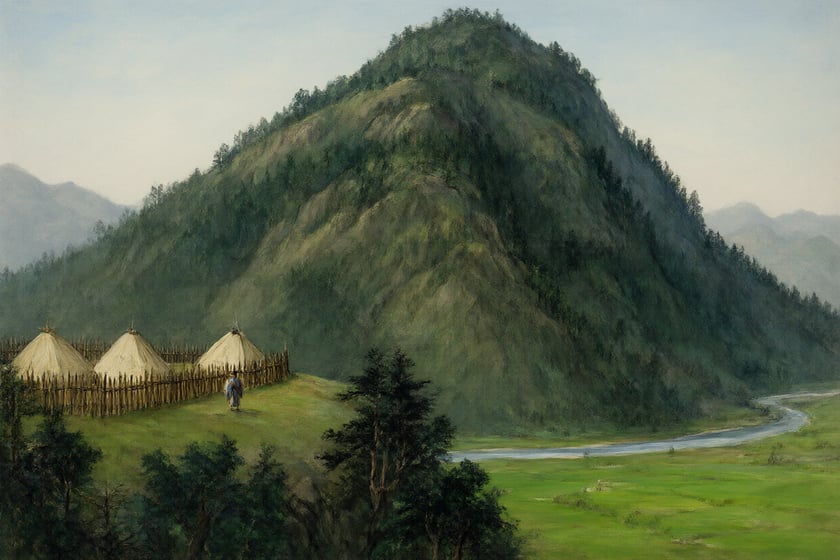
Overview
Mount Dingjun is a mountain in the western part of the Hanzhong Basin, within Mianyang County of Hanzhong Commandery, south of present-day Mian County in Hanzhong, Shaanxi Province. In the twenty-fourth year of Jian’an (219), Liu Bei made camp there. Huang Zhong killed Xiahou Yuan, the commander of Cao Cao’s army, securing a decisive victory for Liu Bei in his campaign to take Hanzhong. After Zhuge Liang, chancellor of Shu Han, died, his final instructions were that he be buried at Mount Dingjun.
History
In the spring of the twenty-fourth year of Jian’an (219), Liu Bei crossed the Mian River south from Yangping Pass and advanced step by step along the mountains, making camp at Mount Dingjun in accordance with the terrain. Xiahou Yuan led troops to contest the area. Liu Bei ordered Huang Zhong to attack from higher ground, raising a loud clamor. Huang Zhong routed Xiahou Yuan’s army and killed Xiahou Yuan, along with Zhao Yong, the Inspector of Yi Province appointed by Cao Cao, and others. Huang Zhong’s biography records that Xiahou Yuan’s troops were exceptionally elite. Huang Zhong led the charge straight ahead, rallying his soldiers; gongs and drums thundered, and their shouts echoed through the valleys. In a single battle, he killed Xiahou Yuan and was promoted for his achievement to General Who Conquers the West. Afterward, Cao Cao personally marched south from Chang'an. Liu Bei held the fortified heights and refused to engage him. By summer, Cao Cao withdrew, and Liu Bei took possession of Hanzhong.
In the twelfth year of Jianxing (234), Zhuge Liang died. In accordance with his final instructions, he was buried at Mount Dingjun in Hanzhong, with his tomb built into the mountain. The burial chamber was only large enough for his coffin; he was dressed in ordinary clothes for burial, and no grave goods were used.
Differences Between the Novel and the Historical Record
The Romance of the Three Kingdoms says that after Cao Cao took Hanzhong, he left Xiahou Yuan to guard the pass at Mount Dingjun; the Records of the Three Kingdoms only says that Xiahou Yuan and others were left to defend Hanzhong. The novel places Huang Zhong’s expedition to Mount Dingjun in the seventh month of autumn in the twenty-third year of Jian’an, whereas the Records of the Three Kingdoms dates it to the spring of the twenty-fourth year of Jian’an. In the novel, Liu Bei calls Mount Dingjun a shield for Nanzheng and a place where provisions are stored, saying that once it was taken, there would be no need to worry about the route through Yangping. The novel also says that Huang Zhong and Xiahou Yuan exchanged prisoners Xiahou Shang and Chen Shi while facing one another. Fa Zheng then advised Huang Zhong to seize a high mountain west of Mount Dingjun from which the latter could be overlooked. They agreed to use white and red flags as signals and, while fresh, wait for the enemy to tire; Huang Zhong then killed Xiahou Yuan. These episodes do not appear in the Records of the Three Kingdoms. However, Fa Zheng did take part in the battle: the Biography of Fa Zheng in the Records of the Three Kingdoms states that when Xiahou Yuan came to contest the area, Fa Zheng told Liu Bei, “We can attack now,” after which Liu Bei ordered Huang Zhong to strike.
The novel says that the Later Lord personally escorted Zhuge Liang’s coffin to Mount Dingjun for burial, but this is not recorded in the Records of the Three Kingdoms. The novel also says that when Zhong Hui campaigned against Shu, he made a patrol to Mount Dingjun, where he encountered dark clouds and fierce winds and was startled by a sudden charge of hidden cavalry. Only after fleeing did he go to pay his respects at the tomb of Marquis Wu. The Biography of Zhuge Liang in the Records of the Three Kingdoms records only that after Zhong Hui reached Hanchuan, he made offerings at Zhuge Liang’s temple and ordered his soldiers not to graze livestock or cut firewood near Liang’s tomb.
Today
At the foot of the mountain stands Zhuge Liang’s tomb, also known as the Tomb of Marquis Wu. It is one of the principal historic sites commemorating Zhuge Liang in Mian County.