Records
Liu Bei's army won
- Commanders
- Xiahou Yuan's armyXiahou Yuan
Vol. 32「先主命黃忠乘高鼓譟攻之,大破淵軍,斬淵」
219 CE (Jian'an 24) · Mount Dingjun
According to chapters seventy and seventy-one of the San Guo Yanyi, at the turn of winter and spring in the twenty-third to twenty-fourth years of Jian'an (218–219 CE), Liu Bei advanced to take Hanzhong and drove his forces toward Dingjunshan — the shield of Nanzheng and the principal grain depot for Cao Cao's forces in Hanzhong. The veteran general Huang Zhong volunteered to lead the assault, and Zhuge Liang goaded him into action with a deliberate challenge to his pride, sending Fa Zheng along as military supervisor. Huang Zhong first drew up against Xiahou Yuan at the foot of the mountain; in the opening engagement the two sides exchanged arrow fire from their respective formations until Xiahou Yuan signaled a withdrawal. Huang Zhong then adopted Fa Zheng's strategy of "seizing the high ground west of Dingjunshan to observe the enemy's dispositions," and captured the heights in a night assault. With the two forces facing each other across the ridge, Fa Zheng directed the battle from the summit using red and white flag signals; in the afternoon, when the Cao forces had grown weary, a single drumbeat sent Huang Zhong charging down from midway up the slope, and with one stroke of his saber he cut Xiahou Yuan in two at the shoulder. The Cao army collapsed in rout, Zhang He retreated in defeat, and Huang Zhong pressed on to take Dingjunshan outright; simultaneously Liu Feng and Meng Da seized the Micangshan line, and Cao Cao, on receiving the news, personally led a great army to the Hanshui. This battle was the decisive turning point in Liu Bei's conquest of Hanzhong.
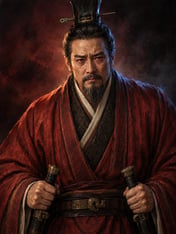 Liu BeiLivedCommanderTalk to me
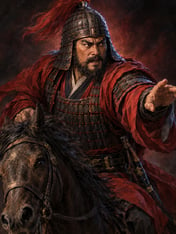 Xiahou YuanKilled in actionTalk to me
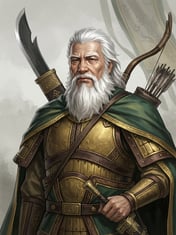 Huang ZhongWarriorTalk to me
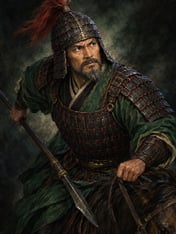 Zhang HeWarriorTalk to me
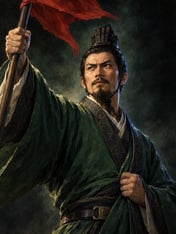 Fa ZhengAdvisorTalk to me
Who won, as each book tells it; commanders as the text names them.
Records
Liu Bei's army won
Vol. 32「先主命黃忠乘高鼓譟攻之,大破淵軍,斬淵」
Romance
Huang Zhong's army won
Ch. 71「黃忠斬了夏侯淵,曹兵大潰,各自逃生」
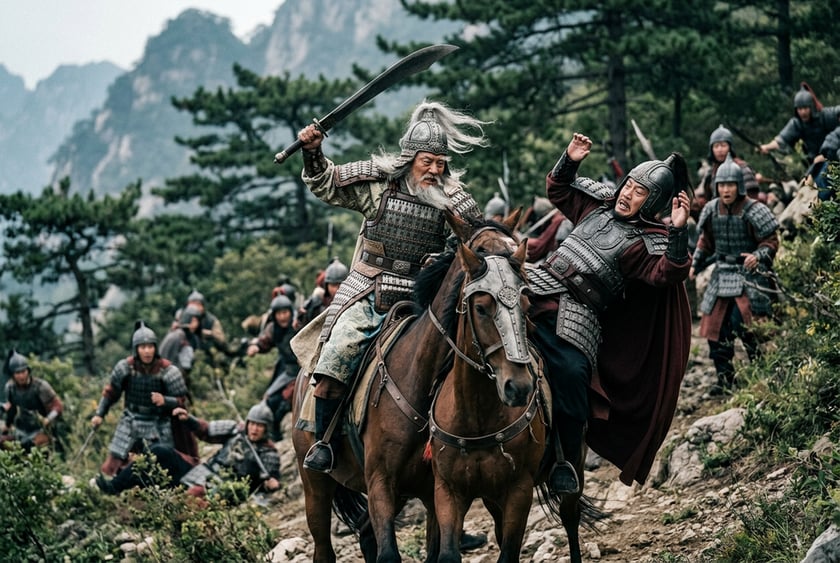
Scene
Huang Zhong charges down from halfway up the mountain, swinging his great sword and striking Xiahou Yuan from his horse as Cao Cao’s ranks fall into disarray.
Featured people: Huang Zhong、Xiahou Yuan
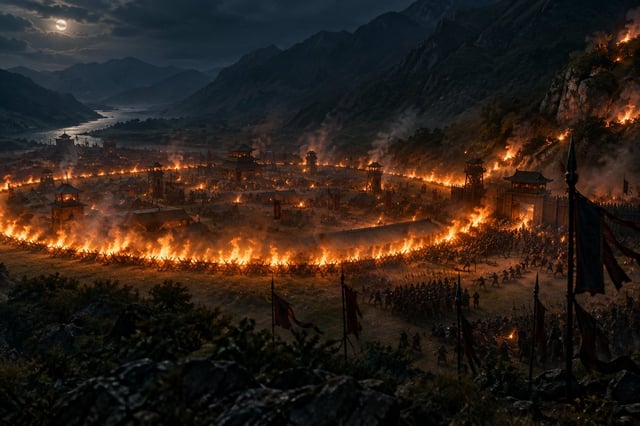
Continue
Replay the Battle of Mount Dingjun phase by phase on real terrain: troop strengths, movements and turning points at a glance, each marked as coming from the Records of the Three Kingdoms or the Romance.
2185 people in common
2193 people in common
2193 people in common
2133 people in common
2123 people in common
2013 people in common
2182 people in common
2152 people in common
Mount Dingjun lies on the southern edge of the Hanzhong Basin. It was the southwestern barrier on the route from Nanzheng to Micang and Yangping, and also the main area where Cao Wei forces stockpiled provisions for Hanzhong. Beginning in the twenty-third year of Jian’an, Liu Bei committed the full strength of Shu to an advance north into Hanzhong, and his forces faced off against the troops of Xiahou Yuan, Zhang He, and others, who were stationed at Nanzheng, for nearly two years. Hanzhong held a dual significance for Shu Han, serving as both a “gateway and a springboard”: if Shu Han took Hanzhong, it could look north toward Guanzhong and control Shangyong to the east; if it lost Hanzhong, Cao Wei could advance south along the Han River and press directly toward Chengdu. Cao Cao made Xiahou Yuan the shield of his western front precisely because he valued his command style, which was “deeply versed in strategy and skilled at understanding the art of war”. Huang Zhong’s volunteering to attack Mount Dingjun came at a pivotal moment, when the struggle for Hanzhong was shifting “from stalemate to decisive battle.”
The Shu deployment was “one general, one strategist, one high ground”: Huang Zhong served as commander, Fa Zheng as military adviser, and their target was the high mountain west of Mount Dingjun, “surrounded on all sides by dangerous paths,” from which they could “look down and see the situation at Mount Dingjun”. When appointing the general, Zhuge Liang even goaded Huang Zhong with the question of whether an “old general could match Xiahou Yuan,” and arranged for Fa Zheng to accompany him, forming an offensive version of a “two-part structure.” On the Cao side, Xiahou Yuan was commander and Zhang He his deputy. Du Xi stationed several hundred troops at West Mountain to keep watch, while other forces were deployed to defend the mountain pass. The problem was that Xiahou Yuan’s command style leaned toward personally leading the vanguard and hastening to seek battle—a fundamental contradiction with Zhang He’s cautious approach, later expressed in his urging that “the general must not go out to fight; he should only hold fast”.
The campaign had three key decision points. First, Fa Zheng proposed the strategy of “first seizing the mountain opposite, to look down and assess the situation at Mount Dingjun.” This transformed the campaign from a face-to-face standoff into a battle fought across three-dimensional terrain, giving the Shu forces the physical advantage of “using high ground to control the low.” Second was Fa Zheng’s command plan from the mountaintop, using white and red flags to control the timing of Huang Zhong’s attack. When the Shu forces raised the white flag, they held their position and did not respond as the Cao forces hurled insults. Then, in the afternoon, when the Cao troops were “weary and unprepared, with many dismounted and sitting to rest,” Fa Zheng switched to the red flag as a signal, and Huang Zhong charged downhill from halfway up the mountain. This was a classic “wait at ease for the exhausted enemy” tactic, whose success hinged on Fa Zheng’s precise control of the battlefield’s pace. Third was Xiahou Yuan’s own error in judgment. After Du Xi returned with the defeated troops and reported, Xiahou Yuan reasoned, “They’ve seized the mountain opposite and are watching our situation—how can we not go out to fight?” He ignored Zhang He’s strenuous objections. Within hours, this decision turned Cao Wei’s command advantage into a command disadvantage.
Huang Zhong struck from halfway up the mountain. Xiahou Yuan was caught off guard and cut in two, head and shoulder, and the Cao troops were routed. Zhang He led the defeated troops toward Mount Dingjun, but then learned that “Mount Dingjun had already been taken by Liu Feng and Meng Da,” leaving him no choice but to retreat to the Han River and set up camp. When Cao Cao heard of Xiahou Yuan’s death, he wept aloud. Xiahou Yuan was not only the shield of the western front but also a kinsman of the Cao clan, bound to Cao Cao by brotherly blood ties. Cao Cao then personally led a large army to Hanzhong to avenge him. By then, however, Liu Bei had already secured the key positions. Though Cao Cao arrived, he could not reverse the disadvantage on the western front, and a few months later the Cao forces had no choice but to withdraw from Hanzhong. In the Romance, this battle is a defining episode in Huang Zhong’s transformation from “old general to top-tier warrior,” and one of Fa Zheng’s most distinctive achievements as a military adviser. Strategically, it directly enabled Liu Bei’s political elevation to “King of Hanzhong,” a decisive step in the process of founding his state.
Two questions can be asked from a counterfactual perspective. First, what might have happened at Mount Dingjun if Xiahou Yuan had accepted Zhang He’s advice to “hold fast and not go out to fight”? Most likely, the two sides would have remained in a stalemate for longer. But the Shu forces had already seized the high ground opposite, and over time the Cao forces would have been unable to keep their grain stores secret. Zhang He’s plan could only delay defeat, not reverse it. If Cao Cao’s reinforcements had arrived during the stalemate, the western front might have been held, at least barely; but the time needed to bring a main force from the Central Plains to Hanzhong exceeded the period for which both sides could withstand the depletion of their provisions. Second, could Shu still have won the Battle of Mount Dingjun if it had not sent Fa Zheng along, and Huang Zhong had led the attack alone? Huang Zhong’s valor, like that of Huang Gai and Zhang Fei, was that of a typical fierce battlefield general, but he lacked the ability to control the pace of the battle in its middle phase. The series of decisions—to seize the opposite mountain, use flags as signals, and wait until midday to strike downhill—all required a strategist to lead. By portraying Fa Zheng as “the one holding the flag on the mountainside,” the Romance essentially acknowledges that, at the tactical level, this victory was driven by a strategist. Taken together, these two lines of analysis show that the value of the Battle of Mount Dingjun lay not in the beheading itself, but in demonstrating how “terrain, tempo, and division of command” could be used to break a renowned general’s formation—a successful template that Zhuge Liang repeatedly tried to recreate in his later northern campaigns, but never managed to reproduce.