Liu Bei's faction · General
Mi Fang
courtesy name 子方 · also called 麋芳
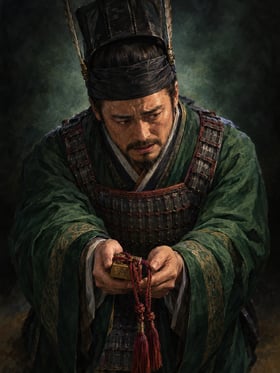
At first he held loyal intentions, but was soon pressed by Shi Ren into surrender. He once drank with Shi Ren and let a fire break out, causing a mishap, and later joined Shi Ren in assassinating Ma Zhong to defect to the Former Lord.

Life
In the novel: 15 chapters · In the Records: 7 volumes
Life?–?
200 CE (Jian'an 5)
208 CE (Jian'an 13)
- Burning of XinyeXinyeWarrior
219 CE (Jian'an 24)
- Lü Meng's River Crossing in WhiteJianglingParticipant
- Liu Bei's faction
- Eastern Wu
- Hatched: dated by chapter
- Life event
List all 4 stops
On the boards
Compare with someone →Where this person ranks on each board.
Who they were
Character profile
- Character
- At first he held loyal intentions, but was soon pressed by Shi Ren into surrender. He once drank with Shi Ren and let a fire break out, causing a mishap, and later joined Shi Ren in assassinating Ma Zhong to defect to the Former Lord.
- Life
- Mi Fang was a man of Donghai who served as Grand Administrator of Nan Commandery. He later rebelled and surrendered to Sun Quan, and in the end was flayed before Lord Guan's spirit-tablet.
- Anecdotes
- Mi Fang was the younger brother of Mi Zhu, and together with his elder brother he once guarded the central army and returned to Gucheng. He had been an aide to Xuande, and once garrisoned with troops alongside Liu Feng and made ready the boats. In the melee at Dangyang he fled back with several arrows in his body, and falsely reported that Zhao Yun had gone over to Cao. He served as a military officer assisting Guan Yu in defending Jing Province, and was later promoted and rewarded among the former officials of Jing and Xiang. As the defending general of Nan Commandery, he was targeted for enticement by Sun Quan, and in the end followed Shi Ren out of the city to surrender to Eastern Wu.
Historical Record
Mi Fang, courtesy name Zifang, was from Donghai and was Mi Zhu’s younger brother. After Liu Bei’s faction entered Jing Province, he first served as the Chancellor of Pengcheng and later as Administrator of Nan Commandery, serving alongside Guan Yu. When Guan Yu led troops to attack Fancheng, Mi Fang remained behind to defend Jiangling, while Shi Ren guarded Gong’an. Both had fallen out with Guan Yu. Supplies for the front line had not been fully provided, and Guan Yu also said he would investigate the matter after returning, leaving Mi Fang and Shi Ren uneasy. Sun Quan secretly sought to entice them, and the two sent people to welcome him, ultimately betraying Liu Bei’s side.
In the twenty-fourth year of Jian’an, Guan Yu besieged Fancheng and flooded the army commanded by Yu Jin, greatly enhancing his reputation. Taking advantage of Guan Yu’s main force being away, Sun Quan sent Lü Meng to seize Gong’an and Jiangling. Shi Ren surrendered first; when Lü Meng advanced to Nan Commandery, Mi Fang opened the city gates and surrendered, and Lü Meng then took control of Jiangling. After Guan Yu retreated, he lost his foothold in Jing Province, his soldiers scattered, and he was later captured and killed by Wu troops at Linju. Chen Shou links Mi Fang’s betrayal and welcoming of Sun Quan to Guan Yu’s defeat; accounts from Eastern Wu give the specific details of Lü Meng’s advance on Nan Commandery and Mi Fang’s surrender of the city to Wu.
After surrendering to Wu, Mi Fang continued to be employed by Sun Quan. Later, he served under He Qi, leading troops in an attack on Qichun, where Wu forces took the enemy by surprise and captured alive Jin Zong, the Qichun Administrator who had defected from Wei. Judging from the surviving material, Mi Fang in the historical biographies was both a key figure in the loss of Jing Province and a participant in military operations in Eastern Wu’s forces.
In the Novel
Romance of the Three Kingdoms portrays Mi Fang as an old subordinate of Liu Bei and Mi Zhu’s younger brother. In his early years, he accompanied his brother in defending Xu Province; later, he returned to Gucheng with Mi Zhu and welcomed Liu Bei and his party as they reunited. In the stories of Bowang and Xinye, he follows Zhuge Liang’s orders to defend the county and support a feint, and sets an ambush with Liu Feng at Quewei Slope. After the fire attack at Xinye, he also takes part in intercepting Cao’s forces and preparing boats. These battlefield achievements belong to the novel’s narrative and should not be confused with the brief accounts of his early life in the historical biographies.
The novel also gives him a misstep before Guan Yu loses Jing Province: he and Shi Ren get drunk and start a fire, destroying weapons and provisions. After Guan Yu has him beaten with a staff, he is assigned to defend Nan Commandery. When Lü Meng attacks, Shi Ren persuades him to surrender. After a messenger arrives seeking provisions for Guan Yu, Shi Ren beheads him, and Mi Fang then leaves the city with him to surrender to Wu. The historical record does confirm that Mi Fang surrendered to Wu, but the fire, the beheading of the messenger, and the specific process of persuasion are all literary embellishments in the novel; the Records of the Three Kingdoms makes no explicit mention of them.
The novel further depicts Mi Fang’s repeated changes of allegiance during the Battle of Xiaoting: Jing Province soldiers in the Wu army resent him and Shi Ren, and the two, fearing they will be killed, assassinate Ma Zhong and take his head to Liu Bei to beg forgiveness. Liu Bei refuses to pardon them and personally executes them before Guan Yu’s spirit tablet. This passage portrays Mi Fang as a man who wavers between fear and a desire to survive, yet ultimately cannot escape retribution—a fate unique to the novel.
Key Relationships
- Mi Zhu: Older brother. Mi Zhu was an important longtime official of Liu Bei, and Mi Fang was his younger brother. Historical accounts say that when Mi Zhu learned his brother had betrayed Liu Bei by welcoming Sun Quan, he bound himself and came to apologize. Liu Bei comforted him, saying, “A brother’s crime does not implicate his sibling,” and continued to treat him generously as before. Mi Zhu, however, fell ill from shame and anguish and died a little over a year later.
- Guan Yu: Colleagues who fell out. Mi Fang served as Administrator of Nan Commandery alongside Guan Yu. Their discord, the inadequate supply of military provisions, and Guan Yu’s threat to investigate formed the background to Mi Fang’s turn to Sun Quan in the historical record. After Guan Yu’s defeat and death, Jiangling, which Mi Fang had defended, fell to Wu.
- Shi Ren: Fellow surrenderer to Wu. Shi Ren guarded Gong’an and surrendered alongside Mi Fang when Lü Meng attacked. The novel further portrays the two as companions who persuade one another and leave the city together to submit to Wu.
- Sun Quan: The one who received and employed Mi Fang. Sun Quan secretly sought to entice Mi Fang, who surrendered to him after Lü Meng seized Jiangling. Mi Fang later also took part in Wu’s attack on Qichun.
Signature Scenes
The Opening of Jiangling’s Gates. Lü Meng Crosses the River in White Robes, capturing the watch posts Guan Yu had established along the river and rapidly closing in on Nan Commandery. According to Eastern Wu accounts, Mi Fang opened the city gates and surrendered; Lü Meng entered the city, reassured the people, and took control of Jiangling. Meanwhile, with Jing Province lost, Guan Yu found his retreat blocked and his troops demoralized and scattered. This scene best shows how Mi Fang’s change of heart affected the course of the war in Jing Province.
The Divide Between History and the Novel. The historical record emphasizes that Mi Fang surrendered because he was on bad terms with Guan Yu and had been enticed by Sun Quan, and that he continued to hold a post in Wu’s army afterward. The novel adds dramatic episodes in which he starts a fire, beheads a messenger, defects back to Shu, and is executed by Liu Bei. Readers thus encounter both a governor marked in the historical biographies by his surrender to Wu and the fall of Jiangling, and a fictional character who repeatedly changes sides and is ultimately cast as a sacrificial victim in the commemoration of Guan Yu.
Quotes
8 lines in the books · 3 featured
「趙子龍反投曹操去了也!」
This line is Mi Fang spreading the rumor at Changban that Zhao Yun had defected, embodying his petty conduct.
「吾等受漢中王厚恩,安忍背之?」
This line is Mi Fang's hypocritical persuasion of Shi Ren before surrendering to Eastern Wu, setting off his betrayal.
「軍心變動,我二人性命難保。今蜀主所恨者,馬忠耳;何不殺了他,將首級去獻蜀主,告稱:『我等不得已而降吳,今知御駕前來,特地詣營請罪。』」
This line is Mi Fang, to save his own skin, inciting Shi Ren to kill Ma Zhong and present his head, laying bare his fickleness.
- Family
- Lord & vassal
- Friends
- Enemies
Who is Mi Fang connected to?
Pick someone to see how many steps lie between them and Mi Fang.
Combat
On the field
Duels, kills and executions as the texts tell them, counted separately for the Records and the Romance.
Events
Events (9)
Battles and events the texts place this person in, by date.
Battles
Other events
Places
- Native of
- DonghaiRecords
- Governed
- JianglingRecords
- Nan CommanderyRecords
Continue
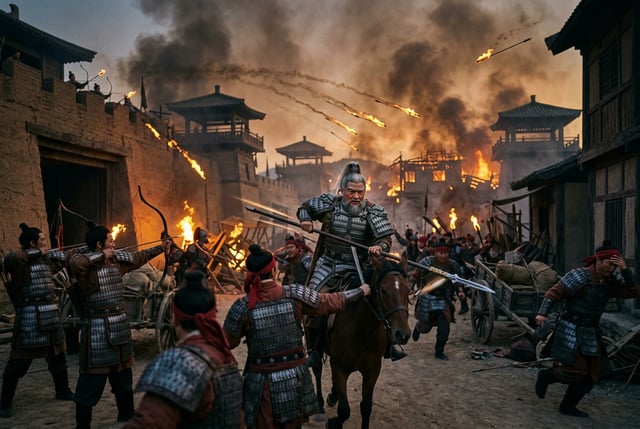
Burning of Xinye
Relationship timeline9 entries ▸
History · vol. 38
History · vol. 45
- Sun Quan§194
Defected to
rebelled together with Shi Ren and welcomed Sun Quan
Novel · ch. 18
- Mi Zhu§20
Sibling
brothers; jointly guarded the central army
Novel · ch. 40
- Zhuge Liang§29
Lord
camped with Liu Feng and 2,000 troops in front of Queweipo as a decoy force
Novel · ch. 41
- Liu Bei§26
Lord
Was struck by several arrows and fled back, reporting that Zhao Yun had defected to Cao; was trusted and vindicated by Xuande
Novel · ch. 83
Inner monologues · AI-generated3 monologues ▸
- Today, there is nothing more I can say in my own defense. I recall that when I was in Nan Commandery, I received the Han
- I recall that our families were joined by marriage to Xuande, and that my elder brother Mi Zhu and I both served under h
- I am Mi Fang, courtesy name Zifang. I was ordered to lead two thousand troops with Liu Feng and station ourselves before