Records
Wu forces won
Vol. 58「斬張南、馮習及胡王沙靡柯等首,破其四十餘營」
222 CE (Huangchu 3) · Xiaoting
During Zhangwu 1 and 2 (221–222), Liu Bei, the First Ruler of Shuhan, personally led his armies eastward against Sunwu to avenge Guan Yu's death and reclaim Jingzhou. In the seventh month of autumn his forces advancing against Wu paused at Zigui, where Wu Ban and Feng Xi first struck out from Wu and crushed the Sunwu general Li Yi and his troops; in the spring of the second year the First Ruler advanced with his generals from Zigui and established a fortified camp at Xiaoting on the road to Yidao, additionally enlisting the Wuling Wuxi tribal peoples as allies; the General Who Pacifies the North, Huang Quan, supervised the armies north of the river, holding the Sunwu forces at bay along the Yiling road. Wu appointed Lu Xun as grand commander, and he led Zhu Ran, Pan Zhang, Han Dang, Xu Sheng, Sun Huan, and others — approximately fifty thousand men — to resist the advance. Lu Xun held his defensive line and refused to give battle, waiting until the Shu forces had "abandoned their ships and taken to the land, establishing camps all along the hills for over seven hundred li," whereupon he launched a unified fire attack, killed Feng Xi and Zhang Nan, and broke more than forty of their camps; the Shu army collapsed entirely and the dead numbered in the tens of thousands. The First Ruler escaped with his life alone and fled back to Baidicheng, where he renamed Yufuxian to Yongan; the following year in the fourth month he died of illness, entrusting his successor to Zhuge Liang.
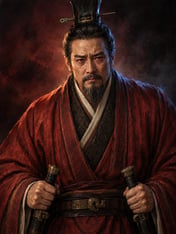 Liu BeiLivedCommanderTalk to me
 Lu XunCommanderTalk to me
 Sun QuanCommanderTalk to me
Famous objectsGreen Dragon Crescent Blade
Ask those who were there →Liu Bei, Lu Xun, Feng Xi and others answer you togetherWho won, as each book tells it; commanders as the text names them.
Scene
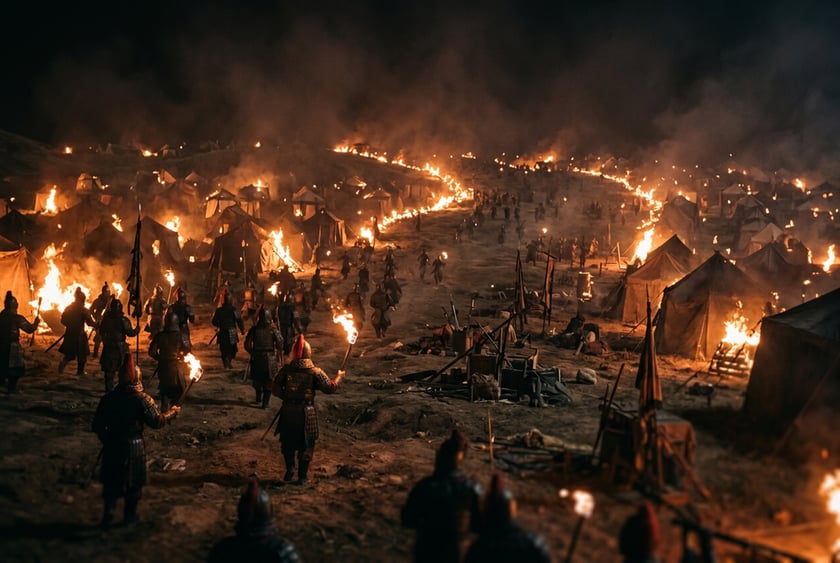
Night falls and flames soar as Wu soldiers carrying torches launch a fierce attack on Shu's camps stretching for seven hundred li. The Shu tents rapidly collapse in a sea of fire.
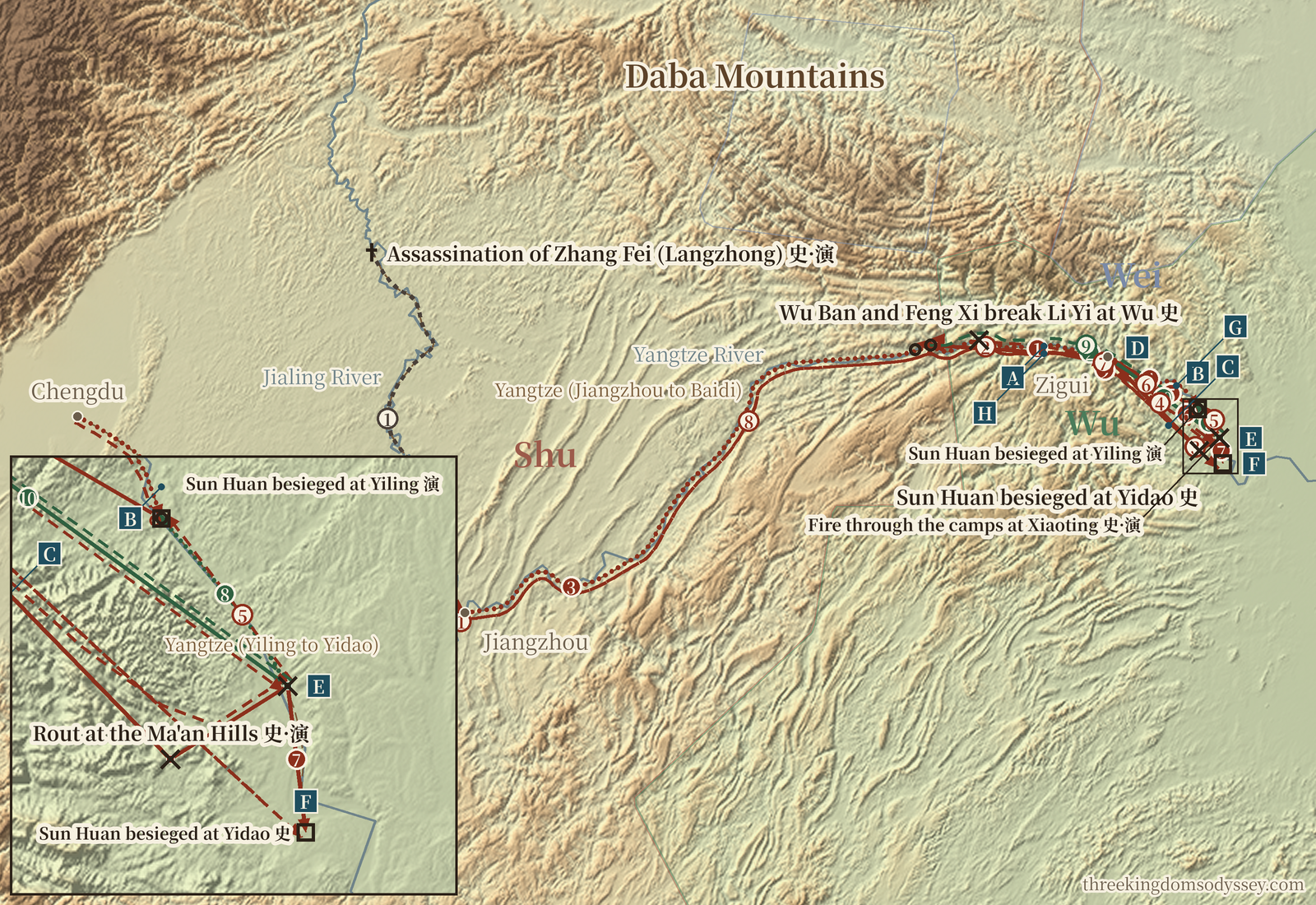
Swipe to see the whole map
In the Sanguozhi Sun Huan is besieged at Yidao; the novel moves the siege to Yiling and adds Zhao Yun's rescue and Lu Xun lost in the Eight Formations.
The books mostly say only where an army set out and arrived: a Records line is solid between the places they name and dotted where it follows a reconstructed road between them; an open ring marks an end the books don't give.
Base map: Natural Earth; terrain: AWS Terrain Tiles (SRTM and others). Roads and marches reconstructed from the sources listed; positions approximate.
Replay the battles on this map in 3D, phase by phase:▶ Battle of Xiaoting
The history records the Battle of Xiaoting as a national strategic campaign in which Liu Bei’s Eastern Campaign against Wu was undertaken mainly to recover Jing Province; the novel instead focuses on the personal, emotional motive of avenging Guan Yu.
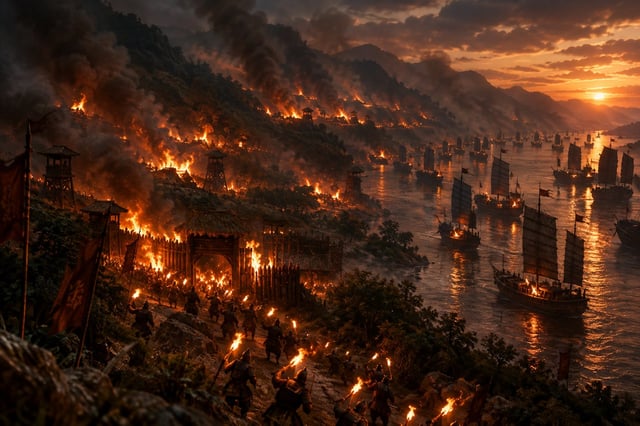
The novel portrays Liu Bei’s “seven-hundred-li chain of camps” as being routed at a stroke by Lu Xun’s fire attack. The history, by contrast, emphasizes that the Shu army first advanced by both land and water, then abandoned its ships and proceeded on foot; the hot weather and easily combustible mountain forests also enabled the fire attack to succeed.
Continue
Replay the Battle of Xiaoting phase by phase on real terrain: troop strengths, movements and turning points at a glance, each marked as coming from the Records of the Three Kingdoms or the Romance.
2213 people in common
2192 people in common
2282 people in common
2282 people in common
2162 people in common
2152 people in common
2292 people in common
2152 people in common
The Battle of Xiaoting took place at the critical juncture when the Three Kingdoms order was taking definitive shape. In the twenty-fourth year of Jian’an (219), Guan Yu attacked Xiangfan in the north, then was ambushed and killed by Sun Quan’s forces at Linju in the east. Overnight, Shu Han lost all six commanderies of Jing Province and its entire Jing Province army. This meant that the strategic foundation of “holding both Jing and Yi” in Zhuge Liang’s Longzhong Plan had been completely destroyed. After Liu Bei proclaimed himself emperor in the first year of Zhangwu (221), he launched an eastern campaign that from the outset had a dual purpose: politically, to “avenge Guan Yu”; strategically, to “recover Jing Province.” In Cao Wei, Liu Ye stood alone against the consensus at court, predicting that Liu Bei would certainly send out an army. His reasoning was not sentiment, but that “Bei seeks to strengthen himself through military power, and will inevitably deploy his forces to show that he has strength to spare”. This shows that, in the eyes of those involved at the time, Shu Han’s recent founding and need to prove its strength through an external offensive were themselves structural constraints.
The Shu forces advanced in successive echelons under their generals: Huang Quan commanded the troops north of the river and faced the Wei army to guard against Cao Pi exploiting the opening to invade south; Wu Ban and Chen Shi led the navy to garrison Yiling, on both the eastern and western banks of the river; the emperor himself led his generals from Zigui, cutting across ridges and along the mountains, and set up camp at Xiaoting in Yidao; Attendant Ma Liang pacified the Wuling tribes of Wuxi, prompting them to “all respond in concert”. Overall, this was a fairly comprehensive deployment, with “land and water forces advancing together, guarding against Wei in the north and linking up with the tribes in the south.” The problem arose after the second month. Once the Shu army had advanced into rugged mountain terrain, it could no longer deploy large ships along the river gorges. It therefore “abandoned its ships and proceeded on foot, setting up camps everywhere,” establishing dozens of garrisons along more than seven hundred li of mountain roads. This was the “seven-hundred-li line of connected camps” that Cao Pi later mocked as proof that “Bei did not understand warfare.” The Wu forces took the opposite approach: as grand commander, Lu Xun exercised authority over Zhu Ran, Pan Zhang, Song Qian, Han Dang, Xu Sheng, Xianyu Dan, Sun Huan, and others, commanding a total of about fifty thousand men. At the outset, they abandoned their forward positions and rapidly withdrew, taking up a defensive line between Yiling and Xiaoting and ceding the entire depth of the mountain terrain to the Shu army.
What truly decided the outcome was not the fire attack, but Lu Xun’s decision to “withdraw deliberately.” At the start of the war, many Wu generals advocated meeting the enemy in battle, but Lu Xun refused. His reasoning was that the Shu army had “advanced east with its whole force, its morale still at its peak, and had taken the high ground and fortified the passes; it would be difficult to attack them at once.” He chose to trade space for time, letting the Shu army spread its forces across seven hundred li of mountainous terrain, use up its supplies, and see its morale worn down. This “retreat to lure the enemy forward” demanded immense political credibility from a commander: a retreat could easily be interpreted by subordinates as fear of the enemy, and Lu Xun had to repeatedly press down opposition, sword in hand. Once the Shu army had camped in the mountains until the sixth month and its morale and fighting strength had both clearly declined, Lu Xun first tried to attack one camp and failed. He then worked out a specific method for defeating the enemy: set fire using thatch, and once the flames had taken hold, attack simultaneously with the entire army. The second key decision was not to rescue Sun Huan. Sun Huan was besieged at Yidao and sent repeated distress calls, but Lu Xun insisted that “it was not yet time.” Sun Huan’s city was well fortified and had ample provisions, Lu Xun reasoned, and he could hold out until the overall situation turned in their favor. This avoided the trap of pulling the main force away to relieve a forward position.
In the intercalary sixth month, the Wu army counterattacked along the entire front, beheading Zhang Nan, Feng Xi, the Hu king Shamoke, and others, and capturing more than forty of the Shu army’s camps. Within days, the Shu main force collapsed, with tens of thousands dead. Liu Bei took up position on Ma’an Mountain and formed his troops around himself, but Lu Xun attacked him from all sides. “The relay troops themselves carried the burning gongs and armor to cover the retreat, and only just managed to reach Baidicheng.” The account’s description that “ships, equipment, military supplies for the water and land forces were all lost at once, while corpses floated down the river, blocking its course” shows the totality of the Shu army’s defeat. General Who Guards the North Huang Quan, with his return route cut off, surrendered to Wei in the north. Zhuge Liang believed that had Fa Zheng been alive, he “would surely have been able to restrain the emperor and prevent him from marching east; even if he had marched east, he would certainly not have suffered such a disastrous defeat”. In the fourth month of the following year (the third year of Zhangwu, 223), Liu Bei died of illness at Baidicheng, entrusting his heir at Yongan. Shu Han then entered the period of Zhuge Liang’s rule, and its entire foreign strategy shifted from “advancing east to recover Jing Province” to “campaigning north against Liang and Yong.” It renewed its alliance with Eastern Wu and undertook no further large-scale campaigns to the east. Lu Xun won fame through this battle, establishing his political standing as Eastern Wu’s leading commander in his later years.
Counterfactual scenarios for the Battle of Xiaoting mainly follow three lines. First: had the Shu army maintained its joint advance by land and water, and not abandoned its ships to proceed on foot, keeping its naval and land forces coordinated throughout, Lu Xun’s fire attack could not have taken effect across the entire front. Under this assumption, Cao Pi’s judgment that “Bei did not understand warfare” would not hold; the Shu army might well have entered a prolonged standoff with Wu along the Yiling–Gong’an line, ending only when Eastern Wu took the initiative to make peace. Second: had strategists such as Fa Zheng and Pang Tong been present (Pang Tong died in battle in 211, and Fa Zheng died of illness in 220), Liu Bei might not have arbitrarily “set up camps everywhere along seven hundred li of mountain roads”; at the very least, he might have adopted the “joint advance by land and water” that Lu Xun had initially feared. Third: had Liu Bei not collapsed at Baidicheng after his defeat, but instead returned to Chengdu to reorganize his forces, Shu Han might not have immediately turned to a northern campaign strategy, and Zhuge Liang would not have had the scope to govern independently in later years. Shu Han’s entire political trajectory would have been entirely different. In other words, the Battle of Xiaoting not only determined who held Jing Province, but also shifted the axis of confrontation among the Three Kingdoms from “two powers attacking the Central Plains from either side” to “a north–south division, with east and west coexisting.”