Records
Wu forces won
Vol. 47「使將軍陸遜督諸將大破休於石亭」
228 CE (Taihe 2) · Shiting
In 228 CE (the second year of Taihe under Wei and the seventh year of Huangwu under Wu), Wei general Cao Xiu led an army against Wu. Lu Xun commanded the Wu forces, with Zhu Huan, Quan Cong, and others taking part. Zhou Fang feigned surrender to lure Cao Xiu deep into Wu territory. Near Shiting, Wu forces attacked from both sides, decisively defeating the Wei army, which retreated, abandoning its armor and supplies. Cao Xiu fell ill and died after reaching Luoyang. The battle foiled Wei’s military campaign against Wu and strengthened Wu’s defensive position in the Jianghuai region.
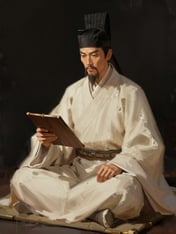 Shi YiParticipantTalk to me
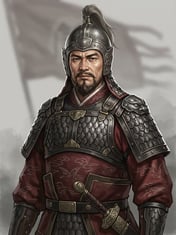 Cao XiuCommanderTalk to me
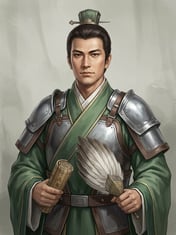 Lu XunCommanderTalk to me
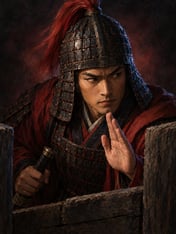 Zhu HuanWarriorTalk to me
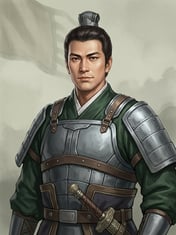 Quan CongWarriorTalk to me
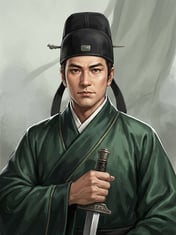 Zhou FangInstigatorTalk to me
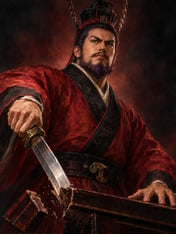 Sun QuanInstigatorTalk to me
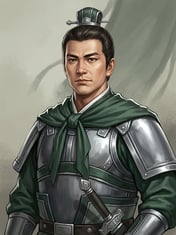 Jia KuiAdvisorTalk to me
Who won, as each book tells it; commanders as the text names them.
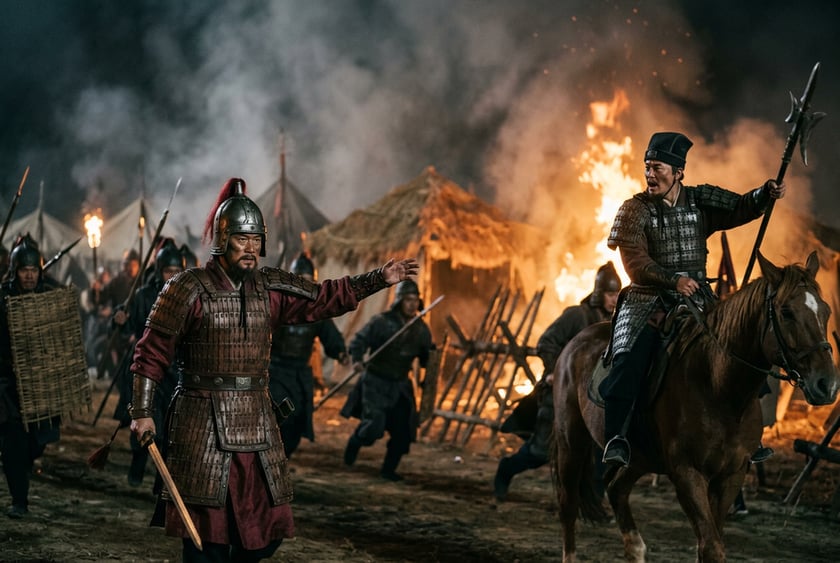
Scene
Under cover of night, the Wu armies led separately by Zhu Huan and Quan Cong set fire to the Wei camps behind Shiting Mountain. Flames soar into the sky, illuminating the chaotic battlefield.
Continue
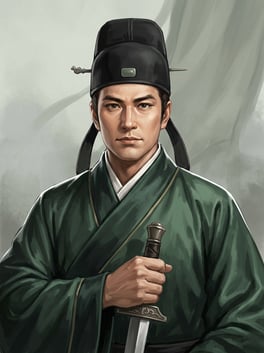
Zhou Fang was cunning in strategy and full of surprising devices, wielding authority and kindness alike. Skilled in ruses, he dared to stake his own person as part of the performance, once drawing his sword to feign cutting his own throat and shearing off his hair as an oath to win others' trust.
2303 people in common
2223 people in common
2423 people in common
2292 people in common
2302 people in common
2302 people in common
2222 people in common
2342 people in common
At the heart of the account of the Battle of Shiting is the advance eastward toward Eastern Wu by Cao Wei general Cao Xiu, and Eastern Wu’s use of Zhou Fang’s feigned surrender to lure him deeper into enemy territory, followed by a counterattack coordinated by Lu Xun. In terms of military logic, this was not simply a direct field engagement, but a contest shaped by the credibility of intelligence, routes of advance, and coordination among troops. Cao Xiu trusted the information Zhou Fang provided when he offered to surrender, while the Wu side sought to exploit that judgment and draw the Wei army into terrain where it could prepare an ambush. The available material places the fighting in the context of the confrontation between Wei and Wu, but does not provide enough evidence to reconstruct the sides’ overall strategic plans, troop strengths, or theater conditions. The tactical details in the Romance should therefore not be treated as established historical fact.
In the story, Zhou Fang’s feigned surrender serves to “change the enemy’s perception.” Cao Xiu is not put in danger merely by inferior numbers or a tactical mistake; more importantly, he treats an enemy envoy’s show of willingness to surrender as reliable intelligence and adjusts his actions accordingly. Jia Kui’s warning reminds him that cutting one’s hair as an oath does not prove that Zhou Fang has sincerely submitted. The risks of the campaign thus take shape before the army reaches Shiting: one side has information about the enemy’s movements and is preparing an ambush, while the other is divided in its assessment of the intelligence. It should be noted that the material provided is chiefly a literary account from Romance of the Three Kingdoms. This portrayal of the characters’ thinking and decisions can therefore be used to analyze how the novel constructs the campaign, but cannot by itself prove that every stage unfolded this way in the historical battle.
The Wu deployment in the Romance presents a plan built around coordination in layers. Lu Xun commands from the center, ordering Zhu Huan and Quan Cong to lead separate forces around the flanks of Shiting Mountain toward the rear of the Wei camp. Lu Xun’s main force advances from the front, with Xu Sheng serving as the vanguard. The plan is not to have all the units launch a frontal assault from the same direction, but to disrupt the camp with attacks from the flanks and rear, then intensify the confusion with pressure from the front. Both Zhu Huan’s and Quan Cong’s forces also encounter Wei ambushes, showing that the plan is not without risk. The Wu army must march at night, identify enemy movements, and keep its units coordinated; if either force is held up, the effectiveness of the pincer attack could be diminished.
On the Wei side, Cao Xiu first orders his troops to enter Shiting and set up camp. After the Wu army appears, he assigns Zhang Pu and Xue Qiao to positions in the north and south, while preparing to feign a retreat with a small force, lure the enemy in, and then give the signal to encircle them. This plan seeks to turn the terrain into an advantage for an ambush, showing that Cao Xiu is not without tactical forethought. The problem is that the plan depends on his assessment of the surrounding situation and the enemy’s likely response, while the rear of his camp is also threatened by Wu forces maneuvering around his flank. The novel also says that Jia Kui is left in camp and deprived of an active role in decision-making, creating a rift in Wei’s assessment and command. Although Shi Yi is listed among the participants, the passage provided does not explain his role or actions, so his deployment should not be supplemented with conjecture.
The first key decision is how Cao Xiu responds to Zhou Fang’s offer to surrender and Jia Kui’s objections. Jia Kui points out that Wu forces may still be in the area around Wan, and explicitly questions whether Zhou Fang’s oath, sworn by cutting his hair, is credible. Cao Xiu, however, interprets the warning as an attempt to claim credit and disrupt morale. At one point he even wants to execute Jia Kui; although he ultimately spares him, he keeps Jia Kui’s troops in camp. Through this conflict, the story highlights a classic danger in command decisions: personalizing doubts about intelligence and treating an adviser who raises objections as a rival can deprive a commander of a means to correct mistakes. Even if Cao Xiu did not accept Jia Kui’s judgment outright, carefully verifying Zhou Fang’s movements and adjusting the pace of the advance would have controlled the risk better than pressing ahead under the influence of emotion.
The second key decision concerns each side’s choice of ambush tactics and its response to developments. After confirming the presence of Wu troops ahead, Cao Xiu still tries to lure them in with a feigned retreat, having already positioned ambush forces in the north and south. Lu Xun, meanwhile, sends Zhu Huan and Quan Cong around to strike the rear camp, aiming to disrupt the Wei army’s positions and command structure. In the novel’s account, the Wu army discovers the Wei ambush forces one after another, confusion then breaks out in the camp, and Cao Xiu retreats along the Jiashi Road, while Jia Kui uses a feint to cover his escape. This shows that the course of a battle is not simply a matter of “the side that lays an ambush must win.” Reconnaissance, identifying friend from foe at night, coordination among units, and routes of retreat are equally important. The novel heightens the drama through a series of reversals, but the precise sequence of engagements and the outcome still need to be corroborated against other historical sources.
According to the Romance of the Three Kingdoms, the Wu army decisively defeated Cao Xiu at Shiting, and the Wei army abandoned its armor and suffered heavy losses. Cao Xiu escaped under Jia Kui’s protection, then fell ill from anxiety and died after developing a carbuncle on his back upon returning to Luoyang. The account also says that Sima Yi withdrew his troops out of concern that Shu might take advantage of the situation and attack. These details form a complete chain of victory and defeat in the novel, but the battle outcome provided by the user is marked “unknown,” and all the cited passages are from the Romance. The novel’s casualty figures, retreat, and account of Cao Xiu’s cause of death therefore cannot be treated as historical conclusions confirmed by the sources. A more cautious formulation is that, in the literary account, the Battle of Shiting is portrayed as a Wu victory in which feigned surrender and flanking maneuvers inflicted a major defeat on Wei; the available citations are insufficient to determine the exact outcome and details of the historical battle.
From a military perspective, the story’s legacy lies not only in victory or defeat, but also in how a command system handles unfavorable information. The narrative of Cao Xiu being deceived focuses on problems of intelligence vetting and flawed decision-making. Jia Kui raises a warning but fails to influence the course of action, and only later, during the retreat, does he play a role in the rescue as the novel portrays it. For the Wu army, Lu Xun’s deployment links luring the enemy, striking from the flank, and advancing from the front. Its success, however, also depends on conditions such as the enemy entering the prepared area and the forces on each route coordinating on time. Given the nature of the sources, these points are better discussed as lessons in warfare and characterization as presented in the Romance, rather than as unqualified conclusions about military history.
If Cao Xiu had heeded Jia Kui’s cautious advice, the likeliest change would not have been a guaranteed victory or defeat, but the extent to which the Wei army was exposed to ambush. He could have delayed his advance, first verified Zhou Fang’s identity and intelligence, sent out scouts to determine the Wu army’s position, and avoided concentrating his main force, supplies, and camp in a location not yet confirmed to be safe. This might have reduced the benefits of Wu’s feigned surrender and given Cao Xiu more options to withdraw or change his route. But the Wu army might still have chosen to engage, and hesitation could have cost Wei its opportunity to attack. Since the material does not specify the actual strength of either side, the condition of the roads, or the sources of intelligence, it cannot establish that caution would necessarily have changed the outcome.
Conversely, if one of Lu Xun’s forces maneuvering around the flank and rear had failed to arrive on time, or if the Wei army had seen through Zhou Fang’s plan and strengthened its camp defenses, the Wu pincer attack might have broken down into separate assaults, or even left the flanking force isolated. If Wei had kept Jia Kui involved in coordination and established reliable reconnaissance and communications, it might at least have reduced the command confusion caused by the surprise attack and improved the order of the retreat; this still would not guarantee a victory over Wu. Counterfactual analysis can clarify the key variables in the account—the credibility of intelligence, the ability to correct decisions, flank security, and routes of retreat—but cannot replace judgments based on historical sources. In particular, when the available citations are concentrated in the Romance of the Three Kingdoms and the battle’s outcome is marked unknown, conclusions should remain conditional, and literary events should not be extrapolated into certain historical fact.