Eastern Wu · Administrator of Poyang; Colonel Who Proclaims Righteousness
Zhou Fang
courtesy name 子鱼
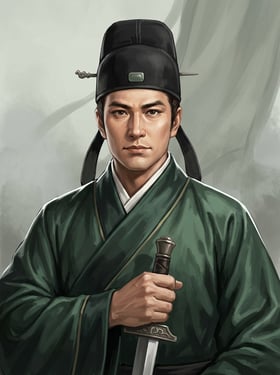
Zhou Fang was cunning in strategy and full of surprising devices, wielding authority and kindness alike. Skilled in ruses, he dared to stake his own person as part of the performance, once drawing his sword to feign cutting his own throat and shearing off his hair as an oath to win others' trust.

Appearances
In the novel: 1 chapter · In the Records: 4 volumes
List all 2 stops
- Wu CommanderyBirthplace
- Shiting228Zhou Fang's Feigned Surrender to Lure Cao Xiu+1 more
On the boards
Compare with someone →Where this person ranks on each board.
Who they were
Character profile
- Character
- Zhou Fang was cunning in strategy and full of surprising devices, wielding authority and kindness alike. Skilled in ruses, he dared to stake his own person as part of the performance, once drawing his sword to feign cutting his own throat and shearing off his hair as an oath to win others' trust.
- Manner of speech
- His manner of speech took the form of self-sworn oaths, as in, 'My loyal heart—only Heaven can bear witness to it.'
- Life
- Zhou Fang, styled Ziyu, was a native of Yangxian in Wu Commandery.
- Anecdotes
- He served as Grand Administrator of Shenyang and Grand Administrator of Poyang. In the seventh year of Huangwu, he feigned rebellion to lure the Wei general Cao Xiu, secretly plotting a false surrender; he drew Cao Xiu to Wan, and when the plan succeeded he was enfeoffed as Marquis Within the Passes.
Historical Record
Zhou Fang, courtesy name Ziyu, was from Yangxian, Wu Commandery. He was fond of learning in his youth and was recommended as a Filial and Incorrupt candidate. He successively served as Chief of Ningguo and an official in Huai'an. Peng Shi, a local leader in Qiantang, gathered followers and became a bandit. Zhou Fang took up the post of Marquis's Chancellor of Qiantang and, within a month, executed Peng Shi and his accomplices. He was then promoted to Commandant of the Western Part of Danyang. During the Huangwu era, Peng Qi, a local leader in Poyang, rebelled and seized subordinate cities. Zhou Fang served as Administrator of Poyang and joined forces with Hu Zong to suppress him. They captured Peng Qi alive and sent him to Wuchang, and Zhou Fang was additionally appointed Colonel Who Proclaims Righteousness.
Later, Sun Quan ordered him to devise a way to induce Cao Xiu, Grand Marshal of Wei and Governor of Yangzhou, to attack. Zhou Fang considered that the mountain chieftains would not easily be trusted and that the plan might be exposed. He proposed having someone close to him deliver the letters while he separately submitted a memorial to carry out the deception. He arranged for Dong Cen and Shao Nan to pretend to defect from Wu and send seven letters, claiming they intended to surrender to Wei. They described the situation within Wu and requested military support from Wei. To make Cao Xiu believe them, Zhou Fang also had Wu officials act on orders to question him about the matter, then sent in a confession of guilt. After Cao Xiu learned of this, his suspicions gradually subsided.
In the seventh year of Huangwu, Cao Xiu duly led 100,000 infantry and cavalry into the Wan region. Lu Xun commanded the army in a counterattack, while Zhou Fang gathered his forces and followed the army to cut off Cao Xiu's troops. Cao Xiu's army was routed and suffered heavy losses. After the battle, Sun Quan assembled the generals and praised Zhou Fang, saying, “By cutting off his hair and displaying his loyalty, he accomplished this great undertaking for me.” Zhou Fang was promoted to General of the Auxiliary Army and granted the title of Marquis within the Passes. Xu Zhong, in a comment cited by Pei Songzhi, criticized this, arguing that Zhou Fang, as a commandery administrator, had taken it upon himself to cut off his hair and deceive the enemy. Though he won merit and received a title, this was not something a gentleman would approve of. Later, when Dong Si went on a plundering raid, Zhou Fang again used spies and stratagems to lure and kill him, prompting his younger brother to surrender and easing the troubles facing the commanderies and counties concerned.
In the Novel
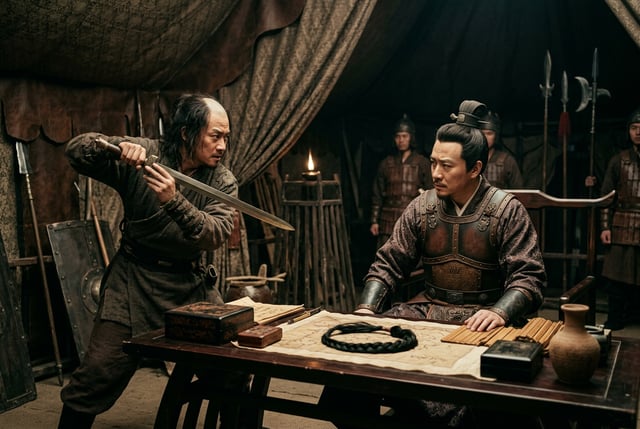
Chapter 96 of Romance of the Three Kingdoms portrays Zhou Fang as the key figure who takes the initiative to lure Cao Xiu deep into Wu territory with a letter of feigned surrender. It places the campaign within a multipronged deployment in the conflict between Wu and Wei: after hearing Cao Xiu's report, the Wei ruler listens as Sima Yi endorses the expedition, while Jia Kui warns that Zhou Fang is scheming and his intent to surrender is suspect. In the end, the various forces nonetheless advance separately toward Wancheng, Dongguan, and Jiangling. The novel further has Zhou Fang go in person to Cao Xiu's camp, weep before him, draw his sword as if to kill himself, and then cut off his hair and throw it to the ground, swearing words such as, “Only Heaven can bear witness to my loyalty,” to dispel Cao Xiu's suspicions. The Records of the Three Kingdoms records that Zhou Fang cut off his hair and submitted a confession of guilt to allay Cao Xiu's doubts, but does not mention him drawing his sword, attempting suicide, or cutting off his hair while making an oath in person. These specific actions and lines of dialogue are dramatic embellishments in the novel.
The novel also makes the plot more intricate by having Jia Kui see through the ruse of the cut hair, Cao Xiu angrily strip him of his command, and Zhou Fang seize the opportunity to send a secret report to Lu Xun. Cao Xiu then leads his army to Shiting, and Zhou Fang departs. The Wu army prepares an ambush and engages the enemy; after the battle, Zhou Fang returns with Lu Xun's army. Sun Quan sees that he has no hair, praises his service, and grants him the title of Marquis within the Passes. The historical account records Cao Xiu's entry into Wan, Zhou Fang's joining Lu Xun's forces to cut him off, and the honors bestowed after the battle. The hair-cutting scene in the novel, Jia Kui being overruled, and the specific depiction of the troop movements are literary inventions.
Key Relationships
- Sun Quan: Acting on Sun Quan's orders, Zhou Fang devised the plan to lure Cao Xiu. After its success, he was made General of the Auxiliary Army and Marquis within the Passes. In the novel, Sun Quan also personally welcomes the victorious generals and comforts Zhou Fang.
- Cao Xiu: The target of Zhou Fang's feigned surrender. Believing that Zhou Fang had come over to his side, Cao Xiu led his army into Wan and was ultimately defeated by Lu Xun and the others. The novel, in contrast, emphasizes how he was deceived by Zhou Fang's oath while cutting off his hair. (The specific oath and hair-cutting scene appears only in the novel.)
- Lu Xun: The Wu commander at the Battle of Shiting. Zhou Fang lured the enemy with his stratagem, then gathered his forces and followed Lu Xun to cut off Cao Xiu's army. The novel depicts Lu Xun receiving Zhou Fang's secret report and then arranging an ambush.
- Dong Cen and Shao Nan: Trusted associates of Zhou Fang. Acting on his orders, they carried letters and pretended to defect, serving as messengers in the plot to lure Cao Xiu.
- Peng Shi and Peng Qi: Local leaders whom Zhou Fang suppressed early in his career and during his tenure as Administrator of Poyang, respectively. One was executed and the other captured.
Signature Scenes
- Seven Secret Letters to Lure the Enemy: In his letters, Zhou Fang sought to win Cao Xiu's trust with claims that he longed to return, had incurred punishment, and feared disaster. He also described Wu's forces and circumstances, and asked Wei to send aid promptly. At the same time, he submitted a memorial to Sun Quan, explaining that it would be better for him to lure Cao Xiu directly through a deception.
- Cutting His Hair to Allay Suspicion: Following the plan, Zhou Fang cut off his hair beneath the commandery gate and submitted a confession of guilt, so that Cao Xiu would hear of it and cease to suspect him. This is a key episode in the historical account. The novel recasts it as a forceful dramatic scene in which Zhou Fang holds a sword in camp as if to kill himself and cuts off his hair to demonstrate his resolve. (The oath while cutting off his hair appears only in the novel.)
- Victory at Shiting and Reward: After Cao Xiu entered Wan, Lu Xun commanded the army in a counterattack, while Zhou Fang gathered his forces and followed the army to cut off Cao Xiu's troops. Wu emerged victorious, and Sun Quan subsequently rewarded Zhou Fang for his service.
Quotes
11 lines in the books · 3 featured
「吾以忠心待公,公以吾為戲,吾割父母所遺之髮,以表此心。」
This line shows the ruthlessness and resolve of Zhou Fang, who mutilated himself to win Cao Xiu's trust and prove his loyalty.
「曹休若用賈逵之言,則東吳敗矣!今天使我成功也!」
This line is the key to the success of Zhou Fang's feigned-surrender scheme, embodying his surpassing cunning.
魴以千載饒幸,得備州民,遠隔江川,敬恪未顯,瞻望雲景,天實為之。精誠微薄,名位不昭,雖懷焦渴,曷緣見明?狐死首丘,人情戀本,而逼所制,奉覿禮違。每獨矯首西顧,未嘗不寤寐勞歎,展轉反側也。今因隙穴之際,得陳宿昔之志,非神啟之,豈能致此!不勝翹企,萬里托命。謹遣親人董岑、邵南等托叛奉箋。時事變故,列於別紙,惟明公君侯垂日月之光,照遠民之趣,永令歸命者有所戴賴。
This is Zhou Fang's first letter feigning surrender to Cao Xiu, the beginning of his scheme, and it carries important historical significance.
- Family
- Lord & vassal
- Enemies
- Other
Who is Zhou Fang connected to?
Pick someone to see how many steps lie between them and Zhou Fang.
History vs. novel
7 points · 2 novel-only
| History | Novel |
|---|---|
| Pacifying Peng ShiHistory only | |
After Zhou Fang became the magistrate of Qiantang, he needed only a little over a month to execute Peng Shi and his followers. For this achievement, he was promoted to Commandant of the Western Division of Danyang. vol. 60 | — |
| Capturing Peng Qi AliveHistory only | |
During the Huangwu era, Peng Qi rebelled. After Zhou Fang became Administrator of Poyang, he joined forces with Hu Zong to put down the revolt, captured Peng Qi alive, and sent him to Wuchang. Zhou Fang was additionally appointed Colonel Who Proclaims Righteousness. vol. 60 | — |
| Seven Letters and a Feigned SurrenderNovel embellishes | |
Zhou Fang said he had sent a trusted aide carrying seven letters to deceive Cao Xiu. The letters set out his reasons for surrendering, the deployment of Wu forces, and a request for Wei forces to advance, among other matters. vol. 60 | The novel says Cao Xiu submitted a memorial claiming that Zhou Fang was willing to surrender the commandery and had secretly sent details of seven matters. After Emperor Ming of Wei consulted with Sima Yi, he dispatched Sima Yi, Jia Kui, and others to assist Cao Xiu. ch. 96 |
| Cutting His Hair and Threatening SuicideNovel only | |
| — | When Cao Xiu questioned Zhou Fang, Zhou Fang wept, drew his sword, and tried to kill himself. He then cut off his hair and threw it to the ground as proof of his loyalty, and Cao Xiu was utterly convinced. ch. 96 |
| Jia Kui Sees Through the RuseNovel only | |
| — | Jia Kui pointed out that Zhou Fang was exceptionally shrewd and urged Cao Xiu not to trust him lightly. He also warned that the hair-cutting was a trick, but Cao Xiu rebuked him, and Jia Kui was left behind in camp without command of the troops. ch. 96 |
| Wei Forces Enter WanNovel embellishes | |
Cao Xiu indeed believed Zhou Fang and led 100,000 infantry and cavalry, with supply wagons filling the roads, into Wan. vol. 60 | After Cao Xiu's forces reached Wan, Zhou Fang welcomed them and guided the Wei army onward. Cao Xiu followed his arrangements, leading his main force and supply wagons to camp at Shiting. ch. 96 |
| Defeating Cao Xiu at ShitingNovel embellishes | |
Zhou Fang assembled his forces and joined Lu Xun in cutting off Cao Xiu. Cao Xiu's army collapsed, and Wu forces took tens of thousands of casualties and prisoners. vol. 60 | The novel says that after Zhou Fang led Cao Xiu to Shiting, he slipped away, while Wu forces had already secured the mountain pass. Cao Xiu realized he had been tricked and then ordered his officers to position ambush troops for battle. ch. 96 |
- Pacifying Peng ShiHistory only
- History
After Zhou Fang became the magistrate of Qiantang, he needed only a little over a month to execute Peng Shi and his followers. For this achievement, he was promoted to Commandant of the Western Division of Danyang.
vol. 60
- Capturing Peng Qi AliveHistory only
- History
During the Huangwu era, Peng Qi rebelled. After Zhou Fang became Administrator of Poyang, he joined forces with Hu Zong to put down the revolt, captured Peng Qi alive, and sent him to Wuchang. Zhou Fang was additionally appointed Colonel Who Proclaims Righteousness.
vol. 60
- Seven Letters and a Feigned SurrenderNovel embellishes
- History
Zhou Fang said he had sent a trusted aide carrying seven letters to deceive Cao Xiu. The letters set out his reasons for surrendering, the deployment of Wu forces, and a request for Wei forces to advance, among other matters.
vol. 60
- Novel
The novel says Cao Xiu submitted a memorial claiming that Zhou Fang was willing to surrender the commandery and had secretly sent details of seven matters. After Emperor Ming of Wei consulted with Sima Yi, he dispatched Sima Yi, Jia Kui, and others to assist Cao Xiu.
ch. 96
- Cutting His Hair and Threatening SuicideNovel only
- Novel
When Cao Xiu questioned Zhou Fang, Zhou Fang wept, drew his sword, and tried to kill himself. He then cut off his hair and threw it to the ground as proof of his loyalty, and Cao Xiu was utterly convinced.
ch. 96
- Jia Kui Sees Through the RuseNovel only
- Novel
Jia Kui pointed out that Zhou Fang was exceptionally shrewd and urged Cao Xiu not to trust him lightly. He also warned that the hair-cutting was a trick, but Cao Xiu rebuked him, and Jia Kui was left behind in camp without command of the troops.
ch. 96
- Wei Forces Enter WanNovel embellishes
- History
Cao Xiu indeed believed Zhou Fang and led 100,000 infantry and cavalry, with supply wagons filling the roads, into Wan.
vol. 60
- Novel
After Cao Xiu's forces reached Wan, Zhou Fang welcomed them and guided the Wei army onward. Cao Xiu followed his arrangements, leading his main force and supply wagons to camp at Shiting.
ch. 96
- Defeating Cao Xiu at ShitingNovel embellishes
- History
Zhou Fang assembled his forces and joined Lu Xun in cutting off Cao Xiu. Cao Xiu's army collapsed, and Wu forces took tens of thousands of casualties and prisoners.
vol. 60
- Novel
The novel says that after Zhou Fang led Cao Xiu to Shiting, he slipped away, while Wu forces had already secured the mountain pass. Cao Xiu realized he had been tricked and then ordered his officers to position ambush troops for battle.
ch. 96
Combat
On the field
Duels, kills and executions as the texts tell them, counted separately for the Records and the Romance.
Stratagems
Plans this person devised or saw through, as the texts tell them.
- Records
- 2 carried out · 2 worked · 0 turned down · 0 seen through
- Romance
- 1 carried out · 1 worked · 0 turned down · 0 seen through
- RecordsFeign SurrenderFalse surrenderWorkedagainst WeiJuan 47「鄱陽太守周魴偽叛,誘魏將曹休」
- RecordsUse a Spy to Lure and KillDeceptionWorkedagainst banditsJuan 60「魴遣間諜,授以方策,誘狙殺嗣」
- RomanceFeign SurrenderFalse surrenderWorkedagainst Wei troopsCh. 96「今魴詐施詭計,暗陳七事,引誘魏兵深入重地」
Events
Events (2)
Battles and events the texts place this person in, by date.
Battles
- 228Battle of ShitingInstigator
Other events
- 228Zhou Fang's Feigned Surrender to Lure Cao XiuInstigator
Places
- Native of
- Wu CommanderyRecords
- Was at
- DanyangRecords
Continue
Zhou Fang's Feigned Surrender to Lure Cao Xiu
Relationship timeline2 entries ▸
Inner monologues · AI-generated3 monologues ▸
- The matter was settled. Looking back on this secret stratagem, what I remember most is not the moment I was rewarded, bu
- At this moment, the northern army had reached Wan, yet Cao Xiu still doubted what I had set out in my letter. Those seve
- I, styled Ziyu, was from Yangxian, Wu Commandery. I recall that in my youth I devoted myself to learning. Later, I was r