Yuan Shao's Faction · Advisor
Chen Lin
courtesy name 孔璋 · –217
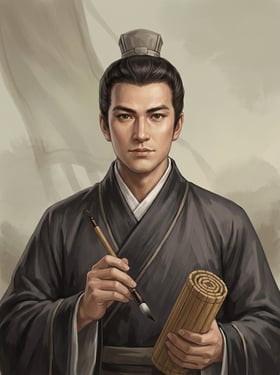
Long renowned for his talent, he once served as records officer for Yuan Shao, and later submitted to Cao Cao and was pardoned. He once sought surrender to the Grand Progenitor together with Yin Kui, and also once rescued Cui Yan. Chen Lin was one of the Seven Masters of the Jian'an era, praised as a man of talent from his home region.

Life
In the novel: 5 chapters · In the Records: 6 volumes
Life?–217
195 CE (Xingping 2)
204 CE (Jian'an 9)
- Battle of YeYeWitness
210 CE (Jian'an 15)
217 CE (Jian'an 22)
- Great Epidemic of the 22nd Year of Jian'anYeKilled in action
Allegiance
- Yuan Shao's Faction
- Cao Wei
- Hatched: dated by chapter
- Life event
- Death
List all 3 stops
- GuanglingBirthplace
- Dongwuyang195Yuan Shao Besieges and Kills Zang Hong
- Ye204–217Battle of Ye+2 more
On the boards
Compare with someone →Where this person ranks on each board.
Who they were
Character profile
- Character
- Long renowned for his talent, he once served as records officer for Yuan Shao, and later submitted to Cao Cao and was pardoned. He once sought surrender to the Grand Progenitor together with Yin Kui, and also once rescued Cui Yan. Chen Lin was one of the Seven Masters of the Jian'an era, praised as a man of talent from his home region.
- Manner of speech
- His memorials and proclamations were exceptionally vigorous, though somewhat over-ornate. His prose ran in parallel and expansive array, drawing on the ancient to prove the present, denouncing crimes to justify a punitive campaign, in pieces of great length.
- Life
- Chen Lin, styled Kongzhang, was a man of Guangling. He first served as recorder to He Jin, and remonstrated with He Jin against summoning outside troops into the capital and against entering the palace at the Empress Dowager's summons, but neither counsel was heeded. Later he took refuge in Jizhou, where Yuan Shao employed him as records officer; he composed for Yuan Shao a proclamation reviling Cao Cao's father and forebears. After the fall of the Yuan clan he submitted to Cao Cao and was pardoned, and together with Ruan Yu served as libationer of military planning to the Excellency of Works, managing the records office. He died in the twenty-second year of Jian'an.
- Anecdotes
- He once remonstrated with He Jin against summoning outside troops into the capital, pointing out that 'to hold the spear reversed and hand others the hilt—the enterprise is bound to fail, and turmoil will arise instead.' He also remonstrated with He Jin against entering the palace at the Empress Dowager's summons, saying, 'This edict of the Empress Dowager must be the scheme of the Ten Attendants; you must not go. If you go, disaster will surely follow.'
Historical Record
Chen Lin, courtesy name Kongzhang, was from Guangling and was renowned for his writing. He was one of the Seven Scholars of Jian’an. Cao Pi judged his memorials and formal documents to be “especially vigorous, though somewhat verbose and elaborate,” while the Dianlun also praised the memorials, formal documents, and letters of Chen Lin and Ruan Yu as the work of outstanding talents of their time. Early in his career, he served as He Jin’s chief clerk. When He Jin plotted to eliminate the eunuchs, the Empress Dowager refused to agree, so he planned to summon troops from across the empire to the capital and force her hand. Using the analogies of “hunting a deer without a guide” and “covering one’s eyes to catch a sparrow,” Chen Lin pointed out that He Jin already held military authority and could have acted decisively, but instead was summoning outside forces—“holding the halberd upside down and handing someone else the handle”—which risked bringing disaster. He Jin did not heed him and later met his downfall as a result.
After Dong Zhuo's Coup, Chen Lin fled to Jizhou, where Yuan Shao appointed him to oversee literary affairs. He drafted a proclamation for Yuan Shao denouncing Cao Cao, whose language extended to Cao Cao’s father and ancestors. After the Yuan clan’s defeat, when Cao Cao attacked Ye, Chen Lin and Yin Kui jointly requested to surrender, but Cao Cao refused their request. After Cao Cao pacified Ye, Chen Lin submitted to him. Cao Cao reproached him, asking why he had not confined himself to denouncing Cao Cao but had also insulted his father and ancestors. Chen Lin apologized, and Cao Cao, valuing his talent, did not pursue the matter. Thereafter, Chen Lin and Ruan Yu both served as Masters of Military Strategy in the Secretariat of the Minister of Works, overseeing the Secretariat’s records. In the twenty-second year of Jian’an, Chen Lin died during an epidemic.
In the Novel
Romance of the Three Kingdoms portrays Chen Lin as a clear-headed scholar who repeatedly speaks out with frank counsel. In Chapter Two, he opposes He Jin’s summoning outside forces to the capital and urges him to use the power already in his hands to deal with the eunuchs swiftly. He Jin dismisses this as “the view of a coward,” while Cao Cao remarks that the matter would be as easy as turning over one’s hand. In Chapter Three, Chen Lin sees through the possibility that the Empress Dowager’s summons for He Jin to enter the palace is a trap set by the Ten Attendants. He urges He Jin not to answer the summons, but is again ignored, and He Jin is ultimately killed in the palace. These two scenes reinforce his image as someone who reads the political situation astutely and dares to offer unwelcome advice. The specific dialogue and dramatic staging are inventions of the novel; the Records of the Three Kingdoms merely records that he once admonished He Jin, not that he later tried to dissuade him from entering the palace.
The novel also depicts him drafting the proclamation against Cao Cao at Yuan Shao’s command in a single stroke, highlighting his quick wit. After Yuan Shao’s defeat, Cao Cao challenges him to his face over the proclamation’s insults against his father and ancestors. Chen Lin replies, “The arrow was on the string; it had to be released.” Cao Cao, appreciating his talent, pardons him and appoints him as an officer. This reply and the scene of his pardon are specific embellishments in the novel; the Records of the Three Kingdoms says that Chen Lin apologized and that Cao Cao, valuing his talent, did not take action against him, but does not include this line.
Key Relationships
Chen Lin’s relationship with He Jin began with his position as chief clerk and his giving counsel: he opposed using outside troops to coerce the Empress Dowager, but his advice went unheeded. With Yuan Shao, he was a staff official serving his lord. After fleeing to Jizhou, he was appointed to oversee literary affairs and drafted a proclamation on behalf of the Yuan clan denouncing Cao Cao. Yuan Shao also once ordered him to write to Zang Hong, urging him to surrender, but Zang Hong refused.
After transferring his allegiance to Cao Cao, Chen Lin joined the Cao clan’s civil-service staff, serving alongside Ruan Yu as a Master of Military Strategy and overseeing the Secretariat’s records. Although Cao Cao once reproached him over the proclamation, he ultimately forgave him. In later generations, Cao Pi also judged his writing to be “especially vigorous, though somewhat verbose and elaborate,” showing that Chen Lin remained renowned for his literary talent within the Cao camp.
Signature Scenes
The clearest illustration of Chen Lin’s political judgment is his urging He Jin not to summon outside forces. He pointed out that He Jin already possessed sufficient authority to act, and that seeking help from afar would instead hand military power to outsiders. The historical account records both this counsel and He Jin’s refusal to heed it, which led to his downfall. The novel expands the warning into two successive interventions: first urging He Jin not to summon troops, then urging him not to enter the palace. Chen Lin thus becomes a remonstrating official who sees the chaos coming but cannot change its course.
Another signature scene centers on Yuan Shao’s proclamation and Chen Lin’s submission to Cao Cao. The historical account says that when Ye was under siege, Chen Lin and Yin Kui sought to surrender but were refused; he submitted to Cao Cao only after the Yuan clan’s defeat. Cao Cao took him to task for insulting his father and ancestors in the proclamation, and Chen Lin apologized and was forgiven. The novel, by contrast, uses “The arrow was on the string; it had to be released” to turn the episode into a dramatic scene of a talented man responding under pressure and Cao Cao sparing him out of appreciation for his ability. (Unique to the novel)
Quotes
3 lines in the books · 2 featured
「不可!俗云:『掩目而捕燕雀』,是自欺也。微物尚不可欺以得志,況國家大事乎?今將軍仗皇威,掌兵要,龍驤虎步,高下在心:若欲誅宦官,如鼓洪爐燎毛髮耳。但當速發,行權立斷,則天人順之﹔卻反外檄大臣,臨犯京闕,英雄聚會,各懷一心:所謂倒持干戈,授人以柄,功必不成,反生亂矣。」
This line warns that He Jin was inviting a wolf into the house; its keen reading of the moment gives it great historical significance.
「箭在弦上,不得不發耳。」
'The arrow is on the bowstring and must be loosed' has become a common saying, giving it high cultural recognition.
- Lord & vassal
- Friends
- Other
Who is Chen Lin connected to?
Pick someone to see how many steps lie between them and Chen Lin.
History vs. novel
7 points · 2 novel-only
| History | Novel |
|---|---|
| He Jin Summoned Outside Troops Despite AdviceNovel embellishes | |
Chen Lin urged He Jin not to summon outside troops, warning that doing so would be like “holding a halberd by its blade” and would surely bring disaster. He Jin did not heed him and ultimately brought ruin upon himself. vol. 21 | The novel retains Chen Lin’s opposition to summoning outside troops, and adds a scene in which He Jin dismisses his advice as “the view of a coward” while Cao Cao laughs beside them, making the admonition more dramatic. ch. 2 |
| Urging He Jin Not to Enter the PalaceNovel only | |
| — | When the Empress Dowager summoned He Jin to the palace, Chen Lin recognized the decree as a plot by the Ten Attendants and warned that disaster awaited him there. He Jin ignored him and was killed after entering the palace. ch. 3 |
| Urging Zang Hong to SurrenderHistory only | |
After besieging Zang Hong for years, Yuan Shao ordered Chen Lin to write a letter urging him to surrender, appealing to both the consequences of fortune and misfortune and their bonds of duty. vol. 7 | — |
| Rescuing Cui Yan from PrisonHistory only | |
After Yuan Shao’s death, his sons vied to recruit Cui Yan. Cui Yan pleaded illness and declined, for which he was imprisoned. Chen Lin and Yin Kui intervened to save him, and he was released. vol. 12 | — |
| Proclamation Against Cao CaoNovel embellishes | |
Chen Lin once managed Yuan Shao’s literary affairs. After the Yuan clan was defeated, he submitted to Cao Cao. Cao Cao brought up the proclamation and reproached him for insulting his father and ancestors. Chen Lin apologized, and Cao Cao, valuing his talent, let the matter pass. vol. 21 | Before the Battle of Guandu, Yuan Shao ordered Chen Lin to draft a proclamation against Cao Cao. The novel depicts him composing it at once and recounts in detail its denunciation of Cao Cao. ch. 22 |
| Pardoned After the ProclamationNovel embellishes | |
Cao Cao questioned Chen Lin about why he had insulted his father and ancestors in the proclamation. After Chen Lin apologized, Cao Cao spared him punishment because he valued his talent. vol. 21 | After Chen Lin was captured, he answered Cao Cao with the words “the arrow was already on the bowstring.” Though Cao Cao’s subordinates urged him to execute Chen Lin, Cao Cao pardoned him and appointed him as an aide. ch. 32 |
| Presenting PoemsNovel only | |
| — | After Cao Cao was made Duke of Wei, Chen Lin, along with the civil officials Wang Lang, Zhong Yao, Wang Can, and others, presented poems praising Cao Cao’s achievements and virtue. Cao Cao laughed and said they had praised him too highly. ch. 56 |
- He Jin Summoned Outside Troops Despite AdviceNovel embellishes
- History
Chen Lin urged He Jin not to summon outside troops, warning that doing so would be like “holding a halberd by its blade” and would surely bring disaster. He Jin did not heed him and ultimately brought ruin upon himself.
vol. 21
- Novel
The novel retains Chen Lin’s opposition to summoning outside troops, and adds a scene in which He Jin dismisses his advice as “the view of a coward” while Cao Cao laughs beside them, making the admonition more dramatic.
ch. 2
- Urging He Jin Not to Enter the PalaceNovel only
- Novel
When the Empress Dowager summoned He Jin to the palace, Chen Lin recognized the decree as a plot by the Ten Attendants and warned that disaster awaited him there. He Jin ignored him and was killed after entering the palace.
ch. 3
- Urging Zang Hong to SurrenderHistory only
- History
After besieging Zang Hong for years, Yuan Shao ordered Chen Lin to write a letter urging him to surrender, appealing to both the consequences of fortune and misfortune and their bonds of duty.
vol. 7
- Rescuing Cui Yan from PrisonHistory only
- History
After Yuan Shao’s death, his sons vied to recruit Cui Yan. Cui Yan pleaded illness and declined, for which he was imprisoned. Chen Lin and Yin Kui intervened to save him, and he was released.
vol. 12
- Proclamation Against Cao CaoNovel embellishes
- History
Chen Lin once managed Yuan Shao’s literary affairs. After the Yuan clan was defeated, he submitted to Cao Cao. Cao Cao brought up the proclamation and reproached him for insulting his father and ancestors. Chen Lin apologized, and Cao Cao, valuing his talent, let the matter pass.
vol. 21
- Novel
Before the Battle of Guandu, Yuan Shao ordered Chen Lin to draft a proclamation against Cao Cao. The novel depicts him composing it at once and recounts in detail its denunciation of Cao Cao.
ch. 22
- Pardoned After the ProclamationNovel embellishes
- History
Cao Cao questioned Chen Lin about why he had insulted his father and ancestors in the proclamation. After Chen Lin apologized, Cao Cao spared him punishment because he valued his talent.
vol. 21
- Novel
After Chen Lin was captured, he answered Cao Cao with the words “the arrow was already on the bowstring.” Though Cao Cao’s subordinates urged him to execute Chen Lin, Cao Cao pardoned him and appointed him as an aide.
ch. 32
Events
Events (6)
Battles and events the texts place this person in, by date.
Battles
- 200Battle of Guandu
- 204Battle of YeWitness
Other events
- 189Dong Zhuo's Coup
- 195Yuan Shao Besieges and Kills Zang HongAdvisor
- 210Bronze Bird Terrace Inauguration CeremonyWitness
- 217Great Epidemic of the 22nd Year of Jian'anKilled in action
Famous objects

Places
- Native of
- GuanglingRecords
Continue
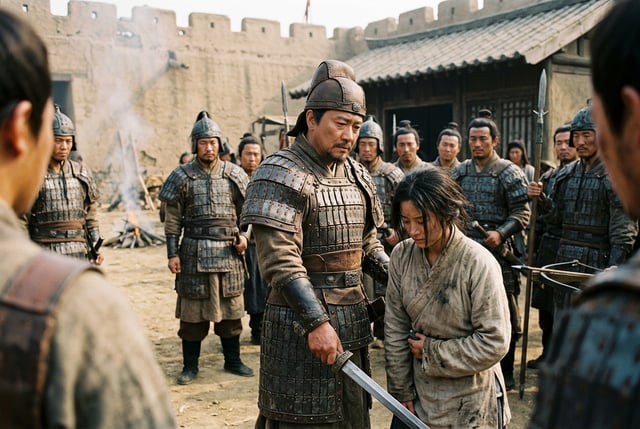
Yuan Shao Besieges and Kills Zang Hong
Relationship timeline7 entries ▸
History · vol. 7
- Yuan Shao§32
Advised
Yuan Shao ordered Chen Lin to write to Zang Hong, explaining the consequences of disaster and fortune
History · vol. 12
- Cui Yan§4
Witnessed
Rescued Cui Yan with Yin Kui, securing his release
History · vol. 21
- He Jin§14
Advised
Previously served as He Jin’s chief clerk; remonstrated that he should not summon generals from outside to threaten the Empress Dowager
Novel · ch. 2
- He Jin§20
Advised
urged not summoning outside troops into the capital ("holding the weapon by the blade and handing someone its hilt")
Novel · ch. 3
- He Jin§6
Advised
urged not entering the palace—"This edict from the empress dowager must be a scheme of the Ten Attendants"
Novel · ch. 22
- He Jin§6
Advised
during Emperor Ling's reign, Chen Lin served as a chief clerk and remonstrated with He Jin, who did not listen
Novel · ch. 32
- Yuan Shao§39
Lord
Had once written a proclamation for Benchu; was now captured and brought before Cao Cao to debate
Inner monologues · AI-generated1 monologue ▸
- I am Chen Lin, courtesy name Kongzhang. I recall serving as a registrar in He Jin’s residence. I saw that he wanted to e