Records
Cao forces won
- Commanders
- Cao forcesZhang Liao
- 陳蘭、梅成Chen Lan
Vol. 17「攻之,斬蘭成首,盡虜其衆」
209 CE (Jian'an 14) · Mount Tianzhu
In 209, the fourteenth year of Jian’an, the Lujiang mountain bandits Chen Lan and Mei Cheng led the remnants of Yuan Shu’s former forces in rebellion, occupying Mount Tianzhu (in present-day Qianshan, Anhui) and raiding counties throughout Huainan. Cao Cao ordered Zhang Liao to command the campaign, leading forces under Yu Jin, Zhang He, Zang Ba, and others to suppress them. Mei Cheng first feigned surrender to Yu Jin, allowing him to withdraw to the mountains and join Chen Lan. Seeing through the ruse, Zhang Liao abandoned his baggage and advanced swiftly into the mountain passes. He ambushed them at the foot of Mount Tianzhu, beheaded Chen Lan and Mei Cheng, and captured their troops. The campaign eliminated the last of Yuan Shu’s former forces that had long been causing unrest in the Lujiang mountains, consolidating Cao Cao’s rear along the Jiang-Huai line. This event has no related citations; its background information comes from the “Biography of Zhang Liao” in the Records of the Three Kingdoms.
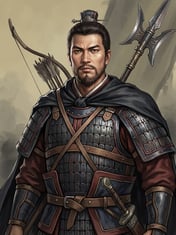 Zhang LiaoCommanderTalk to me
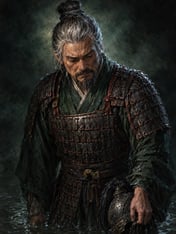 Yu JinWarriorTalk to me
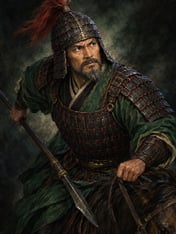 Zhang HeWarriorTalk to me
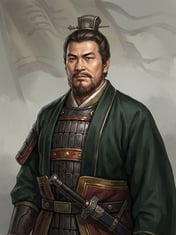 Zang BaWarriorTalk to me
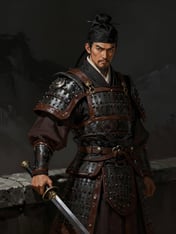 Chen LanKilled in actionTalk to me
Who won, as each book tells it; commanders as the text names them.
Records
Cao forces won
Vol. 17「攻之,斬蘭成首,盡虜其衆」
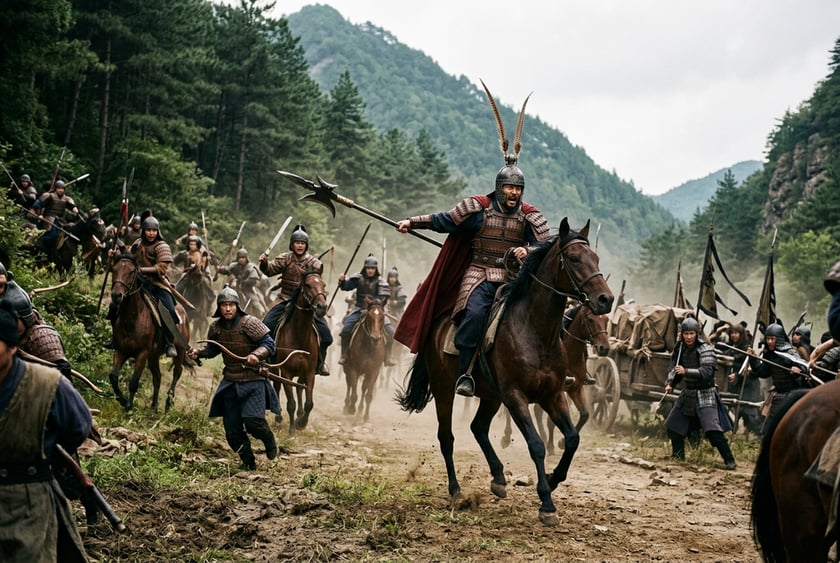
Scene
Zhang Liao leads a lightly equipped force in an ambush beneath Mount Tianzhu. Hidden troops burst from the woods and launch a surprise attack on the forces of Chen Lan and Mei Cheng.
Featured people: Zhang Liao
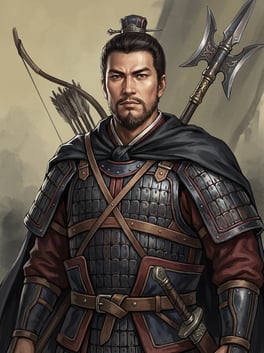
Continue
Zhang Liao's martial prowess surpassed others; he threw himself into battle with valor, stayed composed amid crisis, served his lord with loyalty and diligence, and understood the bond of ruler and minister. He once faced death without fear, stretching out his neck to await execution, and to Cao Cao's face cursed him as a 'traitor to the state.'
2013 people in common
1942 people in common
2101 person in common
2081 person in common
2081 person in common
2071 person in common
2071 person in common
2141 person in common
After the Battle of Chibi in the thirteenth year of Jian'an (208) and Cao Cao's withdrawal to the north, the Jianghuai front entered a protracted stalemate that lasted several years. Although Sunwu's main forces did not mount a large-scale northward offensive, the mountain districts of Jianghuai remained a grey zone under ambiguous Caowei control. On one hand, the former followers of Yuan Shu who had scattered after his death had never been fully reorganized; on the other, the rugged terrain of Lujiang and Jiujiang was naturally suited to mountain bandits holding out. The forces commanded by Chen Lan and Mei Cheng were precisely this kind of army — a core of Yuan Shu remnants mixed with local strongmen. They entrenched themselves at Tianzhushan, plundering the counties of Lujiang, causing large numbers of civilians to flee northward and making it impossible to sustain the military agricultural colonies. Strategically, so long as this grey zone remained unresolved, Cao Cao could not use the north bank of the Yangzi as a genuine forward frontier against Sunwu.
Cao Cao's choice of Zhang Liao as commander was a deliberately targeted personnel decision. Zhang Liao was from Bingzhou and had long participated in northern mountain and steppe warfare; he excelled at small-unit mobile combat in adverse terrain. Following the Battle of Chibi he had already been posted to the Hefei sector and was already responsible for Jianghuai defense. Cao Cao paired him with Yu Jin, Zhang He, and Zang Ba operating in coordination on three axes: Yu Jin handled frontal pressure and accepting surrenders; Zhang He specialized in infantry maneuver in mountain terrain; Zang Ba could deploy the local forces from the Taishan–Qingxu region to suppress the bandits' lateral communications. Chen Lan and Mei Cheng, for their part, adopted classic bandit tactics — concealing their main strength in the deep valleys of Tianzhushan while sending Mei Cheng out to feign surrender and lull the Wei forces into complacency, then withdrawing back into the mountains to rejoin Chen Lan, hoping to drag the Wei forces into an attritional mountain campaign.
The decisive decision in this engagement fell to Zhang Liao. After Mei Cheng's false surrender and retreat to Tianzhushan, most commanders favored a cautious approach — a methodical encirclement from the perimeter, slowly tightening the cordon. Zhang Liao assessed that mountain bandits feared above all else having their supply lines to the outside cut; what they did not fear was a large, slow-moving regular army. He decided to abandon his supply train and push only a picked light-infantry force directly up the mountain roads, turning what the enemy intended as an advantageous stronghold into a situation where they were locked inside that stronghold with no way out. This choice demanded considerable boldness from a frontline commander, since any miscalculation would leave the entire penetrating column exposed to annihilation in the narrows. Zhang Liao dared to do it because he had complete confidence in Zhang He and Zang Ba's ability to cover his rear — as long as the outer ring held his line of retreat, he was certain he could drive Chen Lan out of the mountains.
Zhang Liao completed the encirclement at the foot of Tianzhushan, killing Chen Lan and Mei Cheng while the rest of their forces were either captured or dispersed. This was a critical milestone in Zhang Liao's military career before his later fame at Hefei — it proved that he could not only hold a city (as in the later Battle of Hefei) but also conduct mountain encirclement warfare. Looking at the strategic chain, Tianzhushan cleared the last anti-Cao armed force in the Jianghuai heartland that could have been exploited by Sunwu, enabling Caowei to push more troops forward to the Hefei–Shouchun line. When Sun Quan threw everything into attacking Hefei in the twentieth year of Jian'an (215), the very possibility of Zhang Liao's miracle — routing an army of a hundred thousand with eight hundred men — was directly connected to his long experience pacifying the mountains of Jianghuai.
Had Chen Lan and Mei Cheng not been suppressed and continued to hold Tianzhushan, they would inevitably have become a natural internal collaborator for Sunwu's northward thrusts — Sun Quan could well have dispatched troops before the Hefei campaign to bypass the main front and link up with the Tianzhushan forces, forming a pincer offensive northward along the Yangzi–Chaohu–Lujiang axis. Under those circumstances, Zhang Liao's defense of Hefei would have been far more difficult and Caowei's entire defensive line north of the Yangzi would have been far more vulnerable. Put differently, Tianzhushan may have been an unobtrusive mountain pacification campaign, but it defused a potential bomb before it reached maximum destructive force — it was the essential prelude to Caowei stabilizing the Jianghuai defense.
No citations relevant to this event are available; the analysis draws on the account in San Guozhi, Zhang Liao's biography, and general background knowledge of the Jianghuai region, which is why no [c:N] markers appear in the body.