Liu Bei's faction · Assistant to the Army Supervisor
Fei Shi
courtesy name 公举
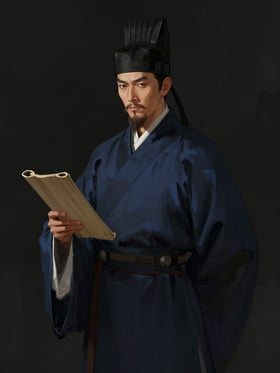
Fei Shi urged Guan Yu to accept office and Liu Bei not to claim an imperial title; the novel recasts this as the Five Tigers receiving seals.
Appearances
In the novel: 3 chapters · In the Records: 1 volume
- Liu Bei's faction· Undated
- Liu Zhang's faction· Undated
On the boards
Compare with someone →Where this person ranks on each board.
Historical Record
Fei Shi, courtesy name Gongju, was from Nan’an in Qianwei. Under Liu Zhang, he served as magistrate of Mianzhu. When Liu Bei attacked Mianzhu, Fei Shi was the first to surrender the city. After Chengdu was pacified and Liu Bei took up the post of governor of Yi Province, Fei Shi was appointed an army supervisor’s aide. He later became Administrator of Zangke, then returned to serve as Chief Clerk of the Province’s Forward Headquarters. When Liu Bei Proclaims Himself King of Hanzhong, he sent Fei Shi with an appointment to install Guan Yu as General of the Vanguard. Guan Yu was angered that Huang Zhong had also been appointed a general and refused the appointment. Fei Shi used the relative ranks of Xiao He, Cao Can, and Han Xin as an analogy, urging him not to fuss over the relative prestige of official titles. He also pointed out that the King of Hanzhong and Guan Yu shared one another’s fortunes and hardships. After hearing this, Guan Yu came to his senses and accepted the appointment.
When the assembled officials discussed recommending that Liu Bei assume the imperial title, Fei Shi submitted a memorial in opposition. He argued that Cao Cao and his sons had yet to be defeated, and that if Liu Bei established himself first, people might become suspicious. Citing Liu Bang’s reluctance to accept power even after taking Xianyang, he bluntly said it was improper for Liu Bei to establish himself before he had even left his own court. These words offended Liu Bei, and Fei Shi was demoted to serve as an aide in Yongchang.
In the third year of Jianxing, Fei Shi accompanied Zhuge Liang on his southern expedition. When they returned to Hanyang County, he was seated with Jiang Wan and heard the surrendered man Li Hong recount old affairs concerning Meng Da. Zhuge Liang said that after returning to Chengdu, he would write to Meng Da. Fei Shi bluntly replied that Meng Da had betrayed his former lords one after another and was not worth corresponding with. Zhuge Liang made no reply, but later continued to correspond with Meng Da. After Jiang Wan took charge of the government, he appointed Fei Shi as an Admonition Grandee. Fei Shi eventually died at home.
In the Novel
The Romance of the Three Kingdoms portrays Fei Shi as a persuasive and forthright adviser, skilled at easing conflicts between commanders, and as a Shu Han envoy. After Liu Bei pacified Yi Province, the novel includes him among the surrendered officials who were promoted; here it gives only his name and appointment, without elaborating on his deeds. Later, the King of Hanzhong sent him to Jing Province bearing an imperial edict. The novel changes his title to Chief Clerk of the Forward Headquarters and has him proclaim Guan Yu’s appointment under the title “Chief of the Five Tiger Generals.” Guan Yu refused the seal and ribbon because Huang Zhong had been ranked alongside him. Fei Shi then used the story of Xiao He, Cao Can, and Han Xin to persuade him, adding that Liu Bei and Guan Yu were as one, and should encourage each other through good times and bad. Guan Yu heeded his advice and accepted the seal and ribbon.
This episode is based on the historical account of Fei Shi persuading Guan Yu to accept his appointment, but the novel changes the context of the investiture: the historical record says Guan Yu was appointed General of the Vanguard, with the dispute concerning Huang Zhong’s appointment as General of the Rear; the novel instead depicts Guan Yu receiving the title of “Five Tiger General” and places Fei Shi’s persuasion in that context. The novel also depicts Fei Shi pleading on behalf of Shi Ren and Mi Fang, urging Guan Yu to spare them from execution for the time being after a fire. In the end, they are beaten with staves and assigned to guard Nan Commandery and Gong’an. Guan Yu then has Fei Shi take Hu Ban back to Shu. These actions and interactions between the characters are unique to the novel. Chapter 91 also lists Fei Shi as a secretary, but does not further depict his words or deeds.
Key Relationships
- Liu Bei: Fei Shi first served under Liu Zhang, then surrendered with Mianzhu to Liu Bei's faction. He was appointed an army supervisor’s aide, Administrator of Zangke, and Chief Clerk of the Province’s Forward Headquarters. He once remonstrated with Liu Bei that he should not assume the imperial title before the rebels had been defeated, and was consequently demoted.
- Guan Yu: The historical record says Fei Shi was ordered to install Guan Yu as General of the Vanguard and persuaded him to accept by citing the relative ranks of meritorious officials in the early Han. The novel elaborates on this persuasion as a dramatic scene in which Guan Yu receives the seal as one of the “Five Tiger Generals.”
- Zhuge Liang and Meng Da: While accompanying Zhuge Liang on the southern expedition, Fei Shi opposed corresponding with Meng Da, whom he considered fickle. Zhuge Liang nevertheless corresponded with Meng Da. Later, when Meng Da was defeated and killed, Zhuge Liang also judged him insincere and did not come to his aid.
- Shi Ren and Mi Fang: In the novel, Fei Shi pleaded on their behalf, so Guan Yu did not execute them immediately. This relationship is unique to the novel.
Signature Scenes
- Mianzhu opens its gates and surrenders: When Liu Bei attacked Mianzhu, Fei Shi was the first to surrender the city. This marked the beginning of his career under Liu Bei after serving Liu Zhang.
- Guan Yu refuses the appointment; Fei Shi remonstrates: Fei Shi cited the historical ranks of Xiao He, Cao Can, Chen Xiang, and Han Xin to explain that meritorious officials need not resent the ordering of official titles. Guan Yu consequently accepted the appointment. In the historical record, this persuasion concerned the appointment as General of the Vanguard; the novel revisits and expands the scene through the seal and ribbon of the “Five Tiger Generals.”
- Opposition to Liu Bei assuming the imperial title: Fei Shi cited Liu Bang’s reluctance to accept power after entering Xianyang, bluntly warning that Liu Bei’s establishing himself before defeating the Cao clan might arouse suspicion. This remonstrance offended Liu Bei and led to Fei Shi’s demotion, showing his willingness to speak frankly.
- Opposition to contacting Meng Da: In response to Li Hong’s account of Meng Da’s past, Fei Shi declared to Zhuge Liang’s face that they should not correspond with a fickle man. Zhuge Liang remained silent, but later wrote to Meng Da according to his own judgment.
Quotes
7 lines in the books · 3 featured
「五虎大將之首。」
This line marks the beginning of the classic concept of the 'Five Tiger Generals,' with strong cultural recognizability.
「關、張、趙、馬、黃是也。」
Explicitly names the roster of the 'Five Tiger Generals,' which became a fixed grouping well known to later generations.
「將軍差矣。昔蕭何、曹參,與高祖同舉大事,最為親近,而韓信乃楚之亡將也;然信立位為王,居蕭、曹之上,未聞蕭、曹以此為怨。今漢中王雖有五虎將之封,而與將軍有兄弟之義,視同一體。將軍即漢中王,漢中王即將軍也。豈與諸人等哉?將軍受漢中王厚恩,當與同休戚,共禍福,不宜計較官號之高下。願將軍熟思之。」
Fei Shi's classic speech persuading Guan Yu, reflecting his political wisdom and deep grasp of the bond among Liu Bei, Guan Yu, and Zhang Fei.
- Family
- Other
Who is Fei Shi connected to?
Pick someone to see how many steps lie between them and Fei Shi.
History vs. novel
6 points · 2 novel-only
| History | Novel |
|---|---|
| Guan Yu Refuses the AppointmentNovel embellishes | |
Guan Yu was dissatisfied that Huang Zhong had been appointed General of the Rear and refused to accept the appointment as General of the Front. Fei Shi cited Xiao He, Cao Can, and Han Xin as examples to persuade him, and Guan Yu eventually accepted. vol. 41 | The novel calls the title “Chief of the Five Tiger Generals” and has Guan Yu explicitly compare Zhang Fei, Ma Chao, Zhao Yun, and Huang Zhong. Unwilling to be ranked alongside Huang Zhong, he refuses the seal of office. ch. 73 |
| Fei Shi’s PersuasionNovel embellishes | |
Fei Shi stresses that Liu Bei and Guan Yu are as close as one body, sharing both fortune and misfortune, and should not quibble over rank. After hearing this, Guan Yu comes to his senses and accepts the appointment. vol. 41 | In addition to comparing Xiao He and Cao Can with Han Xin, Fei Shi says that “the general is the King of Hanzhong,” emphasizing the brotherly bond between Liu Bei and Guan Yu to persuade him. ch. 73 |
| Fei Shi Pleads Against the Execution of Shi Ren and Mi FangNovel only | |
| — | Because Shi Ren and Mi Fang had lost military equipment and provisions, Guan Yu ordered them executed. Fei Shi pleads for them, arguing that executing generals before a campaign is inauspicious. Guan Yu instead has them flogged and demoted. ch. 73 |
| Hu Ban Travels to ShuNovel only | |
| — | The novel says that after Hu Ban arrives in Jing Province to pledge his service to Guan Yu, Guan Yu has him accompany Fei Shi to Shu to meet the King of Hanzhong and receive a title. Fei Shi takes his leave of Guan Yu and returns to Shu with Hu Ban. ch. 73 |
| Opposition to Liu Bei Proclaims Himself EmperorHistory only | |
When the ministers discuss urging Liu Bei to proclaim himself emperor, Fei Shi submits a memorial opposing the plan. He argues that proclaiming himself emperor before Cao Cao and his son have been defeated will sow doubts among the people. This angers Liu Bei, who demotes Fei Shi to an appointment in Yongchang. vol. 41 | — |
| Bluntly Condemning Meng Da’s DisloyaltyHistory only | |
When Zhuge Liang plans to write to win over Meng Da, Fei Shi points out that Meng Da first served Zhenwei and later betrayed Liu Bei, making him a fickle man unworthy of a letter. Zhuge Liang remains silent. vol. 41 | — |
- Guan Yu Refuses the AppointmentNovel embellishes
- History
Guan Yu was dissatisfied that Huang Zhong had been appointed General of the Rear and refused to accept the appointment as General of the Front. Fei Shi cited Xiao He, Cao Can, and Han Xin as examples to persuade him, and Guan Yu eventually accepted.
vol. 41
- Novel
The novel calls the title “Chief of the Five Tiger Generals” and has Guan Yu explicitly compare Zhang Fei, Ma Chao, Zhao Yun, and Huang Zhong. Unwilling to be ranked alongside Huang Zhong, he refuses the seal of office.
ch. 73
- Fei Shi’s PersuasionNovel embellishes
- History
Fei Shi stresses that Liu Bei and Guan Yu are as close as one body, sharing both fortune and misfortune, and should not quibble over rank. After hearing this, Guan Yu comes to his senses and accepts the appointment.
vol. 41
- Novel
In addition to comparing Xiao He and Cao Can with Han Xin, Fei Shi says that “the general is the King of Hanzhong,” emphasizing the brotherly bond between Liu Bei and Guan Yu to persuade him.
ch. 73
- Fei Shi Pleads Against the Execution of Shi Ren and Mi FangNovel only
- Novel
Because Shi Ren and Mi Fang had lost military equipment and provisions, Guan Yu ordered them executed. Fei Shi pleads for them, arguing that executing generals before a campaign is inauspicious. Guan Yu instead has them flogged and demoted.
ch. 73
- Hu Ban Travels to ShuNovel only
- Novel
The novel says that after Hu Ban arrives in Jing Province to pledge his service to Guan Yu, Guan Yu has him accompany Fei Shi to Shu to meet the King of Hanzhong and receive a title. Fei Shi takes his leave of Guan Yu and returns to Shu with Hu Ban.
ch. 73
- Opposition to Liu Bei Proclaims Himself EmperorHistory only
- History
When the ministers discuss urging Liu Bei to proclaim himself emperor, Fei Shi submits a memorial opposing the plan. He argues that proclaiming himself emperor before Cao Cao and his son have been defeated will sow doubts among the people. This angers Liu Bei, who demotes Fei Shi to an appointment in Yongchang.
vol. 41
- Bluntly Condemning Meng Da’s DisloyaltyHistory only
- History
When Zhuge Liang plans to write to win over Meng Da, Fei Shi points out that Meng Da first served Zhenwei and later betrayed Liu Bei, making him a fickle man unworthy of a letter. Zhuge Liang remains silent.
vol. 41
Events
Events (3)
Battles and events the texts place this person in, by date.
Battles
Places
- Governed
- MianzhuRecords
Continue
Fei Li
Kin
Relationship timeline3 entries ▸
History · vol. 41
- Guan Yu§42
Advised
At the Former Lord’s order, appointed Yu General of the Front; he cited the precedents of Xiao He, Cao Shen, Chen Ping, and Han Xin to persuade him, and Yu was deeply moved and immediately accepted the appointment
- Liu Bei§43
Advised
Submitted a memorial remonstrating against and trying to prevent the Former Lord from assuming the imperial title, fearing that people would become doubtful and confused; thereby went against his wishes and was demoted to clerk in Yongchang
- Zhuge Liang§44
Advised
In Jianxing year 3, accompanied Liang south; on the return, at Hanyang, sat with Liang and Jiang Wan and listened as Li Hong spoke about Meng Da; advised that Meng Da was fickle and unworthy of correspondence; Liang remained silent and did not reply
Inner monologues · AI-generated1 monologue ▸
- I am Fei Shi, courtesy name Gongju, from Nan’an in Jianwei. Looking back on my life, I have known both gains and losses;