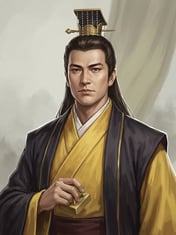
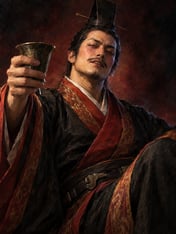
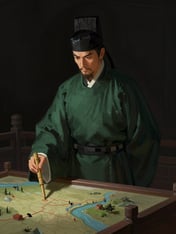
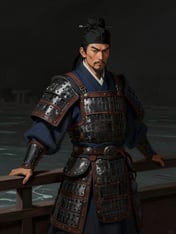
From the winter of the fifth year of Xianning (279) through the summer of the first year of Taikang (280), Jin Emperor Sima Yan, acting on the advice of Yang Hu, Du Yu, and Wang Jun, dispatched more than two hundred thousand troops by land and water together with several thousand warships, advancing in six simultaneous columns against Wu: Du Yu struck out from Jiangling, Wang Jun swept downstream from Bashu, Sima Zhou advanced from Tuzhong, Wang Hun issued from Hengjiang, Wang Rong from Wuchang, and Hu Fen from Xiakou. Wang Jun broke through the iron stakes the Wu army had planted in the river using great rafts, and burned away the iron chains strung across the river with torches, sweeping forward with the force of splitting bamboo. Wu Chancellor Zhang Ti fell in the midst of battle, while Shen Ying, Sun Xin, Lu Jing, and others were captured and executed in quick succession. In the third month of that year, Wang Jun was the first to reach Jianye, where Wu ruler Sun Hao surrendered; Wang Jun "unbound him and burned the coffin he had prepared, then received him in audience". With that, Wu's four provinces, forty-three commanderies, three hundred and thirteen counties, five hundred and twenty-three thousand households, and two hundred and thirty thousand soldiers all passed to Jin. At the end of the year, Jin Emperor Sima Yan changed the reign title to Taikang, enfeoffed Sun Hao as the Marquis of Returning Allegiance, and settled him in Luoyang. This marked the end of nearly a century of division that had begun with the Yellow Turban Rebellion of 184, and China was reunified.
The original Records of the Three Kingdoms ends with the surrender of Sun Hao, ruler of Wu. Its account is restrained: Wang Jun receives the surrender, Sun Hao is made Marquis Who Returns to His Fate, and Emperor Wu of Jin remarks of Yang Hu’s foresight, “This was the achievement of Grand Tutor Yang.” Overall, it portrays a military takeover that was thoroughly prepared and carried out methodically, with no suggestion of a theory of the Mandate of Heaven.
Romance
Chapter 120 of the novel sums up with “the great course of the world is that after long unity comes division, and after long division comes unity,” explicitly placing the Reunification of the Three Kingdoms under Jin within a narrative of Heaven’s mandate and the cycle of order and chaos. Through dramatic scenes of Sun Hao answering questions, Jia Chong feeling ashamed, the Jin ruler shedding tears, and Sun Xiu facing south and weeping, it presents military victory as the moral “restoration of legitimate rule.”
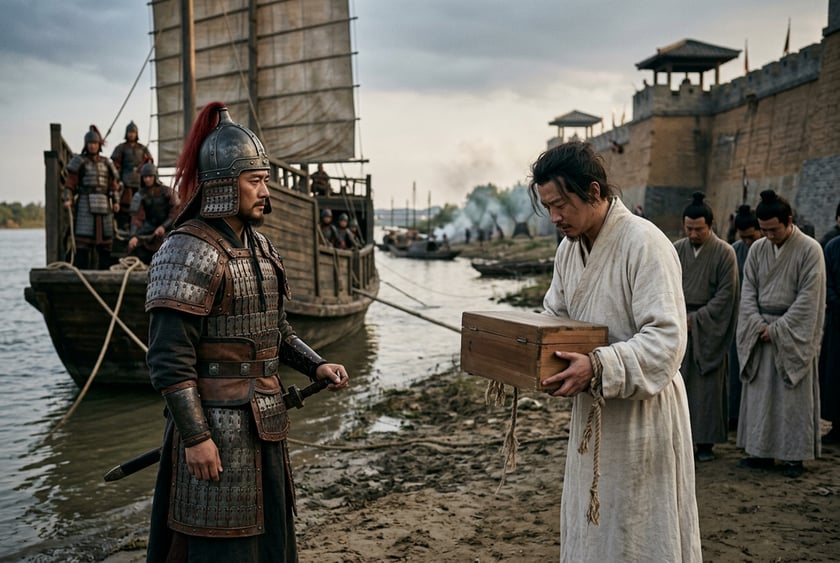
Below Jianye, the Jin general Wang Jun's warships lie moored by the river. Wearing plain mourning clothes, the Wu ruler Sun Hao unties the ropes binding him, holds a coffin in his hands, and surrenders to Wang Jun.
Modern political historians generally regard the Reunification of the Three Kingdoms under Jin as “the finale to a century of division” that began with the Yellow Turban Rebellion in 184 CE. But to understand its underlying logic, we must recognize two parallel trajectories: the consolidation of the north and the decline of the south. In the north, real power in Cao Wei had passed to the Sima clan after Sima Yi’s Incident at the Gaoping Tombs. After Sima Zhao killed Cao Mao in 260, the Sima clan held uncontested power; the conquest of Shu Han in 263 and Sima Yan’s replacement of Wei with Jin in 265 marked the completion of political consolidation in the north. In the south, Eastern Wu’s political legitimacy collapsed from top to bottom, first through Sun Quan’s deposing and installing of heirs in his later years, and then under the extreme rule of Sun Hao after he took the throne: “Ding Feng and Lu Kang both died. At every banquet with his ministers, Wu ruler Hao had them all made drunk. He also appointed ten palace attendants as censors to investigate and impeach officials. After each banquet, they would report their transgressions; those who had offended him might have their faces flayed or their eyes gouged out.” Governance had degenerated into rule by terror. The asymmetrical development of these two trajectories meant that the outcome was decided before the war even began.
Principal Figures
The central decision-maker on Jin’s side was Emperor Wu of Jin, Sima Yan, alongside three generations of advisers. Yang Hu laid the strategic foundations: for more than a decade he “comforted the people and trained troops” in Xiangyang, and strongly advocated a campaign against Wu. Du Yu was his successor, “experienced and capable, and indefatigable in his studies.” Known as an “obsessive devotee of the Zuo Tradition,” he continued Yang Hu’s strategy in Jing Province. Wang Jun commanded the navy, building large ships in Yi Province while keeping his forces ready. Zhang Hua made the decisive intervention at the final moment: when Sima Yan hesitated, he “pushed aside the go board, clasped his hands, and declared” his position, prompting the final decision. On Wu’s side stood “Sun Hao’s lone boat”: Ding Feng and Lu Kang were dead, and the country’s worthy ministers had dwindled away. Among the few remaining men of integrity were Zhang Ti, Shen Ying, and Lu Jing, while many senior officials, such as Xue Ying, Hu Chong, Wang Hun, and Zhang Xiang, were already psychologically prepared to surrender.
Central Issue
The real question in this campaign was not “whether victory was possible,” but “at what cost, and in what manner, the takeover would be carried out.” Sima Yan’s circle clearly understood that crushing Wu’s century-old foundations by purely military means would leave long-term problems of governance. Their strategy therefore placed great emphasis on “political dividends.” At Jiangling, Du Yu launched a night attack on Lexiang with eight hundred naval troops, creating the psychological shock of “the northern army flying across the river,” so that defenders along the river “surrendered at the sight of the windswept banners, bringing their seals with them.” Wang Jun used rafts bearing straw figures to draw out the iron spikes in the water, and torches to melt the chains. These technological innovations served as political propaganda: this was a carefully crafted “narrative of swift victory,” intended to make the people of Wu accept the new regime as quickly as possible, rather than enter a state of resistance. In the end, Sun Hao “also came out to surrender, bound and riding in a coffin cart”; Wang Jun “released his bonds and burned the coffin cart,” faithfully reproducing in ceremony the “rites due to an enemy state” seen in the abdications from Han to Wei, and giving the Jin dynasty a dignified script for legitimizing its rule.
Political Consequences
The most immediate consequence was the reunification of China’s territory: Eastern Wu had four provinces, forty-three commanderies, three hundred and thirteen counties, 523,000 households, 32,000 officials, 230,000 soldiers, a population of 2.3 million, 2.8 million hu of grain, more than five thousand ships, and more than five thousand people in the palace harem. These figures themselves formed the initial capital for the “Peace of Taikang.” The second consequence was the beginning of the “prosperity of Taikang”: Emperor Wu of Jin adopted the Taikang era name and implemented the land-allocation and household-tax systems. The economy and society recovered rapidly, giving rise to a brief golden age between 280 and 290. Yet the third consequence was to sow the seeds of the Western Jin’s rapid collapse. Victory had come too easily, leading Sima Yan to undervalue the importance of governance even more than he undervalued military force. He promptly abolished the armies of the provinces and commanderies and extensively enfeoffed members of the imperial clan as kings, paving the way for the Rebellion of the Eight Princes and the Yongjia Upheaval. It took only thirty-six years to go from unification to renewed division.
Counterfactual
What might have happened if the campaign against Wu had been launched ten years later? One plausible scenario is that the “seasoned old guard” of Yang Hu, Du Yu, and Wang Jun would have successively died, leaving the campaign in the hands of officials such as Jia Chong and Xun Xu, who were more concerned with palace intrigue. The war against Wu might then have turned into a drawn-out “half-war,” giving Sun Hao’s regime an opening to recover under a new ruler. If Sun Hao had been assassinated and replaced by a worthy sovereign of Sun Xiu’s caliber, Wu might well have survived for another decade. A more imaginative alternative is that, had Sima Yan opted to “bring surrender through peace” rather than “bring surrender through force”—using long-term economic penetration alongside border deterrence—Wu might have submitted peacefully. But such “gradual unification” would have deprived Jin of the political dividends of a narrative of “legitimate victory,” and might instead have left it unable to suppress centrifugal tendencies within the imperial clan. From this perspective, the swift victory of 280 was both the beginning of unification and the starting point of overconfidence. That is the paradox of history.