Sima clan · Senior General Who Assists the State
Wang Jun
courtesy name 士治 · 206–286
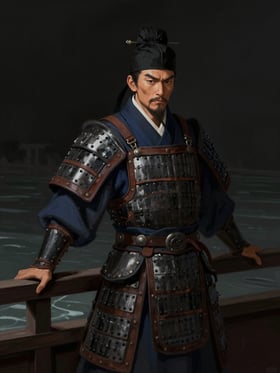
Wang Jun was General Who Rouses the Dragon under the Jin dynasty; sailing downstream to the east, he conquered wherever he went. The lord of Wu, Sun Hao, submitted a letter to him begging to surrender.

Life
In the novel: 1 chapter · In the Records: 3 volumes
Life206–286
279 CE (Xianning 5)
Allegiance
Appearances
By chapter (4)
Novel
- 120
Records
- 48
- 53
- 58
- Sima clan
- Hatched: dated by chapter
- Life event
On the boards
Compare with someone →Where this person ranks on each board.
Who they were
Character profile
- Character
- Wang Jun was General Who Rouses the Dragon under the Jin dynasty; sailing downstream to the east, he conquered wherever he went. The lord of Wu, Sun Hao, submitted a letter to him begging to surrender.
- Anecdotes
- Wang Jun once served as Inspector of Yi Province and built ships to sail downstream to the east.
Historical Record
Wang Jun, courtesy name Shizhi, served Jin as General Who Soars Like a Dragon. When Emperor Wu of Jin deployed six routes to attack Wu, Wang Jun and General of Broad Might Tang Bin led their troops eastward down the river. In summarizing the campaign’s advance, historical accounts describe what happened wherever Wang Jun and Tang Bin went: the Wu army “collapsed like a landslide, with no one left to resist.” The Records of the Three Kingdoms also records that Sun Hao sent envoys separately to Wang Jun, Sima Zhou, and Wang Hun with letters offering to surrender, stating that Wu was willing to hand over its seals and ribbons of office and submit to Jin.
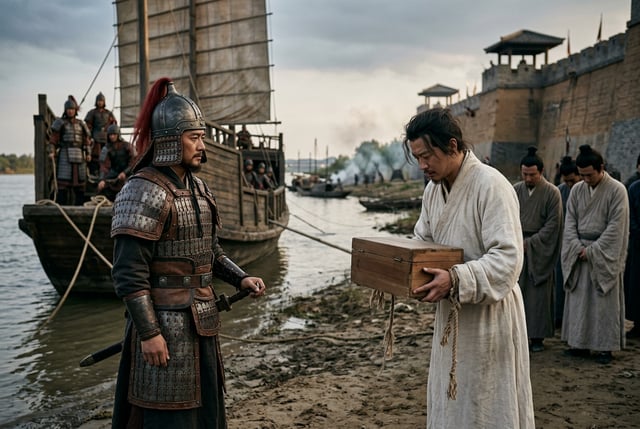
In the first year of the Taikang era, Wang Jun arrived first and accepted Sun Hao’s surrender. He released Sun Hao from his bonds, burned the coffin accompanying him, and invited him to meet. The Jin Yang Qiu, cited in Pei Songzhi’s commentary, records that Wang Jun took possession of Wu’s maps and registers, and gives specific figures for Wu’s households, officials, soldiers, and ships. Sun Hao and his family were later moved west, and the Jin court bestowed on him the title “Marquis Who Submits to His Fate.” The Records of the Three Kingdoms also records that Lu Yan, a Wu general, was killed by a separate force under Wang Jun. It further recounts Wang Jun’s eastward advance with the current and his capture of cities along the way, attesting to the role of his advance by land and water in Wu’s downfall.
In the Novel
Romance of the Three Kingdoms portrays Wang Jun as the commander of the naval forces that destroyed Wu and as a decisive figure who broke the deadlock. The novel has him submit a memorial requesting an attack on Wu, stressing that shipbuilding had been underway for a long time and that he was growing old; he feared that if Sun Hao died and was succeeded by a capable ruler, the opportunity to attack Wu would be lost. This is a dramatized elaboration of the reasons for the campaign, as the Records of the Three Kingdoms does not record such a memorial. On the expedition, he and Tang Bin were ordered to proceed east down the river, coordinating their advance with the forces of Du Yu, Wang Hun, and others.
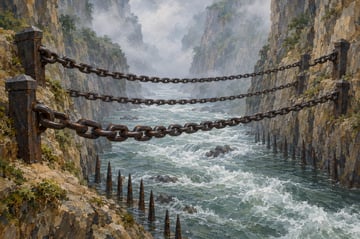
The novel also has Wang Jun overcome Wu’s river defenses of iron chains and spikes. He first uses rafts carrying straw figures to locate and remove the hidden spikes, then uses oil-soaked torches to burn through the chains before continuing east. This specific account of breaking through the defenses appears only in the novel; historical accounts contain no corresponding record. As he nears Shitou City, Wang Jun presses forward to the beat of drums despite the strong winds. After the Wu general Zhang Xiang surrenders, Wang Jun puts him at the head of the vanguard. In the end, he accepts Sun Hao’s surrender as Sun Hao comes out bound and bearing a coffin; Wang Jun releases him from his bonds, burns the coffin, and treats him with the courtesies due a king. Historical accounts likewise record that Wang Jun was the first to accept the surrender and showed Sun Hao the same leniency, but the advance beneath the city walls and Zhang Xiang’s role as guide are details elaborated by the novel. The novel concludes by having the Jin court appoint Wang Jun General Who Assists the State.
Key Relationships
Wang Jun served Emperor Wu of Jin and was the commander responsible for advancing east along the river as part of the six-route attack on Wu. Tang Bin commanded the naval forces alongside him, while Du Yu, Wang Hun, Wang Rong, and others coordinated the attack from different directions. His relationship with Sun Hao shifted from fighting him to accepting his surrender: Sun Hao sent envoys bearing a letter to request submission, and when Wang Jun arrived first, he accepted the surrender, released Sun Hao from his bonds, and burned the coffin. The novel further emphasizes this turning point through Zhang Xiang’s surrender and his guidance of the Jin army into Shitou City; this episode appears only in the novel.
Signature Scene
The scene with the strongest basis in historical sources is Wang Jun’s arrival ahead of the other armies, followed by his acceptance of Sun Hao’s surrender, releasing him from his bonds, burning the coffin, and inviting him to meet. This scene marks Wu’s submission to Jin and shows the courtesies extended at the surrender; historical accounts state that Sun Hao was later made Marquis Who Submits to His Fate. The novel renders the scene with greater theatricality: Wang Jun advances to the beat of drums against the wind, the Wu general Zhang Xiang surrenders first and opens the city gates, and Sun Hao finally comes out bound and bearing a coffin. The episodes of breaking the iron chains, using rafts to remove the hidden spikes, and Zhang Xiang guiding the way appear only in the novel and should not be conflated with the historical accounts.
Lines
- 演 ch.120 §37
「吾目下欲取石頭城,何言住耶!」
- 演 ch.120 §37→ Zhang Xiang
「若是真降,便為前部立功。」
Family, lords and rivals
2 relationships

Who is Wang Jun connected to?
Pick someone to see how many steps lie between them and Wang Jun.
Combat
On the field
Duels, kills and executions as the texts tell them, counted separately for the Records and the Romance.
Battles in command
Battles this person commanded in, with the outcome as each text tells it.
- Records
- 1W 0L 0D 0 undecided
- Romance
- 1W 0L 0D 0 undecided
- Records279Jin's Six-Route Conquest of WuWonvs WuJuan 48「王濬最先到,於是受皓之降」
- Romance279Jin's Six-Route Conquest of WuWonvs Eastern WuCh. 120「亦輿櫬自縛,率諸文武,詣王濬軍前歸降」
Stratagems
Plans this person devised or saw through, as the texts tell them.
- Romance
- 1 carried out · 1 worked · 0 turned down · 1 seen through
- RomanceIron Chains and Iron SpikesOtherSaw throughagainst Jin troopsCh. 120「江南多鐵,可打連環索百餘條」
- RomanceUse Straw Figures and Rafts to Break the PikesDeceptionWorkedagainst Wu troopsCh. 120「吳兵見之,以為活人,望風先走」
Events
Events (3)
Battles and events the texts place this person in, by date.
Battles
- 279Jin's Six-Route Conquest of WuCommander
Other events
- 280Reunification of the Three Kingdoms under JinCommander
- 280Sun Hao Surrenders to JinCommander
Famous objects
Continue
Reunification of the Three Kingdoms under Jin
Inner monologues · AI-generated1 monologue ▸
- I am Wang Jun, courtesy name Shizhi. When I was serving amid the campaign against Wu, I saw that whenever Wu’s ruler, Su