Wang Hun
courtesy name 玄冲 · 223–297

Wang Hun led Jin's campaign against Wu and was recorded as beheading Zhang Ti; the novel says he once requested a delay.

Life
In the novel: 1 chapter · In the Records: 2 volumes
Life223–?
279 CE (Xianning 5)
- Jin's Six-Route Conquest of WuJianyeCommander
280 CE (Xianning 6)
- Sun Hao Surrenders to JinJianyeCommander
Appearances
By chapter (3)
Novel
- 120
Records
- 48
- 53
- Life event
On the boards
Compare with someone →Where this person ranks on each board.
Historical Record
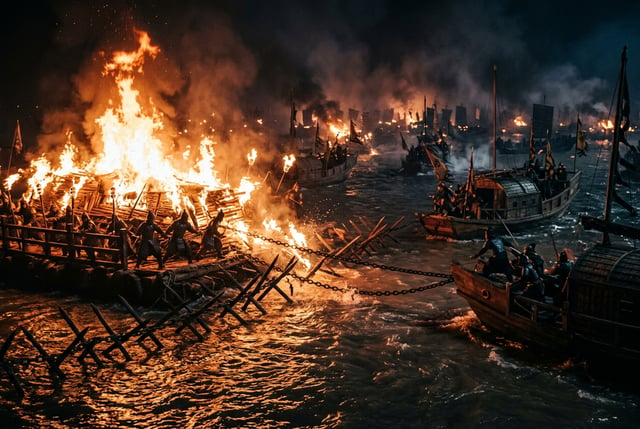
Wang Hun, courtesy name Xuanchong, was an General Who Pacifies the East during the Jin campaign against Wu. In the first year of the Taikang era (280), the Jin court deployed several armies to attack Wu: Wang Hun and Zhou Jun, Inspector of Yang Province, marched on Niuzhu; Sima Zhou advanced toward Tuzhong, Wang Rong toward Wuchang, Hu Fen toward Xiakou, and Du Yu toward Jiangling, while Wang Jun and Tang Bin led a fleet east down the Yangtze, with Jia Chong serving as Grand Commander and coordinating the forces. During the campaign, Wang Hun’s forces fought the Wu army on the river and achieved victories. The Records of the Three Kingdoms records that he “again slew the Chancellor Zhang Ti, the Administrator of Danyang Shen Ying, and others,” placing this alongside Du Yu’s killing of Wu Yan, Commandant of Jiangling, and Wang Jun’s advance downriver, and stating that the various forces “won battles wherever they went.”
After suffering defeats in many places, Sun Hao sent envoys with letters and seals to Wang Jun, Sima Zhou, Wang Hun, and others, requesting to surrender. The Records of the Three Kingdoms goes on to record that Wang Jun was the first to arrive and accept Sun Hao’s surrender; Sima Zhou sent another envoy to Sun Hao because Sun Hao had previously presented him with seals. Sun Hao’s entire family was moved west, and the Jin court granted him the title Marquis of Guiming. Thus, Wang Hun was one of the Jin commanders in the war that destroyed Wu, and he was among those to whom the ruler of Wu sent a letter requesting surrender. The surviving accounts do not say that he personally accepted Sun Hao’s surrender, so the surrender accepted by Wang Jun should not be credited to Wang Hun.
In the Novel
In chapter 120 of Romance of the Three Kingdoms, Wang Hun is portrayed as a Palace Attendant and General Who Conquers the East at the Jin court, and is given a cautious view of when to attack Wu. When Sun Hao claims that his troops are well prepared and his forces are at their height, Wang Hun advises the Jin ruler to delay the campaign for a year, allowing Wu’s army to grow weary before seeking victory. The ruler accepts his advice and issues an order to halt the advance. Later, Zhang Hua strongly advocates attacking while Wu is weakened. The Jin ruler changes his mind, orders Du Yu to command the various armies, appoints Wang Hun General Who Conquers the East, and sends him to attack across the Heng River.
The novel uses Wang Hun’s remonstrance to portray him as cautious and attentive to the enemy’s situation, setting his judgment against Zhang Hua’s eagerness for war. The Records of the Three Kingdoms records Wang Hun’s participation in the campaign against Wu and his defeat and killing of Zhang Ti and others, but does not mention this proposal to delay the campaign or the episode in which Zhang Hua prompts the expedition by moving the pieces on a Go board. These court discussions are literary embellishments in the novel. The novel also depicts Wang Jun entering Stone City, Sun Hao binding himself and surrendering, and Wang Jun releasing his bonds and burning his coffin. In this passage, it is Wang Jun—not Wang Hun—who accepts the surrender.
Key Relationships
With Emperor Wu of Jin, Sima Yan: In the novel, Wang Hun advises the Jin ruler to delay the campaign in his capacity as Palace Attendant, and the ruler initially heeds him. After Zhang Hua makes his case, the court decides to launch the campaign, and Wang Hun is ordered to attack across the Heng River. This account of the ruler and his officials discussing the campaign and making appointments appears only in the novel; the historical accounts describe the deployment of the Jin forces and Wang Hun’s achievements in the campaign against Wu.
With the Wu general Zhang Ti: According to the historical accounts, Zhang Ti led his army across the river to meet the Jin forces in battle. After his defeat, he was captured by the Jin army and executed by Wang Hun. Zhang Ti and Shen Ying’s deaths are the clearest of Wang Hun’s recorded military achievements.
With Sun Hao: As Wu’s power was nearing its end, Sun Hao sent envoys with letters and seals to Wang Hun and other Jin commanders, requesting to surrender. But the historical account says that Wang Jun arrived first and accepted the surrender, so it is important to distinguish between “Sun Hao once requested Wang Hun’s acceptance of his surrender” and “Wang Hun accepted Sun Hao’s surrender.”
Signature Scenes
The campaign across the Heng River: In the novel’s account of the Jin court’s deliberations over an attack on Wu, Wang Hun initially argues for delaying the offensive because Wu’s army is still strong. After Zhang Hua argues for a swift campaign, Wang Hun is ordered to attack across the Heng River as General Who Conquers the East. The scene highlights his caution and obedience to military orders; the specific remonstrance and appointment details appear only in the novel.
The river battle and the execution of Zhang Ti: In contrast to the novel’s court drama, the historical accounts’ signature episode takes place on the battlefield: during the Jin campaign against Wu, Wang Hun kills the Wu Chancellor Zhang Ti, the Administrator of Danyang Shen Ying, and others. The account lists this among the victories won by the various Jin forces.
Distinguishing Sun Hao’s request to surrender from its acceptance: Sun Hao sent envoys with letters requesting surrender to Wang Jun, Sima Zhou, and Wang Hun, showing that the Wu court could no longer continue resisting. However, the account explicitly states that Wang Jun arrived first and accepted the surrender. The novel also depicts Wang Jun releasing Sun Hao’s bonds, burning his coffin, and treating him with courtesy. Wang Hun is associated with the request to surrender, but neither the historical account nor the cited passage from the novel identifies him as the commander who personally accepted it.
Family, lords and rivals
1 relationships

Who is Wang Hun connected to?
Pick someone to see how many steps lie between them and Wang Hun.
Combat
On the field
Duels, kills and executions as the texts tell them, counted separately for the Records and the Romance.
- RecordsJuan 48Struck downZhang TiShen YingWon「渾復斬丞相張悌、丹楊太守沈瑩等」
- RecordsJuan 48Struck downZhang TiShen YingWon「渾復斬丞相張悌、丹楊太守沈瑩等」
Battles in command
Battles this person commanded in, with the outcome as each text tells it.
- Records
- 1W 0L 0D 0 undecided
- Romance
- 1W 0L 0D 0 undecided
- Records279Jin's Six-Route Conquest of WuWonvs WuJuan 48「王濬最先到,於是受皓之降」
- Romance279Jin's Six-Route Conquest of WuWonvs Eastern WuCh. 120「亦輿櫬自縛,率諸文武,詣王濬軍前歸降」
Events
Events (3)
Battles and events the texts place this person in, by date.
Battles
- 279Jin's Six-Route Conquest of WuCommander
Other events
Continue
Jin's Six-Route Conquest of Wu
Relationship timeline1 entry ▸
Novel · ch. 120
- Sima Yan§23
Advised
Gentleman of the Palace; urged delaying the troops, then later went out to Hengjiang
Inner monologues · AI-generated1 monologue ▸
- I am Wang Hun, courtesy name Xuanchong. The military council has now reached its decision, and the order has been issued