Records
Jin forces won
- Commanders
Vol. 48「王濬最先到,於是受皓之降」
279 CE (Xianning 5) · Jianye
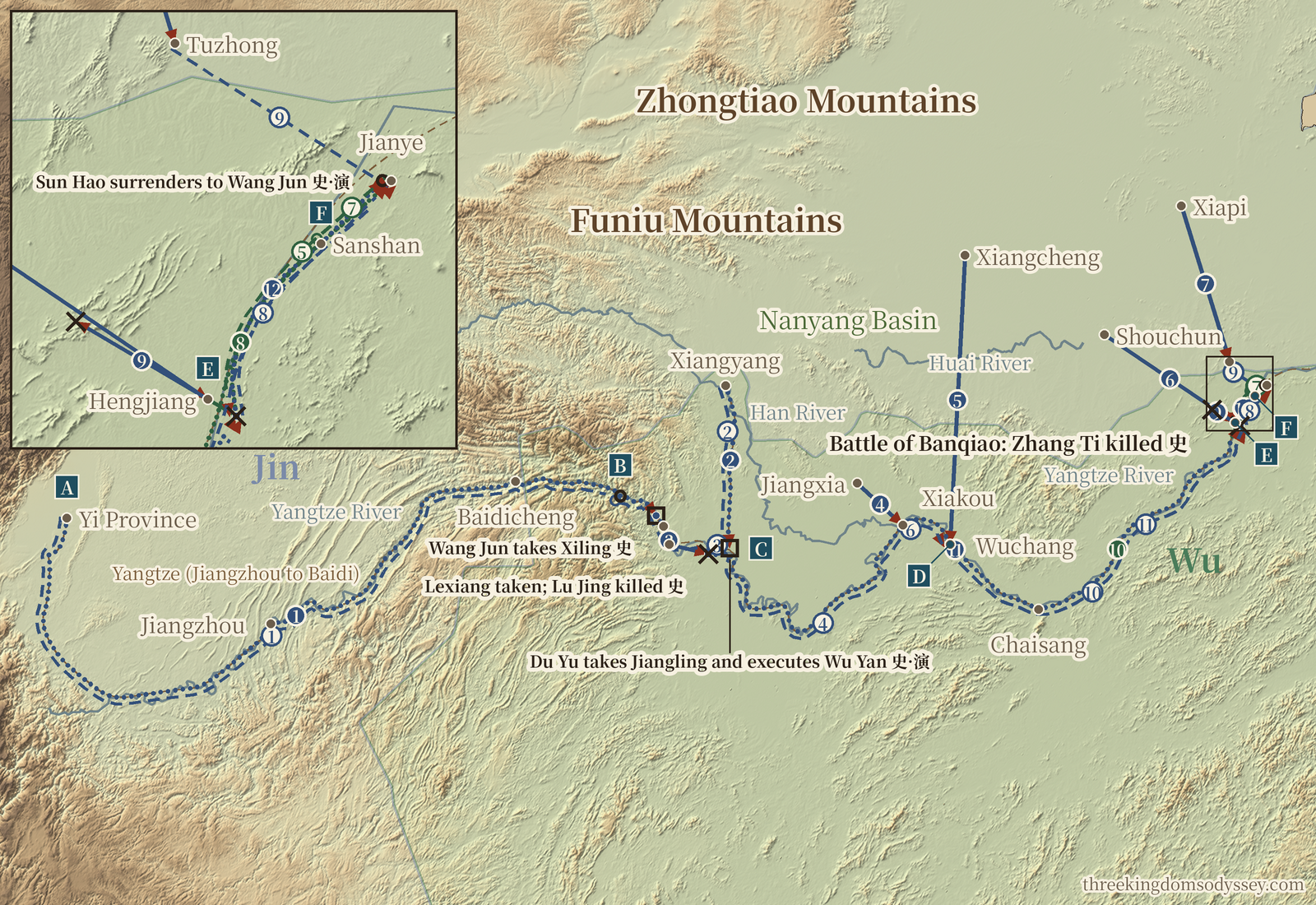
From the winter of the fifth year of Xianning (279) through the spring of the first year of Taikang (280), Emperor Wu of Jin, Sima Yan, appointed Jia Chong as supreme commander and dispatched six columns of forces in a full-front southward advance against Wu: Sima Zhou advanced from Tuzhong, Wang Hun and Zhou Jun from Niuzhu, Wang Rong from Wuchang, Hu Fen from Xiakou, Du Yu from Jiangling, and Wang Jun with Tang Bin leading the Yizhou naval forces downstream along the Yangtze. The Wu Chancellor Zhang Ti deployed Wu Yan to defend Jiangling and Sun Xin to hold Xiakou, while he personally led Shen Ying and Zhuge Jing to station at Niuzhu; he also accepted Cen Hun's suggestion to stretch iron chains and iron spikes across the Yangtze, but Wang Jun neutralized these obstacles with large rafts and torches. Within a matter of months Du Yu had taken Jiangling and Wang Jun had seized Wuchang; the Jin forces advanced directly to Jianye, and Sun Hao emerged to surrender with his hands bound behind his back and a coffin carriage in his train. Wu fell, and the three kingdoms were reunited. The campaign deployed forces exceeding two hundred thousand and warships numbering in the tens of thousands, making it the largest and most complex coordinated mobilization since the end of the Han, and the foundational battle of the Western Jin's brief reunification.
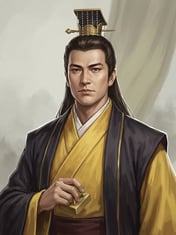 Sima YanInstigatorTalk to me
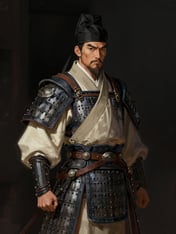 Sima ZhouCommanderTalk to me
 Wang HunCommanderTalk to me
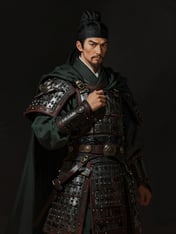 Wang RongCommanderTalk to me
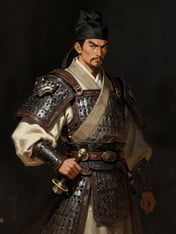 Hu FenCommanderTalk to me
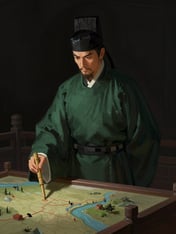 Du YuCommanderTalk to me
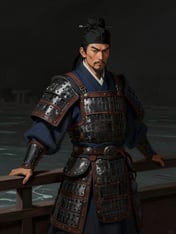 Wang JunCommanderTalk to me
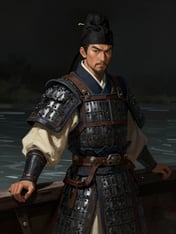 Tang BinCommanderTalk to me
Famous objectsIron Chains Across the River
Who won, as each book tells it; commanders as the text names them.
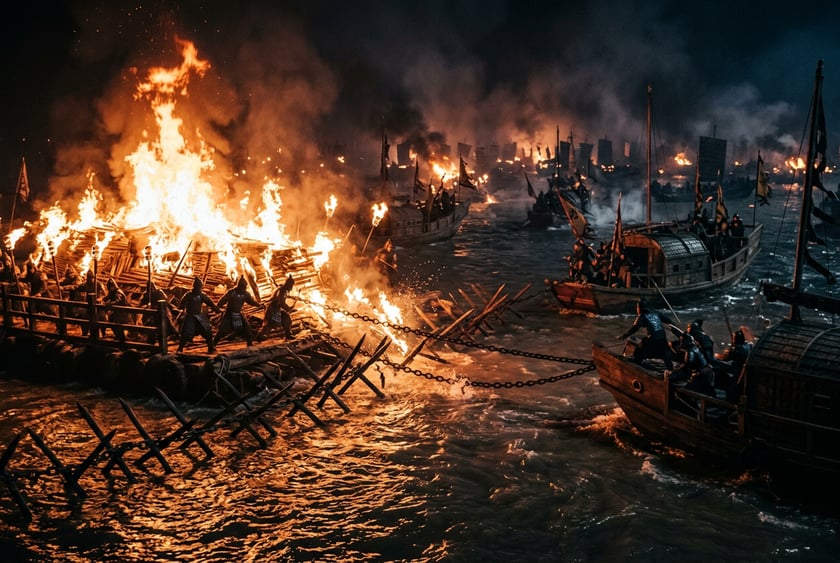
Scene
On the Yangtze, huge Jin army rafts carrying torches rush toward the Wu army’s water defenses of iron chains and iron spikes. The flames light up the night sky, and Wu ships are scattered in the chaos.
Swipe to see the whole map
In the Romance, Du Yu's officer Zhou Zhi kills Shen Ying and Du Yu himself reaches Jianye; the Records say Wang Hun's army killed Zhang Ti and Shen Ying.
The books mostly say only where an army set out and arrived: a Records line is solid between the places they name and dotted where it follows a reconstructed road between them; an open ring marks an end the books don't give.
Base map: Natural Earth; terrain: AWS Terrain Tiles (SRTM and others). Roads and marches reconstructed from the sources listed; positions approximate.
Continue
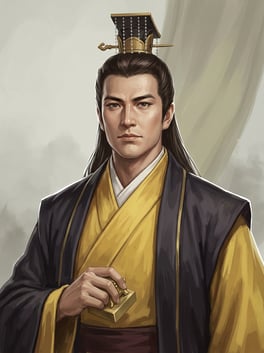
Sima Yan was of imposing stature; when he stood, his hair hung to the ground, and his arms reached below his knees.
2804 people in common
2692 people in common
2662 people in common
2661 person in common
2651 person in common
2641 person in common
2641 person in common
2791 person in common
Since Deng Ai's destruction of Shuhan in the fourth year of Jingyuan (263) and Sima Yan's usurpation of Caowei to found Jin in the second year of Xianxi (265), the realm had settled into a bipolar order: Jin strong, Sunwu weak. After Lu Kang's death, Sunwu consumed itself from within — Sun Hao's brutality, the collapse of court discipline, and the loss of the pillar who had held the Xiling defense line along the middle Yangtze. Jin, meanwhile, had spent ten years with Yang Hu holding Jingzhou and seven years with Wang Jun building warships in Yizhou, accumulating every material and intelligence asset the campaign against Wu would require. The political window for war opened in the winter of the fifth year of Xianning (279) — the resistance of conservatives led by Jia Chong was overridden by the war party of Zhang Hua and Du Yu, who argued that "the forces are ready; if we do not strike, they will rot." The scale of the Jin army — six columns, more than two hundred thousand men, and tens of thousands of warships — reflects a war designed as a single, total, no-retreat strategic annihilation.
Jin's deployment ran along the Yangtze from west to east as follows: Wang Jun and Tang Bin led the Yizhou river fleet downstream — the "thrusting blade" of the entire strategy; Du Yu struck out from Jiangling to seize the heart of Jingzhou; Hu Fen advanced from Xiakou and Wang Rong from Wuchang to support the river fleet and sever the lateral connection between Jingzhou and Yangzhou; Wang Hun and Zhou Jun advanced from Niuzhu; Sima Zhou advanced from Tuzhong — these two columns pinned the northern wing of Jianye; Jia Chong served as grand marshal at the center, coordinating all columns. Sunwu responded in haste. Prime Minister Zhang Ti deployed: General of Chariots and Cavalry Wu Yan to hold Jiangling against Du Yu; General of the Flying Cavalry Sun Xin to hold Xiakou against Hu Fen; Zhang Ti himself, with General of the Left Shen Ying and General of the Right Zhuge Jing, led one hundred thousand men to encamp at Niuzhu and support all other columns. That a prime minister personally took the field reveals that Sun Hao's court had no seasoned commanders left to spare. Sunwu placed its last hope in the Yangtze itself — the favorite courtier Cen Hun proposed stringing iron chains and iron stakes across the river to stop the Jin river fleet on the western bank.
The first decision point was the timing of the offensive. The Emperor of Jin, overruling Jia Chong's repeated objections, accepted the arguments of Zhang Hua and Du Yu — citing "the empire is holy and martial, its people rich and strong; the Wu ruler is licentious and cruel, his people distressed and his state exhausted" — and ordered the war to begin. The second decision point was Wang Jun's river fleet breaking through rapidly. Wang Jun used large rafts to probe the iron stakes and torches to melt the iron chains, breaching Wu's defenses along the middle Yangtze in succession and shifting the war's main axis from overland advance to a combined water-land push. The third decision point was Du Yu's swift southern advance after capturing Jiangling. Without pausing to consolidate, Du Yu ordered his forces to advance on Wuchang by both water and land, denying the Wu army time to contract and regroup. The fourth decision point was Wu's all-or-nothing gamble of committing its prime minister to the front. Zhang Ti's force was shattered by Wang Hun and Zhou Jun near Niuzhu — Shen Ying died in battle, Zhang Ti fell. Wu had lost its last operational field army. Wang Jun's river fleet then arrived at the walls of Jianye, and Sun Hao rode out in a plain cart with his hands bound, bearing the coffin of surrender.
First: Sunwu was destroyed. The three kingdoms returned to Jin — Sanguoguijin. The division that had persisted for nearly a century since the Yellow Turban rising (184) formally ended, making this one of the rare cases in Chinese history where national mobilization achieved reunification in a single campaign. Second: immediately after the conquest of Wu, the Emperor of Jin disbanded provincial and commandery troops, implemented the household-tribute and land-allocation systems, and set about rebuilding society under a "peace" framework — but this design was ground to pieces twenty years later by the War of the Eight Princes, revealing the danger of using military unification to paper over inadequate political integration. Third: Wang Jun's extraordinary speed in reaching Jianye sparked a bitter dispute with Wang Hun over credit — the first great political cause célèbre at the Western Jin court, exposing factional fissures among the generals who destroyed Wu and foreshadowing the inner weakness of Western Jin's capacity for centralized rule. Fourth: Sun Hao was escorted to Luoyang, and his legendary exchange — "I have long prepared this seat for you" — entered the historical record, becoming a standard reference in later discussions of the dignity of conquered and surrendered monarchs.
Had Jia Chong and the conservatives succeeded in blocking the campaign in the winter of Xianning five (279), citing "wait for a better moment" and deferring by a year or two, Jin's advantages in shipbuilding and grain stockpiles would have grown still larger — but if Sunwu had produced an Lu Kang-caliber commander in those one or two years (such as Lu Kang's sons Lu Ji and Lu Yun, then still young men), the middle Yangtze defense line could have been rebuilt, and that would have been Wu's only real chance to reverse the tide. Another counterfactual: had Wu abandoned Jiangling at the very start of the campaign in the winter of Xianning five and contracted its forces to defend Jianye, using the exhaustion of Wang Jun's army — which had to travel thousands of li — as the basis for a war of attrition, the hydrology of the Yangtze and Jin's logistics suggest this might have dragged the war into an uncertain spring-flood season, adding friction and variables for the Jin forces. History chose Zhang Ti's last stand and Sun Hao's capitulation — the fastest possible path to collapse. Unification was achieved completely and abruptly, and the seeds of Western Jin's brief lifespan were sown in the very moment of victory.