Eastern Wu · Chancellor
Zhang Ti
courtesy name 巨先 · –280
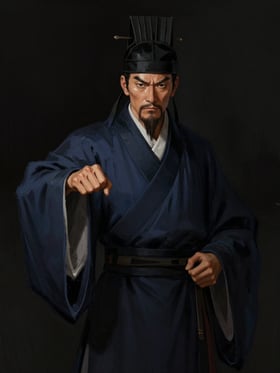
Zhang Ti, Eastern Wu chancellor, was known for leading troops across the river against Jin and refusing to flee after defeat.

Life
In the novel: 1 chapter · In the Records: 2 volumes
Life?–280
279 CE (Xianning 5)
- Jin's Six-Route Conquest of WuJianyeKilled in action
- Rebellion of Guo MaGuang ProvinceCommander
Appearances
By chapter (3)
Novel
- 120
Records
- 48
- 61
- Eastern Wu· Undated
- Life event
- Death
List all 3 stops
On the boards
Compare with someone →Where this person ranks on each board.
Historical Record
Zhang Ti, courtesy name Juxian, was from Xiangyang. The Xiangyang Record says that even in his youth he was renowned for his understanding of principles and reasoning. During Sun Xiu’s reign, he served as Commandant of the Mounted Guard; later he rose to the post of Military Adviser and, in the third year of the Tianji era, was appointed chancellor. The historical accounts also record that he was recommended by Lu Kai on the latter’s deathbed. Lu Kai considered Zhang Ti and the others to be men of either integrity and diligence or exceptional ability, all of them indispensable ministers on whom the state could rely.
Zhang Ti was not unaware of Eastern Wu’s perilous position. The Xiangyang Record relates that when Wei attacked Shu, people in Wu argued that although the Sima clan had military strength, it had not won the people’s hearts. Zhang Ti countered that Sima Yi and his sons had for many years governed with fairness and benevolence, appointing worthy men and putting able men to use; the people had long since come over to their side. He judged that Shu’s government was chaotic and its troops and people exhausted, and that if Wei took advantage of this to attack, Shu would probably be unable to resist. The people of Wu mocked his view at the time, but Shu later did indeed surrender to Wei. This early assessment shows that Zhang Ti did not judge the situation solely by comparing the relative strength of the opposing sides; he also took governance and popular support into account.
When the Jin forces attacked Wu, Sun Hao ordered Zhang Ti to command Shen Ying and Zhuge Jing and lead thirty thousand men across the river to meet them. Shen Ying advocated conserving their strength and waiting for the enemy, reasoning that Wu’s defenses upstream were inadequate and that if they rashly crossed the river to fight, a defeat would leave them with no hope of turning the tide. Zhang Ti, however, judged that if Shu’s forces arrived first, the Wu army’s morale would be shaken even further. He urged them to cross the river and fight decisively while they could still organize their troops. Even if they were defeated, they should give their lives for the state; if they won, they could seize the advantage and counterattack. In the end, he led the army across the river.
During the fighting, Wu forces briefly surrounded Zhang Qiao’s smaller contingent. Zhuge Jing wanted to kill the men who had surrendered to bolster morale, but Zhang Ti refused, arguing that with a powerful enemy before them, they should not attack a lesser target first, and that killing prisoners who had surrendered was inauspicious. After reassuring the opposing troops, he continued the advance. Shen Ying then led his elite troops in a charge against the Jin ranks, but the Wu army fell into disarray when the charge faltered. The Jin forces seized the opportunity to attack from both sides and defeated Zhang Ti and the others. The main text of the Records of the Three Kingdoms records that Wang Hun beheaded Zhang Ti, Shen Ying, and others. As Zhuge Jing retreated, he turned back and urged Zhang Ti to leave. Weeping, Zhang Ti replied that this was the day he was destined to die. Since childhood, he had been raised to prominence by a chancellor of the Zhuge family, and had often feared that he might fail to meet a fitting end and thereby betray the favor he had received. Now that he could give his life for the state, he would not flee. Zhuge Jing let go and left; Zhang Ti was soon killed by the Jin forces.
In the Novel
Chapter 120 of Romance of the Three Kingdoms retains the central thread of Zhang Ti going to meet the Jin forces, accompanied by Shen Ying and Zhuge Jing, and Zhuge Jing urging him to avoid battle while Zhang Ti resolves to stand his ground unto death. The novel portrays him as a Wu official who knows that the state’s fall is inevitable yet refuses to save himself while the country faces catastrophe. In response to the warning, “Eastern Wu is in peril,” he says that it would be shameful for all the ruler and his ministers to surrender, with not one person dying for the country in its hour of crisis. In the end, he and Shen Ying lead their troops into battle and die amid the chaos.
The novel elaborates on the battlefield in a literary manner, writing that Zhou Zhi was the first to break into the Wu camp, that Zhang Ti fought valiantly before dying, and that Shen Ying was killed by Zhou Zhi. These specific details belong to the novel’s narrative and should not be conflated with the historical account of the defeat and Zhang Ti’s beheading by Wang Hun. The historical account of Zhang Ti refusing to kill those who surrendered, crossing the river for a decisive battle, and refusing to flee at the end forms the historical basis for the novel’s portrayal of him as a martyr for his state.
The novel also relates that after Sun Hao Surrenders to Jin, Zhang Ti was honored posthumously: the Jin emperor enfeoffed his descendants. This is part of the account in chapter 120 of the novel. The supplied Records of the Three Kingdoms records that Sun Hao was enfeoffed as the Marquis Who Returned to His Mandate and that his descendants were given official posts, but it does not mention Zhang Ti’s descendants being enfeoffed. Therefore, this detail from the novel cannot be added to the historical account.
Key Relationships
- Eastern Wu and Sun Hao: Zhang Ti served under Sun Hao, first as Military Adviser and then, in the third year of the Tianji era, as chancellor. When Guo Ma rebelled, the court appointed him chancellor; when the Jin forces advanced south, it again ordered him to command the troops crossing the river to meet them. His final choice was to put the interests of Eastern Wu above his own and refuse to flee alone.
- Lu Kai: On his deathbed, Lu Kai included Zhang Ti among the worthy ministers he recommended, saying that he, Yao Xin, Lou Xuan, He Shao, and others could serve as pillars of the state and able assistants to the country. This recommendation reflects Zhang Ti’s standing and political position at the Wu court.
- Zhuge Jing: The two men commanded troops together against Jin. Zhuge Jing once wanted to kill those who had surrendered, but Zhang Ti refused. When defeat became apparent, Zhuge Jing urged him to withdraw and personally tried to pull him to safety. Zhang Ti insisted on staying, making this the pivotal moment of their farewell.
- Shen Ying: Shen Ying crossed the river with Zhang Ti at the head of the army. The historical account says that he led elite troops from Danyang in a charge, after which the Wu army collapsed and Zhang Ti, Shen Ying, and others were captured or killed by the Jin forces. The novel, by contrast, depicts Zhang Ti and Shen Ying fighting together and dying one after the other, with Zhou Zhi as their killer—a detail found only in the novel.
Defining Scenes
The scene that best captures Zhang Ti is the one in which, after the Jin forces have pressed into Wu and its army has retreated across the river in defeat, Zhuge Jing turns back and tries to pull him away. In the historical account, Zhang Ti weeps and says that this is the day he is destined to die. He also says that in his youth he had been raised to prominence by a chancellor of the Zhuge family and that he does not wish to betray the favor he received. He therefore refuses to be dragged away. The scene conveys both his remembrance of past kindness and his resolve to entrust his life to the state; he is soon killed by the Jin forces.
Another scene that reveals his judgment and principles is the surrender at Yanghe Bridge. Zhang Qiao raises a white flag to surrender, and Zhuge Jing proposes burying the men alive while Wu’s morale still needs bolstering. Zhang Ti, however, says that with a powerful enemy before them, they should not focus first on a lesser enemy, and that killing those who have surrendered is inauspicious. After comforting the surrendering troops, he continues the advance. This does not contradict his later decision to fight decisively despite knowing that their chances of victory are slim: the former reflects his adherence to military discipline and propriety, while the latter is a choice he makes in response to the state’s peril.
The novel brings these two aspects of the historical Zhang Ti together in a final exchange before battle, expressed as the conviction that a ruler and his ministers cannot all escape without anyone dying for the state. It ends dramatically with Zhang Ti fighting alone and dying amid the chaos. This specific depiction of the fighting is unique to the novel, while the central choice not to abandon his country is grounded in the historical account.
Lines
- 演 ch.120 §27→ Sun Hao📍 Jianye
「可令車騎將軍伍延為都督,進兵江陵,迎敵杜預;驃騎將軍孫歆進兵拒夏口等處軍馬。臣敢為將,率領左將軍沈瑩,右將軍諸葛靚,引兵十萬,出屯牛渚,接引諸路軍馬。」
- 演 ch.120 §31
「吳之將亡,賢愚共知;今若君臣皆降,無一人死於國難,不亦辱乎?」
Family, lords and rivals
2 relationships

Who is Zhang Ti connected to?
Pick someone to see how many steps lie between them and Zhang Ti.
History vs. novel
6 points
| History | Novel |
|---|---|
| Rebellion of Guo MaHistory only | |
In the third year of Fenghuang during Sun Hao’s reign, Guo Ma rebelled over the assignment of his troops and the verification of household registers, and attacked and killed Yu Shou, the Inspector of Guangzhou. In the eighth month of that year, Zhang Ti was appointed chancellor. vol. 48 | — |
| Foreseeing Shu’s fallHistory only | |
Before Wei’s campaign against Shu, Zhang Ti analyzed how the Sima clan had won popular support and how Shu Han’s political situation had deteriorated, concluding that Shu could not withstand the attack. The people of Wu laughed at him, but Shu later indeed surrendered to Wei. vol. 48 | — |
| Size of the forceNovel embellishes | |
When Jin attacked Wu, Sun Hao ordered Zhang Ti to lead Shen Ying and Zhuge Jing with thirty thousand troops across the river to meet the enemy. vol. 48 | Zhang Ti asked to lead Shen Ying and Zhuge Jing with one hundred thousand troops to garrison Niuzhu, and Sun Hao accepted his proposal. ch. 120 |
| Position before the battleNovel embellishes | |
Shen Ying advocated conserving their strength and waiting for the Jin army to attack, while Zhang Ti believed Wu was doomed and that they should still cross the river for a decisive battle, dying with the state if they were defeated. vol. 48 | Shen Ying and Zhuge Jing both feared that if they crossed the river to fight and were defeated, all would be lost. After the Jin army advanced downstream, Zhuge Jing urged Zhang Ti to flee. ch. 120 |
| Refusing to retreatNovel embellishes | |
After Wu’s army was defeated, Zhuge Jing turned back and pulled Zhang Ti away, but Zhang Ti said that he was destined to die that day. Having been raised to prominence by the Zhuge family, he did not wish to flee and evade dying for his country. vol. 48 | Zhuge Jing urged Zhang Ti to escape. Weeping, Zhang Ti said it was shameful if both ruler and ministers surrendered and no one died in the cause. Zhuge Jing, also in tears, then departed. ch. 120 |
| Defeat and death at Ban BridgeNovel embellishes | |
Shen Ying led his Blue Turban troops in three charges but failed to shake the Jin army. After the Wu troops fell into disorder during their retreat, they collapsed. Zhang Ti, Sun Zhen, and Shen Ying were captured and then executed. vol. 48 | Zhou Zhi was the first to break into the Wu camp. Zhang Ti fought fiercely and died amid the chaos; Shen Ying was also killed by Zhou Zhi, and the Wu soldiers scattered in defeat. ch. 120 |
- Rebellion of Guo MaHistory only
- History
In the third year of Fenghuang during Sun Hao’s reign, Guo Ma rebelled over the assignment of his troops and the verification of household registers, and attacked and killed Yu Shou, the Inspector of Guangzhou. In the eighth month of that year, Zhang Ti was appointed chancellor.
vol. 48
- Foreseeing Shu’s fallHistory only
- History
Before Wei’s campaign against Shu, Zhang Ti analyzed how the Sima clan had won popular support and how Shu Han’s political situation had deteriorated, concluding that Shu could not withstand the attack. The people of Wu laughed at him, but Shu later indeed surrendered to Wei.
vol. 48
- Size of the forceNovel embellishes
- History
When Jin attacked Wu, Sun Hao ordered Zhang Ti to lead Shen Ying and Zhuge Jing with thirty thousand troops across the river to meet the enemy.
vol. 48
- Novel
Zhang Ti asked to lead Shen Ying and Zhuge Jing with one hundred thousand troops to garrison Niuzhu, and Sun Hao accepted his proposal.
ch. 120
- Position before the battleNovel embellishes
- History
Shen Ying advocated conserving their strength and waiting for the Jin army to attack, while Zhang Ti believed Wu was doomed and that they should still cross the river for a decisive battle, dying with the state if they were defeated.
vol. 48
- Novel
Shen Ying and Zhuge Jing both feared that if they crossed the river to fight and were defeated, all would be lost. After the Jin army advanced downstream, Zhuge Jing urged Zhang Ti to flee.
ch. 120
- Refusing to retreatNovel embellishes
- History
After Wu’s army was defeated, Zhuge Jing turned back and pulled Zhang Ti away, but Zhang Ti said that he was destined to die that day. Having been raised to prominence by the Zhuge family, he did not wish to flee and evade dying for his country.
vol. 48
- Novel
Zhuge Jing urged Zhang Ti to escape. Weeping, Zhang Ti said it was shameful if both ruler and ministers surrendered and no one died in the cause. Zhuge Jing, also in tears, then departed.
ch. 120
- Defeat and death at Ban BridgeNovel embellishes
- History
Shen Ying led his Blue Turban troops in three charges but failed to shake the Jin army. After the Wu troops fell into disorder during their retreat, they collapsed. Zhang Ti, Sun Zhen, and Shen Ying were captured and then executed.
vol. 48
- Novel
Zhou Zhi was the first to break into the Wu camp. Zhang Ti fought fiercely and died amid the chaos; Shen Ying was also killed by Zhou Zhi, and the Wu soldiers scattered in defeat.
ch. 120
Combat
On the field
Duels, kills and executions as the texts tell them, counted separately for the Records and the Romance.
- RecordsJuan 48Struck downWang HunLost「渾復斬丞相張悌、丹楊太守沈瑩等」
- RecordsJuan 48Struck downWang HunLost「渾復斬丞相張悌、丹楊太守沈瑩等」
Battles in command
Battles this person commanded in, with the outcome as each text tells it.
- Records
- 0W 1L 0D 0 undecided
- Romance
- 0W 1L 0D 0 undecided
- Records279Jin's Six-Route Conquest of WuLostvs Jin forcesJuan 48「王濬最先到,於是受皓之降」
- Romance279Jin's Six-Route Conquest of WuLostvs Jin troopsCh. 120「亦輿櫬自縛,率諸文武,詣王濬軍前歸降」
Events
Events (3)
Battles and events the texts place this person in, by date.
Battles
- 279Jin's Six-Route Conquest of WuKilled in action
Other events
Places
- Native of
- XiangyangRecords
Continue
Last scene: Jin's Six-Route Conquest of Wu
Relationship timeline1 entry ▸
Novel · ch. 120
- Shen Ying§31
Slayer
Together with Shen Ying, resisted the Jin troops and died amid the chaos of battle
Inner monologues · AI-generated1 monologue ▸
- I was appointed chancellor just as Guo Ma occupied Guangzhou and rebelled, and the court was beset by turmoil inside and