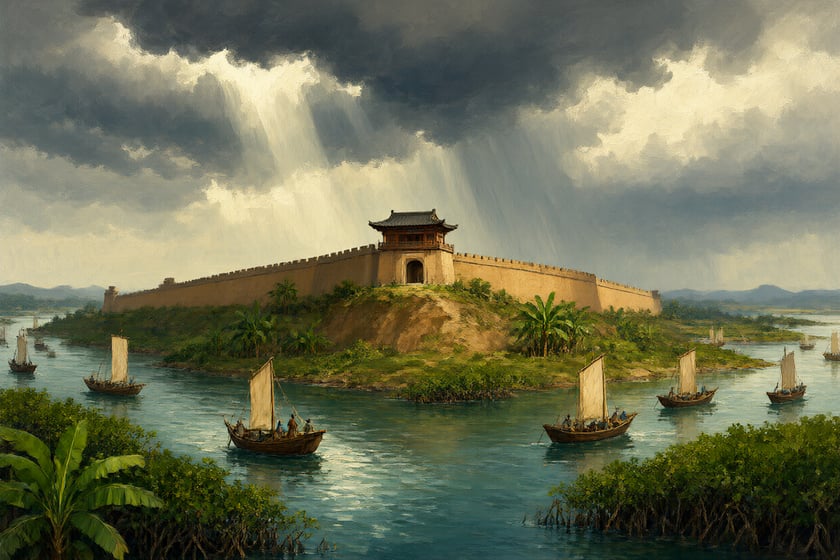
Overview
Guangzhou was a province established by Eastern Wu from Jiaozhou. It governed most of present-day Guangdong Province and eastern Guangxi, with its provincial seat at Panyu, in present-day Guangzhou, Guangdong Province. Because Jiaozhi was too distant to govern effectively, Sun Quan designated the area north of Hepu as Guangzhou, while the lands south of Jiaozhi remained Jiaozhou. Guangzhou was established twice: first in 226, during the fifth year of Huangwu, but abolished soon afterward; then reestablished in 264, during the seventh year of Yongan, and remained in existence until the fall of Wu. During Sun Hao’s reign, it was a remote place to which disgraced officials and their families were exiled. Near the end of Wu, the Rebellion of Guo Ma also broke out there.
History
In 226, during the fifth year of Huangwu, Shi Xie, Administrator of Jiaozhi, died. Sun Quan appointed his son Shi Hui Administrator of Jiuzhen and sent Chen Shi to succeed Shi Xie as Administrator of Jiaozhi. Lü Dai submitted a memorial proposing that the three southern-sea commanderies be made into Jiaozhou, with Dai Liang as Inspector, and the four commanderies east of the sea be made into Guangzhou, with Lü Dai himself as Inspector. Shi Hui refused to accept the appointment and sent troops to hold the river mouth. Lü Dai led three thousand men across the sea overnight. Shi Hui and his brothers came out to meet him bare-chested, but Lü Dai still had them beheaded. After Jiaozhou was pacified, Guangzhou was soon abolished and the territory returned to Jiaozhou.
In the autumn of 264, during the seventh year of Yongan, Sun Xiu again divided Jiaozhou to establish Guangzhou. That same year, Sun Hao Ascends the Throne. In the eleventh month, he arrested Puyang Xing and Zhang Bu, who had helped him take the throne, exiled them to Guangzhou, and then had them pursued and killed on the way. Thereafter, Sun Hao repeatedly exiled to Guangzhou those who had angered him. After Wang Fan was killed, his family was moved to Guangzhou. Xue Ying was imprisoned over the excavation of Sheng Creek and exiled to Guangzhou. Lou Xuan was falsely accused of slandering the court and was also sent to Guangzhou. Pei Songzhi’s commentary, citing the Spring and Autumn Annals of Han and Jin, says that Sun Hao believed the prophecy “Gongsun will bring about Wu’s downfall” and moved all officials, civil and military, and even soldiers surnamed Gongsun to Guangzhou, forbidding them to remain along the Yangtze. Pei Songzhi’s commentary, citing Wang Yin’s Record of Jiaozhou and Guangzhou, records that after Wu reestablished Guangzhou, Teng Xiu, a native of Nanyang, was appointed Inspector.
In the summer of 279, during the third year of Tianji, Guo Ma, a unit commander under Xiu Yun, Administrator of Hepu, raised an armed revolt. Xiu Yun was transferred to serve as Administrator of Guilin but remained in Guangzhou due to illness. After his death, his troops were to be disbanded and reassigned. Guo Ma and others, old subordinates who had served alongside Xiu Yun for generations, were unwilling to be separated. Just then, Sun Hao ordered a census of Guangzhou’s population, and Guo Ma, He Dian, Wang Zu, Wu Shu, Yin Xing, and others incited soldiers and civilians to revolt and killed Yu Shou, the Commandant of Guangzhou. Guo Ma proclaimed himself Commandant of the Military Affairs of Jiaozhou and Guangzhou and General Who Pacifies the South, appointing Yin Xing Inspector of Guangzhou and Wu Shu Administrator of Nanhai. When Sun Hao heard the news, he was greatly alarmed and lamented, “Heaven is bringing us to ruin”. In the eighth month of that year, Sun Hao appointed Teng Xiu (given as Teng Xun in the Biography of Sun Hao) General Who Guards the South, granting him a tally and appointing him Governor of Guangzhou. Teng Xiu led ten thousand men along the eastern route to put down the revolt, but encountered Wang Zu at Shixing and could not advance. Guo Ma then killed Liu Lue, Administrator of Nanhai, and drove out Xu Qi, Inspector of Guangzhou. Sun Hao sent Tao Jun with seven thousand men along the western route and ordered Tao Huang, Governor of Jiaozhou, to muster troops from Hepu, Yulin, and other commanderies for a pincer attack.
People
- Lü Dai: Guangzhou’s first Inspector. After pacifying Shi Hui, he was enfeoffed as Marquis of Panyu and went on to campaign in Jiuzhen. He also sent envoys south to proclaim Wu’s prestige, after which Funan, Linyi, and other states sent envoys bearing tribute.
- Teng Xiu: A native of Nanyang who served as Inspector and Governor of Guangzhou near the end of Wu. The Record of Jiaozhou and Guangzhou says that someone told him shrimp whiskers could grow one zhang long. He did not believe it, so the man specially brought shrimp whiskers more than four zhang long from Donghai to show him.
- Wang Zhu and Wang Yan: Wang Fan’s two younger brothers, both talented men. They were exiled to Guangzhou along with their family and, when Guo Ma revolted, refused to serve him and were killed.
- Lou Xuan: A native of Qi in Pei Commandery, he once served as Administrator of Kuaiji and Grand Minister of Agriculture. While in charge of the palace guard, he was upright and repeatedly offended Sun Hao, ultimately being exiled.
Today
The provincial seat of Eastern Wu’s Guangzhou, Panyu, lies in present-day Guangzhou, Guangdong Province. The name “Guangzhou” dates from this division of the province.