Shu Han · Education Officer; Deputy Attendant to the Heir Apparent; Admonition Grandee; Army Libationer; Grand Master of the Palace
Yin Mo
courtesy name 思潜
Not to be confused with Yin Mo (殷模) — Yin Mo, a Wu commandant, was pardoned by Sun Quan after Zhuge Jin pleaded on his behalf.
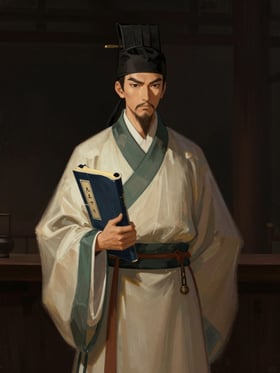
Yin Mo, a Shu Han classicist and official, mastered the Zuo Zhuan, taught Liu Shan, and urged his accession.
Appearances
In the novel: 2 chapters · In the Records: 2 volumes
By chapter (4)
Novel
- 80
- 91
Records
- 32
- 42
- Shu Han· Undated
On the boards
Compare with someone →Where this person ranks on each board.
Historical Record
Yin Mo, courtesy name Siqian, was from Fu County in Zitong. As a young man, he traveled far to Jing Province, where he studied the Classics with Sima Hui and Song Zhong. He mastered the various Classics and histories, and was especially well versed in the Zuo Commentary on the Spring and Autumn Annals. He could recite, in broad outline, the commentaries of Liu Xin, Zheng Zhong, Jia Kui and his son, Chen Yuan, Fu Qian, and others. After Liu Bei pacified Yi Province, Yin Mo was appointed an Attendant in the Office of Encouraging Learning. When the heir apparent was appointed, he became an Attendant to the Heir Apparent and taught the future emperor Liu Shan the Zuo Commentary. After Zhuge Liang became chancellor, he appointed Yin Mo as Army Libationer. Following Zhuge Liang’s death, Yin Mo returned to Chengdu and was appointed Grand Master of the Palace. His son, Yin Zong, inherited the family’s learning and later served as a erudite.
In the first year of Huangchu, news arrived that Emperor Wen of Wei had proclaimed himself emperor and that the Han emperor had been killed. Liu Bei donned mourning attire for the Han emperor and posthumously honored him as Emperor Xiaomin. Afterward, Yin Mo and a group of officials from Yi Province submitted a memorial urging Liu Bei to take the throne, joining the political campaign to support him; the Records of the Three Kingdoms records this memorial, but the materials provided do not include its full text. The historical accounts present Yin Mo both as a Shu Han scholar renowned for his mastery of the Classics and as an official who successively helped educate the future emperor and served in the chancellor’s office and at court.
In the Novel
In Chapter 80 of Romance of the Three Kingdoms, Yin Mo is listed among the “scholars” and placed among the officials who support Liu Bei’s proclamation as King of Hanzhong. The novel has Zhuge Liang urge Liu Bei to accept the calls for him to take the throne, citing fears that the Han house will come to an end and that the officials will lose heart. Yin Mo is named alongside Xiang Ju, Liu Bao, Zhao Zuo, Yang Hong, Du Qiong, Zhang Shuang, and others as one of those urging Liu Bei to accept. This echoes the historical account that Yin Mo joined officials from Yi Province in submitting a memorial urging Liu Bei to take the throne. But the novel places him in a specific scene of persuasion in Liu Bei’s bedchamber, with the assembled officials and Liu Bei’s assent—dramatic details absent from the Records of the Three Kingdoms materials provided.
Chapter 91 of the novel also includes Yin Mo in the assignments made to officials before Zhuge Liang’s Northern Expeditions, appointing him an erudite alongside Li Zhuan. As Kongming sets out on campaign, he delegates court affairs to the officials left behind, making Yin Mo one of the civil officials who remain in Shu. Although the Records of the Three Kingdoms records that Yin Mo served as an Attendant in the Office of Encouraging Learning, an Attendant to the Heir Apparent, an Army Libationer, and a Grand Master of the Palace, it does not mention his appointment as an erudite during this campaign. His position as an erudite here is therefore an addition to his career in the novel and should not be conflated with the historical record.
Key Relationships
The historical account explicitly links Yin Mo’s scholarly lineage to Sima Hui and Song Zhong: he traveled to Jing Province to study with them, laying the foundations of his learning in the old traditions, and became known for his mastery of the Zuo Commentary on the Spring and Autumn Annals. At the Shu Han court, his relationship with Liu Shan combined the roles of teacher and official: he was appointed to teach the future emperor the Zuo Commentary and had also served as an Attendant to the Heir Apparent. His son, Yin Zong, inherited his learning, showing that this scholarship continued within the family.
Zhuge Liang was an important patron in Yin Mo’s career: the historical account says that Liang appointed him Army Libationer, while the novel separately portrays him as an erudite who remained in Shu as part of the personnel arrangements before Kongming’s Northern Expeditions. The former is found in the historical account; the latter belongs to the novel’s narrative. As for Li Zhuan, the available materials provide only the title of his biography and a note stating that “Li Zhuan was a student of Yin Mo.” This supports a description of their scholarly lineage, but no further details about their teacher-student relationship should be added.
Signature Scenes
The historical scene that best illustrates Yin Mo’s political role is the joint memorial submitted by officials from Yi Province in the early Huangchu period, urging Liu Bei to take the throne. Yin Mo is named alongside Liu Bao, Xiang Ju, Zhang Yi, Huang Quan, Zhao Zuo, Yang Hong, He Zong, Du Qiong, Zhang Shuang, Qiao Zhou, and others, showing that he was not only a scholar who taught the Classics but also took part in major ritual and political declarations by the Shu Han regime. The materials do not provide the memorial’s precise wording, so it cannot be reconstructed from them.
The novel transforms this historical connection into a more theatrical scene of urging Liu Bei to take the throne. After Zhuge Liang persuades him, Liu Bei leaves his bedchamber and sees the civil and military officials assembled outside, with Yin Mo listed among them as a scholar. The novel then describes the construction of an altar, the offering of sacrifices, and the officials’ invitation for Liu Bei to ascend the altar and proclaim himself emperor. Yin Mo does not speak during this ceremony; the text presents him only as one of the assembled officials. Another scene in Chapter 91 has Kongming appoint Yin Mo to remain behind as an erudite before the Northern Expeditions. This assignment appears only in the novel and should not be mistaken for an appointment recorded in the Records of the Three Kingdoms.
- Family
- Teacher & student
Who is Yin Mo connected to?
Pick someone to see how many steps lie between them and Yin Mo.
Events
Events (2)
Battles and events the texts place this person in, by date.
Places
- Native of
- FuRecords
Continue
Yin Zong
Kin
Relationship timeline3 entries ▸
History · vol. 42
- Song Zhong§42
Teacher
Studied ancient learning under Song Zhongzi
- Liu Shan§42
Student
Taught the Later Lord the Zuo Commentary.
- Sima Hui§42
Teacher
Traveled afar to Jing Province and studied classical learning under Sima Decao and Song Zhongzi.
Inner monologues · AI-generated1 monologue ▸
- I am Yin Mo, courtesy name Siqian. Looking back on my life, what I can speak of is neither distinction on the battlefiel