Shu Han · General
Gao Xiang
also called 高详
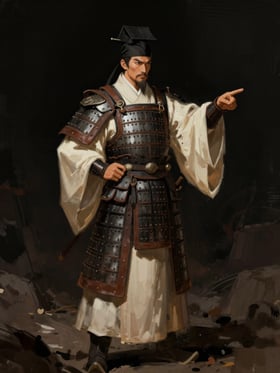
Gao Xiang, a Shu Han general, reportedly camped at Liucheng and fought invaders; the novel depicts him defending, hauling grain, and luring foes.

Life
In the novel: 6 chapters · In the Records: 3 volumes
Life?–?
231 CE (Taihe 5)
234 CE (Qinglong 2)
Allegiance
Appearances
By chapter (9)
Novel
- 91
- 93
- 95
- 96
- 102
- 103
Records
- 26
- 35
- 40
- Shu Han
- Hatched: dated by chapter
- Life event
List all 2 stops
On the boards
Compare with someone →Where this person ranks on each board.
Historical Record
Gao Xiang was a Shu Han general. The Records of the Three Kingdoms state that in the fifth year of Jianxing (227), when Zhuge Liang first advanced from Mount Qi, Gao Xiang was stationed at Lieliu City. The same passage records that the Wei general Guo Huai attacked his camp and that Zhang He defeated Ma Su. Later, Wei forces also defeated the Qiang leader Tang Ti at Fuhan, after which Guo Huai was promoted to General Who Establishes Might. The historical account briefly notes only that Gao Xiang was stationed at Lieliu City and that his camp was attacked and captured; it does not explain how he fought back or escaped.
In the ninth year of Jianxing, when Zhuge Liang again advanced from Mount Qi, the History of Han and Jin, cited in Pei Songzhi’s commentary, records that Sima Yi led troops to reinforce the Wei forces. Zhuge Liang sent Wei Yan, Gao Xiang, and Wu Ban to resist them. The Shu army routed the Wei forces, capturing armor, weapons, and crossbows, and Sima Yi retreated to his camp. Thus, Gao Xiang also appears in accounts of resistance to the enemy during the Northern Expeditions. In the same year, over grain-supply problems, Zhuge Liang submitted a memorial concerning Li Ping. The memorial preserved in Pei Songzhi’s commentary lists Gao Xiang as “General of the Right, Director of the Vanguard, and Marquis of Xuandu,” and records that he joined several other generals in deciding to remove Li Ping from office and strip him of his title. Gao Xiang was not only a frontline general but also took part in military and governmental deliberations.
In the Novel
The Romance of the Three Kingdoms portrays Gao Xiang as a Shu general repeatedly dispatched by Zhuge Liang. In Chapter 91, the novel names him General of the Right and Marquis of Xuandu; these titles do not exactly match the “General of the Right, Director of the Vanguard, and Marquis of Xuanyang” found in the historical account. In the battle at Tianshui in Chapter 93, Zhao Yun falls for Jiang Wei’s stratagem and is defeated. Gao Xiang and Zhang Yi emerge along separate routes to escort Zhao Yun back to camp. This scene highlights his role in rescuing troops in battle; its details belong to the novel’s narrative.
The fall of Jieting is an important episode in the novel’s portrayal of Gao Xiang. Kongming orders him in advance to lead ten thousand men and station them at Lieliu City as a supporting force for Jieting. On learning that Jieting has fallen, Gao Xiang gathers all the troops in the city and rushes to the scene. He confers with Wei Yan about a night raid on the Wei camp, but they fall into an ambush. Wang Ping breaks through the encirclement and rescues Gao and Wei Yan. As the three retreat to Lieliu City, Guo Huai attacks them, forcing them to flee to Yangping Pass. Wang Ping then reports to Kongming how Jieting was lost, and Gao Xiang accompanies Ma Su, Wang Ping, and Wei Yan back to camp to appear before him. Although the Records of the Three Kingdoms records that Gao Xiang was stationed at Lieliu City and that Guo Huai captured his camp, it does not mention the novel’s specific episodes of the night raid on the Wei camp, Wang Ping’s rescue, or the retreat to Yangping Pass.
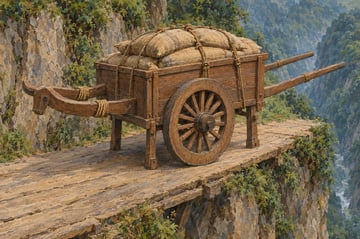
Later in the novel, Gao Xiang is also assigned grain transport and a mission to lure the enemy. He leads troops driving Wooden Oxen and Flowing Horses to transport grain from Jianmen Pass to Mount Qi; on the way, Wei forces ambush them and seize several of the machines. In the stratagem at Shangfang Valley, he is ordered to drive Wooden Oxen and Flowing Horses along the mountain road carrying rice, pretending to transport grain in order to lure the Wei forces into trying to seize it. The novel says that he feigns defeat repeatedly, leading Sima Yi to misjudge the situation. These episodes depict Gao Xiang in the novel as adept at carrying out military orders and assisting Zhuge Liang’s stratagems; they should not be conflated with the historical record.
Key Relationships
Gao Xiang’s relationship with Zhuge Liang is presented in both the historical record and the novel as that of a general serving under his commander. The historical account records that he was stationed at Lieliu City during Zhuge Liang’s Northern Expeditions and was named in the memorial concerning Li Ping; the novel repeatedly depicts Kongming assigning him to defend a city, reinforce troops, transport grain, and lure the enemy. In the ninth year of Jianxing, he and Wei Yan and Wu Ban were ordered to resist the Wei forces; according to the historical account, the Shu army routed the enemy. The novel also has him stand alongside Wei Yan and Wang Ping in an attempt to recover from the fall of Jieting, but they are ambushed and forced to retreat. His clashes with Guo Huai are likewise recounted in two ways: the historical record says Guo Huai captured his camp at Lieliu City, while the novel further describes Guo Huai taking advantage of the disorder to attack the city and forcing Gao Xiang and the others to retreat to Yangping Pass.
Signature Scenes
Lieliu City was Gao Xiang’s most representative stronghold. The historical account is brief and clear: when Zhuge Liang first advanced from Mount Qi, Gao Xiang was stationed at Lieliu City, and Guo Huai attacked and captured his camp. The Romance of the Three Kingdoms expands this defense into a series of dramatic actions: Kongming stations Gao Xiang at Lieliu City in advance to support Jieting; after Jieting falls, Gao Xiang proposes a night raid on the Wei camp, then becomes trapped in an encirclement alongside Wei Yan. Wang Ping rescues them, but Guo Huai attacks again, and they ultimately retreat to Yangping Pass. (Unique to the novel)
Another signature scene is the transport of grain by Wooden Ox and Flowing Horse. The novel orders Gao Xiang to lead a thousand men transporting grain from Jianmen Pass to Mount Qi, then has him pretend to transport grain around Shangfang Valley to make the Wei forces believe that the Shu army has been repeatedly defeated and that its supply route is vulnerable. This literary portrayal expands the historically recorded Gao Xiang, whose role centered on defending cities, resisting the enemy, and taking part in military deliberations, into an active general carrying out multiple tasks during the Northern Expeditions.
Lines
- 演 ch.95 §9
「不如今晚去劫魏寨,再復街亭。」
Family, lords and rivals
1 relationships

Who is Gao Xiang connected to?
Pick someone to see how many steps lie between them and Gao Xiang.
Combat
On the field
Duels, kills and executions as the texts tell them, counted separately for the Records and the Romance.
Stratagems
Plans this person devised or saw through, as the texts tell them.
- Romance
- 1 carried out · 0 worked · 0 turned down · 0 seen through
- RomanceRaid the CampOtherFailedagainst Wei's campCh. 95「不如今晚去劫魏寨,再復街亭」
Events
Events (5)
Battles and events the texts place this person in, by date.
Battles
Other events
Famous objects
Continue
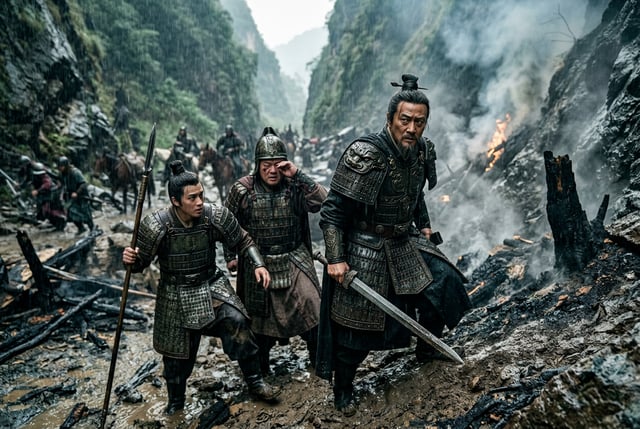
Fire Attack at Shangfang Valley
Relationship timeline1 entry ▸
Novel · ch. 103
Commands
was ordered to drive the Wooden Ox and Flowing Horse along the mountain road to lure the Wei troops into seizing them
Inner monologues · AI-generated1 monologue ▸
- When I was ordered to garrison Lieliu City, I knew this was no idle assignment. Jieting lay ahead, with narrow mountain