Overview
Mengde's New Book is the title given in Romance of the Three Kingdoms to a military treatise written by Cao Cao. The novel says that it consists of thirteen chapters, all dealing with essential principles of warfare. The Weishu, quoted in Pei Songzhi's commentary on the Annals of Emperor Wu in Records of the Three Kingdoms, stated that Cao Cao “personally wrote a military treatise of more than a hundred thousand words,” and that his generals on campaign “all conducted operations according to the new book”.
Origins
According to the Weishu, quoted in Pei Songzhi's commentary on the Annals of Emperor Wu in Records of the Three Kingdoms, Cao Cao generally followed the methods of Sun and Wu in military operations, devising unconventional tactics to suit the circumstances. He wrote a military treatise of more than a hundred thousand words, and his generals all followed the “new book” when setting out on campaign.
In chapter 60 of Romance of the Three Kingdoms, Yang Xiu says that the Chancellor composed the book by weighing ancient practices against present circumstances, modeling it on the thirteen chapters of the Sunzi. He also says that the Chancellor keeps it secret: although compiled into a volume, it has not yet circulated publicly.
Notable Episodes
The Yibu qijiu zaji, quoted in Pei Songzhi's commentary on the biography of the Former Lord in Records of the Three Kingdoms, recorded that Liu Zhang sent Zhang Song to see Cao Cao. Cao Cao treated him with little courtesy, but his Registrar, Yang Xiu, held him in high regard. Yang Xiu showed Zhang Song “the military treatise written by His Excellency.” After reading it once during a banquet, Zhang Song could recite it from memory, which made Yang Xiu consider him all the more extraordinary.
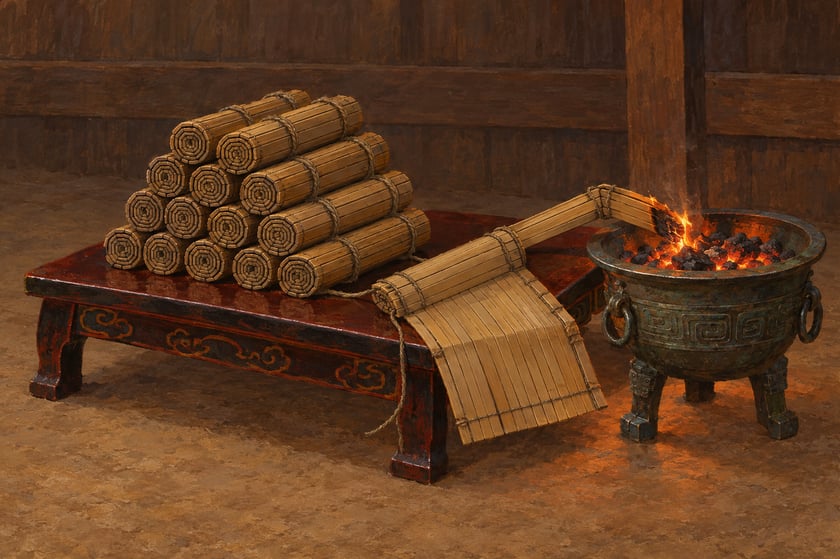
In chapter 60 of Romance of the Three Kingdoms, Yang Xiu argues with Zhang Song and orders his attendants to take a scroll from a chest and show it to him. It is titled Mengde's New Book. After reading it once, Zhang Song laughs and claims that even a child three chi tall in Shu can recite it from memory. He falsely alleges that an anonymous writer of the Warring States period composed it and that Cao Cao stole it and passed it off as his own, then recites the entire text without a single error. Yang Xiu reports this to Cao Cao, who wonders, “Could it be that an ancient writer and I arrived at the same ideas without knowing it?” He orders the book torn up and burned. This episode appears in Zhang Song Presents the Map and Plots to Cede Shu.
In chapter 68 of Romance of the Three Kingdoms, Zuo Ci (called “Ci” in this chapter) conjures purple-sprouted ginger in a golden basin at a banquet. A book titled “Mengde's New Book” suddenly appears in the basin. Cao Cao takes it and reads it; not a single word differs, leaving him deeply suspicious. This is a supernatural episode in the novel.
History and the Romance
Title: Records of the Three Kingdoms does not record the title “Mengde's New Book.” The Yibu qijiu zaji, quoted in Pei Songzhi's commentary on the biography of the Former Lord, referred to the work Yang Xiu showed Zhang Song only as “the military treatise written by His Excellency”.
Plot: Zhang Song's ability to recite the text after a single reading was attested in Pei Songzhi's commentary on Records of the Three Kingdoms, but the work Yang Xiu showed him was called only “the military treatise written by His Excellency”. The title “Mengde's New Book,” its thirteen chapters, Zhang Song's false claim that an anonymous writer of the Warring States period composed it, and Cao Cao's tearing up and burning the book all appear in chapter 60 of Romance of the Three Kingdoms.
Other works: Sun Sheng's Yitong zayu, quoted in Pei Songzhi's commentary on the Annals of Emperor Wu in Records of the Three Kingdoms, stated that Cao Cao compiled extracts from various writers on warfare into a work titled Jieyao and also annotated Sun Wu's thirteen chapters. These were two separate works.
Scholarship
According to later scholarship, the Tang-dynasty Li Weigong wendui mentions Lord Cao's Xinshu. This work is now lost.