Cao Wei · Chief Clerk of the Army
Yang Xiu
courtesy name 德祖 · 175–219
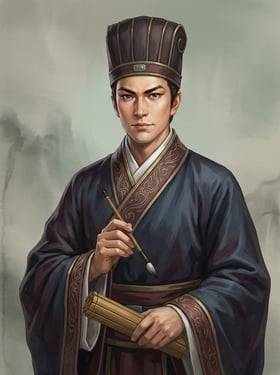
Learned and eloquent, he presumed upon his talent and looked down on the scholars of the realm. Trusting in his gifts and unrestrained, quick-witted and fond of showing off, he repeatedly ran afoul of Cao Cao's taboos.

Life
In the novel: 4 chapters · In the Records: 3 volumes
Life175–219
211 CE (Jian'an 16)
217 CE (Jian'an 22)
- Succession Struggle Between Cao Pi and Cao ZhiYeKilled in action
219 CE (Jian'an 24)
Allegiance
- Cao Wei
- Hatched: dated by chapter
- Life event
- Death
List all 4 stops
On the boards
Compare with someone →Where this person ranks on each board.
Who they were
Character profile
- Character
- Learned and eloquent, he presumed upon his talent and looked down on the scholars of the realm. Trusting in his gifts and unrestrained, quick-witted and fond of showing off, he repeatedly ran afoul of Cao Cao's taboos.
- Manner of speech
- Sharp and quick in intellect, lucid in tone as he parsed characters and unraveled riddles, often self-satisfied in his sophistry.
- Life
- He died at the age of thirty-four; for leaking confidential instructions and consorting with the feudal lords he was seized and executed by the Grand Progenitor, implicated also in the affair of Cao Zhi. In the end he was beheaded outside the camp gate on the charge of 'confounding the morale of the army.'
- Anecdotes
- A man of Hongnong, he was recorder in the Chancellor's office and once served as army recorder on campaign. Together with the Ding Yi brothers he formed the wings supporting Cao Zhi, and was one of the two whom Mi Heng dismissed as 'mere boys.'
Historical Record
Yang Xiu, courtesy name Dezu, was from Hongnong and the son of Grand Commandant Yang Biao. The Dianlüe, cited in Pei Songzhi’s annotations, describes him as modest and talented. During the Jian’an era, he was recommended as a Filial and Incorrupt official and appointed a Gentleman of the Palace. Cao Cao later summoned him to serve as Chief Clerk of the Granaries in the Chancellor’s Office. When military and state affairs were numerous, Yang Xiu oversaw both internal and external matters, and his work often met with Cao Cao’s approval. Exceptionally talented and resourceful, he was on friendly terms with many people, including those below the level of the Cao Wei heir apparent. Cao Zhi, too, was favored by Cao Cao for his talents and actively associated with Yang Xiu; the two exchanged letters many times. Yang Xiu, Ding Yi, Ding Yi, and others became supporters of Cao Zhi. But Cao Zhi was willful, drank excessively, and lacked self-restraint, and ultimately failed to become heir.
Cao Cao once worried that the future succession of power might lead to upheaval. Believing Yang Xiu to be highly talented and resourceful, and also a nephew of the Yuan clan, he had him executed on a charge of guilt. The Dianlüe, cited in Pei Songzhi’s annotations, records that Yang Xiu said before his death that he was “dying because of Cao Zhi.” The account in the Records of the Three Kingdoms also places the matter within Cao Cao’s concerns about the succession. The sources support the conclusion that Yang Xiu’s death was connected to Cao Zhi, but the specific execution details in the novel should not be treated as historical fact. The Records of the Three Kingdoms, in Volume 21, also mentions Yang Xiu of Hongnong among men of literary talent, noting that details of his story appear in the “Biography of the Prince of Chen Si.”
In the Novel
The Romance of the Three Kingdoms portrays Yang Xiu as a quick-witted, widely read and well-remembered chief clerk who was also arrogant about his talents. When Zhang Song came to Xu, Yang Xiu debated with him. After showing him the New Book of Mengde, Yang Xiu saw Zhang Song recite it after a single reading and mock it as no new work by Cao Cao. Yang Xiu then praised Zhang Song’s talent and insight to Cao Cao and urged him to receive the visitor. The novel also depicts Yang Xiu accompanying Zhang Song to watch military drills and, when Cao Cao wanted to kill Zhang Song, joining Xun Yu in urging Cao Cao to reconsider. This presents him as someone who appreciated talent but also weighed the possible consequences of killing an envoy.
The novel further highlights Yang Xiu’s cleverness through a series of stories about interpreting characters and discerning intent. Cao Cao writes the character “活” (“alive”) on a garden gate, and Yang Xiu interprets it as meaning “wide,” since adding “活” inside “門” (“gate”) makes “闊” (“wide”). Cao Cao writes “一合酥” (“a box of crisp”), and Yang Xiu breaks it down as “one person, one bite of crisp.” When Cao Cao pretends to kill people in his sleep, Yang Xiu sees through his intentions. The novel also has Yang Xiu take part in the contest over succession between Cao Pi and Cao Zhi: he tells Cao Cao that Wu Zhi is hidden in a large basket, instructs Cao Zhi to kill the gatekeeper, and drafts a reply for Cao Zhi in advance. These details echo the historical background of Yang Xiu’s support for Cao Zhi, but the specific stories of his cleverness and their plots are not recorded in the Records of the Three Kingdoms.
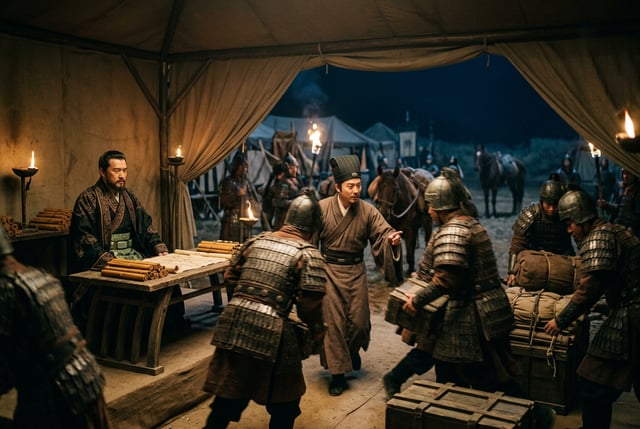
The novel brings Yang Xiu’s story to a close with the password “chicken ribs”: Yang Xiu judges that Cao Cao is about to withdraw and first tells the soldiers to pack their gear. Cao Cao rebukes him for disrupting morale and has him executed at the command tent. The novel also links his repeated earlier offenses to this execution as cause and effect, and says that he died at the age of thirty-four. These details about his age and execution belong to the novel’s narrative and should not be confused with the historical biographies.
Key Relationships
- Cao Cao: Historical accounts say that Yang Xiu served as chief clerk in the Chancellor’s Office, oversaw internal and external affairs, and was highly talented and resourceful; Cao Cao ultimately had him executed out of concern about the succession. The novel portrays him as someone who could often see through Cao Cao’s thoughts and repeatedly angered him, before being executed over the “chicken ribs” incident—a detail unique to the novel.
- Cao Zhi: Historical accounts say that Cao Zhi and Yang Xiu were close and exchanged letters many times; Yang Xiu, Ding Yi, and Ding Yi were among Cao Zhi’s supporters. The novel expands this, depicting Yang Xiu as advising Cao Zhi and drafting replies for him, strengthening the impression that the two were jointly caught up in the struggle over succession. These specific schemes are unique to the novel.
- Yang Biao: The Dianlüe, cited in Pei Songzhi’s annotations, says that Yang Xiu was the son of Grand Commandant Yang Biao.
- Zhang Song: The Romance of the Three Kingdoms depicts Yang Xiu debating with Zhang Song in the Chancellor’s Office, recommending him to Cao Cao, and pleading for him at the drill ground. This association appears only in the novel.
Signature Scenes
- Managing affairs as chief clerk: Historical biographies say that Yang Xiu served as a Gentleman of the Palace during the Jian’an era, then became Chief Clerk of the Granaries in the Chancellor’s Office. At a time of numerous military and state affairs, he oversaw internal and external matters and handled them well. This episode illustrates not puzzle-solving ingenuity but his actual duties and abilities within Cao Cao’s administration.
- Displaying talent through character analysis: The novel uses the “活” on the garden gate and the “一合酥” episode to show Yang Xiu quickly inferring Cao Cao’s intentions from written characters. It also suggests that his cleverness gradually turned into showing off his talent—a detail unique to the novel.
- Inferring the time of withdrawal from “chicken ribs”: In the novel, Yang Xiu interprets “chicken ribs” as something with no meat to eat but some flavor to discard, concludes that Cao Cao is about to withdraw, and has the troops pack their gear in advance. Cao Cao kills him for disrupting morale. This is the central scene through which the novel portrays Yang Xiu’s intelligence and tragic end; the password and execution are not recorded in the Records of the Three Kingdoms and are unique to the novel.
Quotes
25 lines in the books · 3 featured
「以今夜號令,便知魏王不日將退兵歸也:雞肋者,食之無肉,棄之有味。今進不能勝,退恐人笑,在此無益,不如早歸。來日魏王必班師矣。故先收拾行裝,免得臨行慌亂。」
The 'chicken ribs' allusion embodies both Yang Xiu's talent and the source of the disaster he courted; it is widely circulated.
「『門』內添『活』字,乃『闊』字也。丞相嫌園門闊耳。」
The 'kuo (wide)' character-on-the-gate allusion shows Yang Xiu's exceptional wit and is also a portrait of his talent-flaunting arrogance.
「盒上明書『一人一口酥』,豈敢違丞相之命乎?」
The 'one bite of pastry per person' allusion highlights Yang Xiu's brilliance, yet also hints at his overexposed edge.
- Family
- Friends
- Enemies
Who is Yang Xiu connected to?
Pick someone to see how many steps lie between them and Yang Xiu.
History vs. novel
7 points · 6 novel-only
| History | Novel |
|---|---|
| Cao Zhi’s SupportersNovel embellishes | |
Yang Xiu, Ding Yi, Ding Yi, and others assisted Cao Zhi, becoming important supporters in his bid to succeed to the throne. Cao Cao wavered several times, but Cao Zhi ultimately failed to succeed him. vol. 19 | The novel portrays Yang Xiu as close to Cao Zhi, who often invited him to talk through the night. Yang Xiu also repeatedly offered Cao Zhi advice, leading Cao Cao to grow increasingly displeased with the two of them. ch. 72 |
| Zhang Song’s DebateNovel only | |
| — | Yang Xiu crossed wits with Zhang Song, boasting of his learning by showing off the New Book of Mengde. Zhang Song recited the entire work on the spot and called it an old text, greatly astonishing Yang Xiu. ch. 60 |
| The Riddle on Cao E’s SteleNovel only | |
| — | The novel says Yang Xiu solved the riddles on the back of Cao E’s stele, including “yellow silk, young woman,” arriving at “wonderfully fine words.” Cao Cao also said the answer matched what he had thought. ch. 71 |
| The Character “Alive” and the Pastry BoxNovel only | |
| — | Yang Xiu interpreted the character “alive” on a gate as meaning that Cao Cao thought the gate was too wide. He also shared a box of pastries marked “one he” among the others, explaining it to mean one person, one bite. These clever acts made Cao Cao wary of him. ch. 72 |
| Killing in a DreamNovel only | |
| — | Cao Cao pretended that he killed people in his sleep. Seeing through his intent, Yang Xiu mocked him, saying that Cao Cao was not the one dreaming—his attendants were. Cao Cao consequently detested him even more. ch. 72 |
| Drafting Replies to Help Cao ZhiNovel only | |
| — | The novel says Yang Xiu prepared more than ten sets of model replies for Cao Zhi, enabling him to answer Cao Cao’s questions fluently. After Cao Pi reported this, Cao Cao flew into a rage and became even more determined to kill Yang Xiu. ch. 72 |
| Killed over “Chicken Ribs”Novel only | |
| — | In the Hanzhong army camp, the order “chicken ribs” was passed down. From this, Yang Xiu concluded that Cao Cao would retreat and ordered the men to pack their gear. Cao Cao had him executed for disrupting military morale; the novel says he was thirty-four when he died. ch. 72 |
- Cao Zhi’s SupportersNovel embellishes
- History
Yang Xiu, Ding Yi, Ding Yi, and others assisted Cao Zhi, becoming important supporters in his bid to succeed to the throne. Cao Cao wavered several times, but Cao Zhi ultimately failed to succeed him.
vol. 19
- Novel
The novel portrays Yang Xiu as close to Cao Zhi, who often invited him to talk through the night. Yang Xiu also repeatedly offered Cao Zhi advice, leading Cao Cao to grow increasingly displeased with the two of them.
ch. 72
- Zhang Song’s DebateNovel only
- Novel
Yang Xiu crossed wits with Zhang Song, boasting of his learning by showing off the New Book of Mengde. Zhang Song recited the entire work on the spot and called it an old text, greatly astonishing Yang Xiu.
ch. 60
- The Riddle on Cao E’s SteleNovel only
- Novel
The novel says Yang Xiu solved the riddles on the back of Cao E’s stele, including “yellow silk, young woman,” arriving at “wonderfully fine words.” Cao Cao also said the answer matched what he had thought.
ch. 71
- The Character “Alive” and the Pastry BoxNovel only
- Novel
Yang Xiu interpreted the character “alive” on a gate as meaning that Cao Cao thought the gate was too wide. He also shared a box of pastries marked “one he” among the others, explaining it to mean one person, one bite. These clever acts made Cao Cao wary of him.
ch. 72
- Killing in a DreamNovel only
- Novel
Cao Cao pretended that he killed people in his sleep. Seeing through his intent, Yang Xiu mocked him, saying that Cao Cao was not the one dreaming—his attendants were. Cao Cao consequently detested him even more.
ch. 72
- Drafting Replies to Help Cao ZhiNovel only
- Novel
The novel says Yang Xiu prepared more than ten sets of model replies for Cao Zhi, enabling him to answer Cao Cao’s questions fluently. After Cao Pi reported this, Cao Cao flew into a rage and became even more determined to kill Yang Xiu.
ch. 72
- Killed over “Chicken Ribs”Novel only
- Novel
In the Hanzhong army camp, the order “chicken ribs” was passed down. From this, Yang Xiu concluded that Cao Cao would retreat and ordered the men to pack their gear. Cao Cao had him executed for disrupting military morale; the novel says he was thirty-four when he died.
ch. 72
Combat
On the field
Duels, kills and executions as the texts tell them, counted separately for the Records and the Romance.
Events
Events (3)
Battles and events the texts place this person in, by date.
Other events
- 211Zhang Song Presents the Map and Plots to Cede ShuWitness
- 217Succession Struggle Between Cao Pi and Cao ZhiKilled in action
- 219Death of Yang XiuVictim
Famous objects
Places
- Native of
- Hongnong CommanderyRecords
Continue
Death of Yang Xiu
Relationship timeline4 entries ▸
History · vol. 19
- Cao Zhi§10
Friend
together with the Ding Yi brothers, served as a support for Zhi; was implicated in Cao Zhi's death
Novel · ch. 60
- Cao Cao§13
Advised
urged accepting Zhang Song; cited Mi Heng as a comparison
Novel · ch. 72
- Cao Zhi§12
Friend
Xiu appreciated Zhi’s talent and often invited him to talk through the night; he also wrote more than ten instructional replies for Zhi, teaching him to have the gate guard beheaded
- Cao Cao§14
Enemy
Repeatedly incurred Cao Cao's displeasure; in this chapter, was beheaded for the crime of confusing and disrupting the army's morale
Inner monologues · AI-generated3 monologues ▸
- I am Yang Xiu, courtesy name Dezu. If I were to ask myself now what I relied on throughout my life, what would it be? No
- I am Yang Xiu, courtesy name Dezu, a chief clerk in the Chancellor’s residence, and have always prided myself on my quic
- I am Yang Xiu, courtesy name Dezu, son of Yang Biao, the Grand Commandant. I recall that when I first served as registra