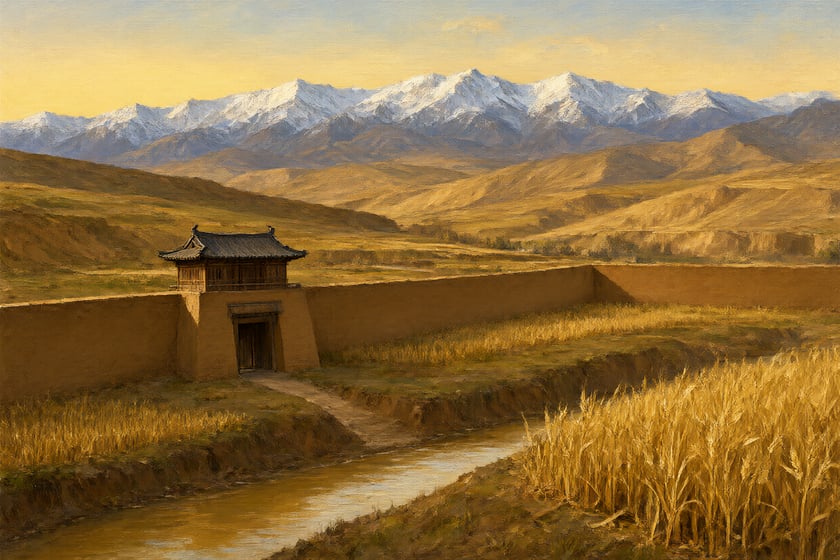
Overview
Fuhan was a county under Longxi Commandery in Liang Province during the Eastern Han. Its former site lies northeast of present-day Linxia City, Linxia Hui Autonomous Prefecture, Gansu Province. At the end of the Eastern Han, Song Jian declared himself King of Heshou Pinghan at Fuhan and ruled independently for more than thirty years, until Xiahou Yuan defeated and destroyed his regime in the nineteenth year of Jian’an (214).
History
Song Jian, a native of Longxi, took advantage of turmoil in Liang Province to gather followers at Fuhan, proclaim himself King of Heshou Pinghan, adopt a new era name, and establish official posts. He held power for more than thirty years in all. In the nineteenth year of Jian’an (214), Cao Cao sent Xiahou Yuan from Xingguo to campaign against him. After besieging Fuhan for more than a month, Xiahou Yuan broke through the city walls. In the tenth lunar month of winter, he massacred the city and executed Song Jian and the officials he had appointed, from the chancellor on down, thereby pacifying Liang Province. Xiahou Yuan also dispatched Zhang He and others to pacify Heguan. They crossed the Yellow River and entered Xiaohuangzhong, whereupon all the Qiang tribes west of the river surrendered. Cao Cao issued an order praising him: “He strides like a tiger west of the passes, and none can stand against him”.
After the Battle of Jieting in the second year of Taihe (228), the Wei general Guo Huai defeated Tang Ti, a leader of the Qiang people in Longxi, at Fuhan and was promoted to General Who Establishes Might for his achievements. After Guo Huai’s death, Jiang Wei and Xiahou Ba of Shu Han led tens of thousands of men to Fuhan, then turned toward Didao. Wang Jing, Inspector of Yong Province for Wei, was subsequently defeated west of the Tao River and withdrew to defend Didao city.