Cao Wei · Empress → Empress Dowager
Empress Guo
also called 郭贵妃、郭贵嫔 · 184–235
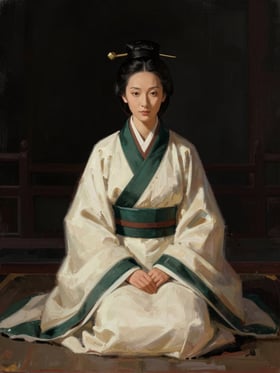
She was intelligent and strategic. From her time in the Eastern Palace until she took the honored position, though favored, she remained respectful and solemn. She was frugal and disliked music.
Life
In the novel: 2 chapters · In the Records: 6 volumes
Life184–235
Allegiance
Appearances
On the boards
Compare with someone →Where this person ranks on each board.
9 more boards
- Most Advisors: #42of 88Romance
- Plans That Worked: #55of 159Romance
- Most Talkative: #58of 349Records
- Master Strategists: #79of 220Romance
- Died Youngest: #81of 182Records
- Longest Lived: #101of 182Records
- Overlooked by the Novel: #131of 2139Both
- Best Connected: #172of 1005Romance
- Novel Embellished: #472of 2139Both
Who they were
Character profile
- Character
- She was intelligent and strategic. From her time in the Eastern Palace until she took the honored position, though favored, she remained respectful and solemn. She was frugal and disliked music.
- Life
- A native of Guangzong, Anping, she lost both parents at an early age and was left adrift amid turmoil. She later entered the household of the Marquis of Tongdi. When Taizu became Duke of Wei, she entered the Eastern Palace; later, she became Emperor Wen’s consort and honored concubine. In the third year of Huangchu, she was made empress. After Emperor Ming ascended the throne, he honored her as empress dowager and named her residence Yongan Palace. She died in Xu Chang in the third year of Qinglong and was buried west of Shouyang Mausoleum.
- Anecdotes
- She played a role in Emperor Wen’s decision on the heir. During Emperor Wen’s eastern campaigns in the fifth and sixth years of Huangchu, she was left to oversee Xu Chang’s Yongshi Terrace and the palace at Qiao, respectively.
Historical Record
Empress Guo, whose personal name is unknown, was from Guangzong, Anping. For generations, her ancestors had served as local officials. The Book of Wei, cited in Pei Songzhi’s commentary, says that her father, Guo Yong, rose to the office of Administrator of Nan Commandery, and that her mother was née Dong. Empress Guo’s courtesy name was “Queen among Women.” When she was young, her father thought her extraordinary and called her “the queen among my daughters.” She lost both parents early and was displaced by war before later entering the household of the Marquis of Tongdi. When Cao Cao became Duke of Wei, she was admitted to the Eastern Palace; when Cao Pi was designated heir, she took part in deliberations. After Cao Pi became king, she was made a consort; after he became emperor, she was elevated to Noble Lady. In the third year of Huangchu, Cao Pi intended to make her empress. Zhonglang Zhan Qian submitted a memorial opposing the move, warning that making a favored concubine empress would violate ritual propriety and disrupt the established order. Cao Pi did not heed him, and Guo was made empress in the ninth month of that year.
The biography in the Records of the Three Kingdoms says, “The death of Empress Zhen was due to the favor shown to the empress,” but does not detail the cause of her death in the biography itself. The Wei Lue and Han-Jin Chunqiu, cited in Pei Songzhi’s commentary, offer other accounts, including claims that Cao Rui grieved over the death of his birth mother, Lady Zhen, and that Empress Guo was consequently forced to her death. These are alternative accounts recorded in Pei’s commentary and should not be conflated with the biography’s direct narrative. Empress Guo had no sons, and Cao Rui was raised by her. After Cao Rui ascended the throne, he honored her as empress dowager and gave her residence the name Yongan Palace. She died at Xu Chang in the spring of the third year of Qinglong and was buried west of Shouyang Mausoleum in the third month. The mausoleum’s design followed the arrangements she had made during her lifetime.
In the biography and the accounts cited in Pei Songzhi’s commentary, Empress Guo is portrayed as both resourceful and known for her modesty and frugality. She cared for the residents of Yongshou Palace and was renowned for her filial piety. She instructed the favored Lady Chai and often shielded noblewomen of the harem when they erred, pleading with the emperor on their behalf; as a result, there was little resentment in the inner palace. She disliked music and admired Empress Ma, the virtuous consort of Emperor Ming of Han. She also kept her relatives in check: she forbade them from using their influence to force marriages with families from other regions, barred them from taking young women as concubines, and warned them not to invite disaster through arrogance and extravagance.
In the Novel
Chapter 91 of Romance of the Three Kingdoms depicts Guo as an assertive schemer at court. The novel retains the account of her origins in Guangzong, Anping, and of her father calling her “queen among women,” but goes further by having her consult with the favored courtier Zhang Tao about contending for the position of empress. Zhang Tao falsely claims to have unearthed a paulownia-wood figurine inscribed with the emperor’s birth date in Lady Zhen’s palace. Cao Pi consequently orders Lady Zhen’s death and makes Guo Guifei empress. The novel also says that, having no sons, she raised Cao Rui, and places after this account of their relationship the episode in which Cao Pi tests Cao Rui with a “mother deer and fawn”: Cao Rui earns praise for refusing to kill the fawn out of compassion. The plot in which Guo fabricates the wooden figurine to frame Lady Zhen and conspires with Zhang Tao is not found in the Records of the Three Kingdoms. The historical biography merely states that the death of Empress Zhen was “due to the favor shown to the empress”; the two accounts differ markedly in narrative emphasis and specific details.
Chapter 91 says that Cao Rui succeeded Cao Pi after the latter had reigned for seven years. Chapter 106, by contrast, depicts Cao Fang’s accession, after which Empress Guo is honored as empress dowager, and moves into the political situation of Sima Yi and Cao Shuang's Regency. This later scene places Empress Dowager Guo against the backdrop of a transfer of imperial power, but does not portray how she took part in the regency or made decisions. This accords with the historical account that she was honored as empress dowager, though the novel does not develop her personal actions at this point.
Key Relationships
Cao Pi: Guo rose from a consort in the Eastern Palace to Noble Lady and then empress, becoming Cao Pi’s empress. Historical accounts say that she took part in deliberations when Cao Pi was designated heir, and that he later made her empress despite Zhan Qian’s opposition. The biography also sums up the connection between Guo’s favor and Empress Zhen’s death with the words, “The death of Empress Zhen was due to the favor shown to the empress.”
Cao Rui: Guo had no sons, and Cao Rui was raised by her. After he ascended the throne, he honored her as empress dowager. Historical sources also record the title he bestowed on her at his accession and her subsequent burial. The claim that he forced Guo to her death over his birth mother’s death belongs to an alternative account cited in Pei Songzhi’s commentary and should not be treated as confirmed by the biography itself.
Guo’s relatives: She imposed restrictions on her relatives’ marriages, taking of concubines, and funerals. After Cao Rui’s accession, relatives such as Guo Biao received fiefs and promotions; she also once urged Meng Wu against an extravagant burial and the construction of a family shrine, to avoid attracting grave robbers.
Zhang Tao: In the novel, this favored courtier conspires with Guo and frames Lady Zhen using a paulownia-wood figurine. Both the relationship and the plot are unique to the novel.
Notable Scenes
Opposition to her appointment as empress: In the third year of Huangchu, Zhan Qian opposed making Guo Guifei empress, citing ancient rites and the distinction between primary and secondary consorts. Cao Pi nevertheless decided to appoint her. This episode shows the political context of Guo’s rise to the throne and makes clear that her appointment was not without controversy.
Remaining at her post and refusing to appropriate state property: When Cao Pi campaigned east, Empress Guo remained at Xu Chang’s Yongshi Terrace. After days of heavy rain damaged many of the city towers, officials asked her to move, but she refused, invoking the precedent of Zhen Jiang remaining at her post. The following year, when Cao Pi campaigned against Wu and she stayed at Qiao Palace, Guo Biao wanted to divert water to catch fish. She objected, pointing out that the waterways were important to transport and that timber was also in short supply; she opposed the private appropriation of official bamboo and timber to build a dam. These two historical episodes give concrete expression to her self-restraint and care in handling public property.
Framing Lady Zhen with a wooden figurine: The novel portrays Guo as the mastermind who causes Lady Zhen to be put to death through a fabricated object used in a curse, then rises to the position of empress. This is a vivid plot point unique to the novel, with no corresponding details in the historical biographies.
Quotes
5 lines in the books · 3 featured
「昔楚昭王出遊,貞姜留漸台,江水至,使者迎而無符,不去,卒沒。今帝在遠,吾幸未有是患,而便移止,奈何?」
She compares herself to Zhen Jiang, who kept her word, highlighting the empress’s adherence to propriety and righteousness.
「自喪亂以來,墳墓無不發掘,皆由厚葬也;首陽陵可以為法。」
She opposes lavish burials, reflecting a practical view of economical funerals in troubled times.
「今世婦女少,當配將士,不得因緣取以為妾也。宜各自慎,無為罰首。」
She strictly forbids taking women by force as concubines, demonstrating concern for the people and self-discipline.
- Family
- Other
Who is Empress Guo connected to?
Pick someone to see how many steps lie between them and Empress Guo.
Combat
On the field
Duels, kills and executions as the texts tell them, counted separately for the Records and the Romance.
Stratagems
Plans this person devised or saw through, as the texts tell them.
- Romance
- 1 carried out · 1 worked · 0 turned down · 0 seen through
- RomanceUse a Paulownia Effigy to Falsely Accuse the EmpressDeceptionWorkedCh. 91「韜乃詐稱於甄夫人宮中掘得桐木偶人」
Events
Events (1)
Battles and events the texts place this person in, by date.
Other events
Places
Continue
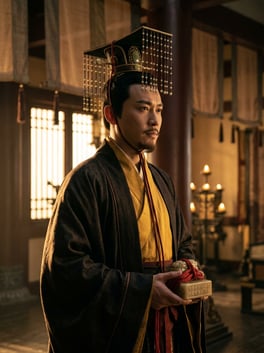
Cao Pi
Spouse
Relationship timeline3 entries ▸
History · vol. 2
- Cao Pi§38
Spouse
On the gengzi day of the ninth month in the third year of Huangchu, she was made empress
History · vol. 5
- Cao Pi§26
Spouse
Emperor Wen designated him as heir; she later plotted against him; Lady → Honored Consort → Empress
Novel · ch. 91
- Cao Rui§10
Child
having no children, adopted Cao Rui as his own son
Inner monologues · AI-generated1 monologue ▸
- I am of the Guo clan, and my courtesy name is Nüwang. When I was installed as empress, I had nothing in my heart of whic