Cao Wei · Staff Officer to the Minister of Works; Registrar; Recorder; Secretary; Director of the Central Secretariat; Marquis of Weishouting; Marquis of Xixiang; Marquis of Fangcheng; Left Grand Master of the Palace; General of the Agile Cavalry; Marquis Jing
Liu Fang
courtesy name 子弃 · –250
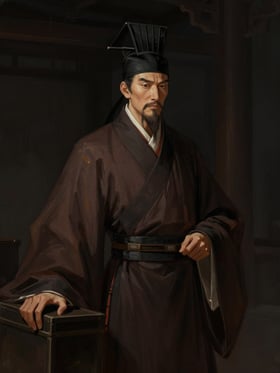
Liu Fang, Cao Wei's Secretariat Supervisor, was known for deft drafting and Liaodong plans; the novel stresses his backing of Cao Shuang.
Life
In the novel: 1 chapter · In the Records: 3 volumes
Life?–250
Allegiance
- Cao Wei
- Hatched: dated by chapter
On the boards
Compare with someone →Where this person ranks on each board.
Historical Record
Liu Fang, courtesy name Ziqi, was from Zhuo Commandery and descended from Liu Hong, King Shun of Guangyang in the Han dynasty. He held various posts overseeing affairs in the commandery and was recommended as a Filial and Incorrupt official. When the realm fell into chaos, he attached himself to Wang Song, who controlled Yuyang, and urged Wang Song to submit to Cao Cao. When Cao Cao campaigned against Yuan Tan, he sent a letter inviting Wang Song to join him. Liu Fang drafted Wang Song’s reply, whose wording was highly elegant. Cao Cao also heard of Liu Fang’s advice and summoned him. In the tenth year of Jian’an, Liu Fang came to Cao Cao together with Wang Song and took part in the military affairs of the Minister of Works. He successively served as registrar and secretary, and later became magistrate of Heyang, Duiyu, and Zanling.
After the Kingdom of Wei was established, Liu Fang served as a Secretariat Gentleman. At the beginning of the Huangchu era, he was made Secretariat Supervisor and concurrently given the title Attendant-in-Ordinary. Thereafter, he and Sun Zi oversaw confidential affairs for many years. Much of the persuasive language in the edicts of the Three Ancestors came from Liu Fang, and the histories record that he excelled at composing official letters and proclamations. At the beginning of the Qinglong era, a letter from Sun Quan reached the frontier. Liu Fang revised its wording, then had Man Chong seal it and show it to Zhuge Liang. Zhuge Liang passed it on to the Wu generals Bu Zhi and others, prompting Sun Quan to worry that Zhuge Liang would become suspicious, so he took pains to explain. After Liaodong was pacified in the second year of Jingchu, Liu Fang was enfeoffed as Marquis of Fangcheng for his contributions to the planning. He was later enfeoffed as Marquis of Xixiang, among other titles, and ultimately reached the posts of Attendant-in-Ordinary and Secretariat Supervisor. In the first year of Zhengshi, he was additionally appointed Left and Right Senior Grandee of Brilliant Happiness. After his death, he was posthumously named Marquis Jing.
When Emperor Ming was gravely ill, he initially intended to appoint Cao Yu, the Prince of Yan, as General-in-Chief to assist the government. Liu Fang and Sun Zi went in to see him, saying that Cao Yu knew he was unequal to the responsibility. They supported replacing Cao Yu with Cao Shuang and strongly urged that Grand Commandant Sima Yi be summoned without delay to secure the imperial house. Emperor Ming changed his mind for a time and ordered that the summons to Sima Yi be stopped. He later summoned the two men again, saying that Cao Zhao and the others had nearly ruined the matter, and ordered them to draft a new edict. Cao Shuang received the edict together with Liu Fang and Sun Zi; Cao Yu, Xiahou Xian, Cao Zhao, and Qin Lang were then removed from office. When Sima Yi arrived, he was appointed to assist the government. This episode shows Liu Fang’s influence over decisions at court, as well as how his advice directly contributed to the reshaping of the regency appointments.
In the Novel
Chapter 106 of Romance of the Three Kingdoms portrays Liu Fang as a close courtier who, together with Sun Zi, controlled the Privy Council and influenced Emperor Ming of Wei’s arrangements on his deathbed. The novel says that the emperor placed the two men in charge of the Privy Council, then summoned Cao Yu, the Prince of Yan, to assist the heir Cao Fang. After Cao Yu repeatedly declined, Liu Fang and Sun Zi recommended Cao Shuang and requested that the Prince of Yan be sent back to his fief. The emperor issued an edict, and Cao Yu left in tears. Cao Shuang was then appointed General-in-Chief and given overall charge of the government. The novel also links the two men’s role in bringing about Cao Shuang's Regency to an old debt to Cao Zhen, saying that they had “long enjoyed Cao Zhen’s kindness.” These specific motives and the scene of the Prince of Yan departing in tears are part of the novel’s portrayal. The historical accounts say that the emperor had initially intended Cao Yu and others to assist the government, that Liu Fang and Sun Zi urged him to summon Sima Yi and supported Cao Shuang, and that Cao Yu and the others were subsequently removed from office; they do not explain the two men’s choice as repayment for Cao Zhen’s kindness.
The novel then says that Sima Yi hurried to the palace upon receiving the summons. Citing Liu Bei's Deathbed Entrustment at Baidi, where Liu Bei entrusted Zhuge Liang with his young son, Emperor Ming entrusted the young Cao Fang to Sima Yi and veteran members of the imperial clan. Cao Fang clung to Sima Yi as the emperor wept and gave his instructions. This passage emphasizes the pathos of the deathbed entrustment, but the Records of the Three Kingdoms provided here does not record the summons to Sima Yi on this occasion, the conversation entrusting the heir, or the scene of Cao Fang embracing him. These should not be conflated with the historical account of the regency arrangements. Liu Fang appears in this scene as an Attendant-in-Ordinary present at court, while the novel’s focus shifts to Emperor Ming, Cao Fang, and Sima Yi.
Key Relationships
Wang Song and Cao Cao: Liu Fang once attached himself to Wang Song and urged him to submit to Cao Cao. He drafted Wang Song’s letter in reply to Cao Cao, and its elegant wording impressed Cao Cao, leading to Liu Fang’s recruitment. This was the key turning point that took Liu Fang from being a local retainer into Cao Cao’s administration.
Sun Zi: The two men oversaw confidential affairs together for many years, handling edicts and government business and taking part in the decisions made when Emperor Ming was on his deathbed. The histories record both Liu Fang’s skill in composing official letters and proclamations and the two men’s joint efforts to bring about Sima Yi’s summons and Cao Shuang’s appointment to assist the government.
Cao Shuang and Sima Yi: In the historical account of the regency arrangements, Liu Fang and Sun Zi supported Cao Shuang as Cao Yu’s replacement and recommended that Sima Yi be summoned to assist the government. Together, they took part in reshaping the regency appointments. The novel, by contrast, highlights Liu Fang and Sun Zi recommending Cao Shuang and sending Cao Yu away, and adds Cao Zhen’s past kindness as their motive.
Xin Pi: Emperor Ming trusted Liu Fang and Sun Zi, and the two had influence over current affairs. Xin Pi did not associate with them and also refused his son’s advice to follow the crowd in supporting them. When Xin Pi was recommended as Vice Director of the Department of State Affairs, Liu Fang and Sun Zi said that although he was upright and forthright, he was also obstinate and domineering. Xin Pi was ultimately not appointed and instead became Commandant of the Guards.
Notable Scenes
Recruited by Cao Cao for his writing: After Wang Song accepted Liu Fang’s advice to submit to Cao Cao, Liu Fang drafted the reply. Cao Cao praised not only the letter but also Liu Fang’s counsel, and summoned him to serve. This episode brings together Liu Fang’s political judgment and literary talent, marking the start of his official career.
Revising a letter from Wu to drive a wedge between Sun Quan and Zhuge Liang: At the beginning of the Qinglong era, Liu Fang altered the wording of a letter from Sun Quan and, with Man Chong, arranged for it to be sealed and shown to Zhuge Liang. Zhuge Liang then passed it on to Bu Zhi and other Wu generals. Sun Quan consequently worried that Zhuge Liang suspected him and hurried to explain himself. This is the historical account’s clearest example of Liu Fang’s skill at composing official letters and proclamations and using the written word in political strategy.
The dispute over the regency while Emperor Ming was ill: Emperor Ming first proposed that Cao Yu and others assist the government. Liu Fang and Sun Zi urged him to appoint Cao Shuang and summon Sima Yi. After the emperor repeatedly changed his orders, he finally issued a new edict, removed Cao Yu and the others from office, and appointed Sima Yi upon his arrival. The historical account shows Liu Fang’s influence over the decisions while also preserving the emperor’s uncertainty and changes of mind.
Cao Yu’s tearful departure and the entrustment at Baidi: The novel says that Liu Fang and Sun Zi requested that Cao Yu be sent back to his fief, and that Cao Yu departed in tears after receiving the edict. It also says that Emperor Ming cited Liu Bei’s entrustment at Baidicheng and entrusted Cao Fang to Sima Yi; Cao Fang embraced Sima Yi, and the emperor wept. Both the specific order sending Cao Yu away and his tearful departure, and the entire scene of the deathbed entrustment, are unique to the novel. Although the Records of the Three Kingdoms records the reshaping of the regency arrangements and Sima Yi’s summons, it contains none of these descriptions.
Quotes
4 lines in the books · 2 featured
「惟曹子丹之子曹爽可也。」
This statement directly brought about Cao Shuang's monopoly on power, shaping the political situation of the state of Wei.
「陛下用思者,誠欲取其効力,不貴虛名也。毗實亮直,然性剛而專,聖慮所當深察也。」
This statement reflects Liu Fang's political influence over Cao Rui, as well as his incisive judgment of people.
- Friends
- Enemies
- Other
Who is Liu Fang connected to?
Pick someone to see how many steps lie between them and Liu Fang.
History vs. novel
8 points · 3 novel-only
| History | Novel |
|---|---|
| Cause of Illness and Ominous SignNovel only | |
| — | The novel says that before Cao Rui became gravely ill, a sinister wind blew out the lamps at night, and Empress Mingdao, accompanied by palace attendants, wept and demanded his life. The Records of the Three Kingdoms makes no mention of this omen. ch. 106 |
| Choice of RegentNovel embellishes | |
Cao Rui initially intended to appoint Cao Yu as General-in-Chief and have Xiahou Xian, Cao Shuang, Cao Zhao, and Qin Lang jointly assist in governing. Cao Yu was modest and respectful, and firmly declined. vol. 14 | The novel also says that Cao Yu declined the appointment, but claims Cao Rui asked which member of the imperial clan could take on the responsibility, whereupon Liu Fang and Sun Zi immediately recommended Cao Shuang. ch. 106 |
| Reason for the RecommendationNovel only | |
| — | The novel says Liu Fang and Sun Zi recommended Cao Shuang, Cao Zhen’s son, because they had long been indebted to Cao Zhen. The account of the regency arrangements cited in the Records of the Three Kingdoms does not mention this motive. ch. 106 |
| Summons for Sima YiHistory only | |
Liu Fang and Sun Zi advised that Sima Yi be summoned quickly to assist in governing. Cao Rui at first issued an edict forbidding him to come, but then changed his mind, summoned him, and issued him an edict. vol. 14 | — |
| Cao Yu Leaves the CapitalNovel only | |
| — | The novel says Liu Fang and Sun Zi advised sending Cao Yu back to his fief, and that they presented an edict ordering him to set out that very day and forbidding him to attend court without an edict. Cao Yu left in tears. ch. 106 |
| Outcome of the Regency ArrangementsNovel embellishes | |
The historical account says Cao Yu, Xiahou Xian, Cao Zhao, and Qin Lang were removed from office. After Sima Yi arrived, he climbed onto the bed to receive the edict, and Cao Rui died soon afterward. vol. 14 | The novel simplifies events, saying Cao Shuang was made General-in-Chief and took charge of the court, while omitting Sima Yi’s reception of the edict and Cao Rui’s repeated changes of mind about summoning him. ch. 106 |
| Drafting a Reply and Being RecruitedHistory only | |
Liu Fang drafted a reply to Cao Cao on Wang Song’s behalf, and his writing won Cao Cao’s praise. Cao Cao recruited Liu Fang to serve on the staff of the Minister of Works; Liu Fang later held posts including chief clerk and records officer. vol. 14 | — |
| Xin Pi’s ReassignmentHistory only | |
Bi Gui recommended Xin Pi to replace Wang Si. Liu Fang and Sun Zi considered Wang Si practical and Xin Pi forthright and domineering. Cao Rui did not appoint Xin Pi, instead making him Commandant of the Guards. vol. 25 | — |
- Cause of Illness and Ominous SignNovel only
- Novel
The novel says that before Cao Rui became gravely ill, a sinister wind blew out the lamps at night, and Empress Mingdao, accompanied by palace attendants, wept and demanded his life. The Records of the Three Kingdoms makes no mention of this omen.
ch. 106
- Choice of RegentNovel embellishes
- History
Cao Rui initially intended to appoint Cao Yu as General-in-Chief and have Xiahou Xian, Cao Shuang, Cao Zhao, and Qin Lang jointly assist in governing. Cao Yu was modest and respectful, and firmly declined.
vol. 14
- Novel
The novel also says that Cao Yu declined the appointment, but claims Cao Rui asked which member of the imperial clan could take on the responsibility, whereupon Liu Fang and Sun Zi immediately recommended Cao Shuang.
ch. 106
- Reason for the RecommendationNovel only
- Novel
The novel says Liu Fang and Sun Zi recommended Cao Shuang, Cao Zhen’s son, because they had long been indebted to Cao Zhen. The account of the regency arrangements cited in the Records of the Three Kingdoms does not mention this motive.
ch. 106
- Summons for Sima YiHistory only
- History
Liu Fang and Sun Zi advised that Sima Yi be summoned quickly to assist in governing. Cao Rui at first issued an edict forbidding him to come, but then changed his mind, summoned him, and issued him an edict.
vol. 14
- Cao Yu Leaves the CapitalNovel only
- Novel
The novel says Liu Fang and Sun Zi advised sending Cao Yu back to his fief, and that they presented an edict ordering him to set out that very day and forbidding him to attend court without an edict. Cao Yu left in tears.
ch. 106
- Outcome of the Regency ArrangementsNovel embellishes
- History
The historical account says Cao Yu, Xiahou Xian, Cao Zhao, and Qin Lang were removed from office. After Sima Yi arrived, he climbed onto the bed to receive the edict, and Cao Rui died soon afterward.
vol. 14
- Novel
The novel simplifies events, saying Cao Shuang was made General-in-Chief and took charge of the court, while omitting Sima Yi’s reception of the edict and Cao Rui’s repeated changes of mind about summoning him.
ch. 106
- Drafting a Reply and Being RecruitedHistory only
- History
Liu Fang drafted a reply to Cao Cao on Wang Song’s behalf, and his writing won Cao Cao’s praise. Cao Cao recruited Liu Fang to serve on the staff of the Minister of Works; Liu Fang later held posts including chief clerk and records officer.
vol. 14
Combat
On the field
Duels, kills and executions as the texts tell them, counted separately for the Records and the Romance.
Stratagems
Plans this person devised or saw through, as the texts tell them.
- Records
- 1 carried out · 1 worked · 0 turned down · 0 seen through
- RecordsAlter a Letter to Sow DiscordSowing discordWorkedagainst Wu and ShuJuan 14「放乃改易其辭,往往換其本文而傅合之」
Events
Events (3)
Battles and events the texts place this person in, by date.
Places
- Native of
- Zhuo CommanderyRecords
Continue
Sun Zi
Friend
Relationship timeline3 entries ▸
History · vol. 14
- Wang Song§121
Advised
Went to seek refuge with Wang Song and urged him to submit to Cao
- Sun Zi§131
Friend
jointly handled confidential affairs for more than thirty years; jointly decided on the proposal to summon Sima Yi and appoint Cao Shuang to assist in governing as regent
- Cao Shuang§131
Advised
Supported Cao Shuang replacing Cao Yu as General-in-Chief
Inner monologues · AI-generated1 monologue ▸
- I am Liu Fang, courtesy name Ziqi. I recall that in the tenth year of Jian’an, the Grand Ancestor sent a letter to summo