Cao Wei · Administrator of Dong Commandery
Liu Yan
Not to be confused with Liu Yan (刘焉, ?–194); Liu Yan (刘琰, ?–234)


Appearances
In the novel: 2 chapters · In the Records: 4 volumes
On the boards
Compare with someone →Where this person ranks on each board.
Historical Record
Liu Yan was the Grand Administrator of Dongjun in the late Eastern Han. In the fifth year of Jian’an, Yuan Shao sent Yan Liang to attack Baima, which Liu Yan held in defense. Cao Cao marched north to relieve the siege. Xun You proposed a feint: first make a show of crossing the river to attack Yuan Shao’s rear, drawing Yuan’s forces westward to meet the threat, then hurry with a light force to Baima and engage Yan Liang while he was unprepared. Cao Cao followed this plan, and Zhang Liao and Guan Yu, serving as the vanguard, routed Yan Liang’s troops and killed Yan Liang, thereby lifting the siege of Baima. The historical records say that Liu Yan was the one under attack, defending the city, and recount Cao Cao’s campaign to relieve the siege; they do not describe Liu Yan personally leading troops into battle or taking part in the planning.
The historical accounts of Liu Yan focus on the siege of Baima. His office and circumstances are explained in the context of the campaign: as Grand Administrator of Dongjun, he faced an attack by Yuan Shao’s large army and sent an urgent appeal for aid, prompting Cao Cao to lead troops to his rescue. After Yan Liang was killed, Cao Cao’s forces evacuated the people of Baima and moved west along the Yellow River; Yuan Shao then crossed the river in pursuit, and the fighting shifted to Yanjin. These accounts record no further independent actions or statements by Liu Yan, so later novel episodes, such as Guan Yu crossing the Yellow River, should not be treated as historical facts about him.
In the Novel
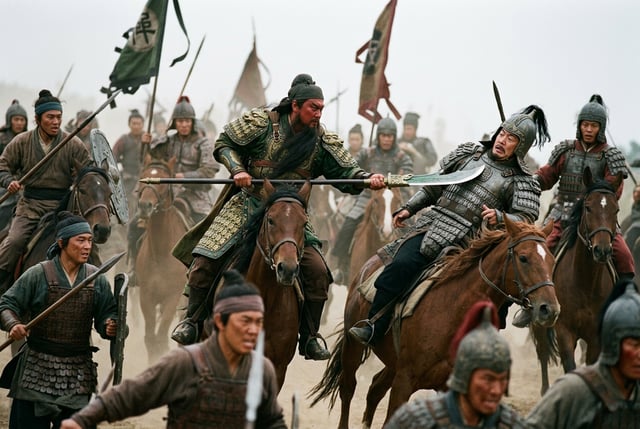
Romance of the Three Kingdoms portrays Liu Yan as the one who appeals for help during the Battle of Boma, and brings him back into the story during Guan Yu’s journey to leave Cao Cao and seek his sworn brother. In Chapter 25, Yuan Shao sends Yan Liang as the vanguard to attack Baima, and Liu Yan sends an urgent appeal to Xu Chang. Cao Cao personally leads troops to the rescue, while the novel heightens the drama with episodes in which Yan Liang repeatedly kills Cao Cao’s officers before Guan Yu rides out and kills him. In this part, Liu Yan’s main narrative role is to convey the urgent military situation and prompt Cao Cao to send troops, rather than to be a central figure on the battlefield.
In Chapter 27, Liu Yan receives Guan Yu at Huazhou. Guan Yu explains that he is going to Hebei to look for Liu Bei and asks Liu Yan to arrange a boat crossing. Fearing that Xiahou Dun will hold him accountable, Liu Yan dares not help. Guan Yu therefore goes to a Yellow River crossing on his own and crosses after killing the defending officer, Qin Qi. The novel uses Liu Yan’s reluctance to highlight Guan Yu’s determination to overcome every obstacle and seek his sworn brother, while also recalling that Guan Yu had once relieved Liu Yan by killing Yan Liang and Wen Chou. Although historical accounts mention Liu Yan in connection with the siege of Baima, they do not record him receiving Guan Yu, refusing to provide a boat, or Guan Yu killing Qin Qi; all these episodes are inventions of the novel.
Key Relationships
Historically, Liu Yan’s relationship with Cao Cao is one of appeal and relief: when Yan Liang besieged Baima, Cao Cao sent troops to lift the siege, and Xun You’s plan and the charge led by Zhang Liao and Guan Yu decided the battle. The sources record no more specific dealings between Liu Yan and Cao Cao. Liu Yan was on the opposing side from Yuan Shao: Yuan Shao ordered Yan Liang to attack Baima, which Liu Yan was defending. Ju Shou once advised Yuan Shao not to entrust the task solely to Yan Liang, but Yuan Shao did not heed him.
In the historical accounts, Liu Yan’s connection to Guan Yu is limited to the relief of Baima and Guan Yu’s killing of Yan Liang. Romance of the Three Kingdoms expands this into an episode in which Guan Yu once rescued Liu Yan from trouble, then later asked him for a boat and was refused. The latter is a fictional addition and should not be treated as history. Liu Yan’s fear of punishment by Xiahou Dun and his refusal to provide a boat also appear only in the novel.
Defining Scene
The scene that best captures Liu Yan’s historical circumstances is the siege of Baima and Cao Cao’s rush to its relief: Yan Liang attacked Baima on Yuan Shao’s orders; Cao Cao, following Xun You’s plan, turned toward Baima; Zhang Liao and Guan Yu routed the enemy and killed Yan Liang, lifting the siege. Although Liu Yan is not depicted as the one who actively defeated the enemy, he is the central figure on the defending side of this campaign.
The more dramatic scene in the novel is Guan Yu asking Liu Yan for a boat before crossing the river. Liu Yan dares not take the risk, so Guan Yu no longer relies on him and goes straight to the crossing, where he kills Qin Qi and obtains a boat. This episode portrays Liu Yan as a cautious, timid local official, in contrast with Guan Yu’s decisiveness. Both the refusal to provide a boat and the killing of Qin Qi are unique to the novel.
Quotes
5 lines in the books · 2 featured
「公今欲何往?」
This terse, forceful question opens the prelude to Guan Yu Passes Five Passes and Slays Six Generals.
「玄德在袁紹處,紹乃丞相讎人,如何容公去?」
It highlights the opposition between Liu Bei and Cao Cao, foreshadowing Guan Yu's dilemma between loyalty and righteousness.
Family, lords and rivals
1 relationships

Events
Events (3)
Battles and events the texts place this person in, by date.
Battles
- 200Battle of Guandu
- 200Battle of BomaVictim
Other events
Places
- Was at
- BaimaRecords
- Governed
- Dong CommanderyRecords
Continue
Battle of Boma
Relationship timeline1 entry ▸
Novel · ch. 27
- Guan Yu§12
Friend
Guan Gong had earlier helped him out of the predicament involving Yan Liang and Wen Chou; now he did not dare deal with the ships
Inner monologues · AI-generated1 monologue ▸
- I am Liu Yan, Administrator of Dongjun. The office of administrator carries responsibilities beyond a single city or cou