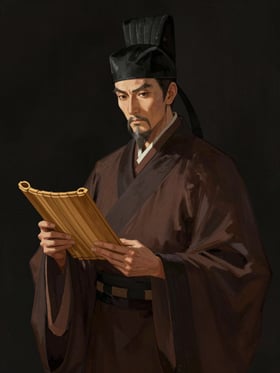
Xu Zhi, Wei’s Grand Astrologer in the novel, urged Emperor Xian to abdicate; he is absent from the Records of the Three Kingdoms.
Appearances
In the novel: 3 chapters
On the boards
Compare with someone →Where this person ranks on each board.
Historical Record
The Records of the Three Kingdoms does not mention Xu Zhi. In the surviving materials, Xu Zhi appears only in Romance of the Three Kingdoms. Therefore, accounts of his office, words and deeds, and political activities belong to the novel and cannot be treated as historical facts recorded in the Records of the Three Kingdoms. The novel calls him the Assistant Director of the Grand Astrologer and depicts him as recommending Guan Lu to Cao Cao and later taking part in urging Emperor Xian of Han to abdicate in favor of Cao Pi. None of these episodes is supported by the historical biographies considered here.
In the Novel
Xu Zhi appears in the novel as the Assistant Director of the Grand Astrologer, an official in charge of celestial phenomena who can invoke divination and auspicious signs to lend support to political arguments. In Chapter 69, Cao Cao falls ill and summons Xu Zhi to divine the cause. Rather than directly pronounce whether Cao Cao will fare well or badly, Xu Zhi brings up Guan Lu of Pingyuan, saying that he is well versed in the Book of Changes, stargazing, and physiognomy, and suggesting that Cao Cao summon him. Xu Zhi serves here as an introducer: invoking Guan Lu’s reputation in response to Cao Cao’s desire for divination, he also leads the narrative into the various supernatural tales about Guan Lu.
By Chapters 79 and 80, Xu Zhi’s role shifts from recommending a diviner to advocating the transfer of the throne. The novel first describes the appearance of auspicious signs such as phoenixes, qilin, and yellow dragons. On this basis, Xu Zhi and Li Fu discuss how Wei will replace Han, then join a group of officials in the palace to urge Emperor Xian to abdicate in favor of Cao Pi. Xu Zhi then declares before the throne that he is responsible for observing the heavens. After studying celestial phenomena, he concludes that the Han dynasty’s allotted destiny has ended and that Wei is flourishing. He also breaks apart prophetic texts to extract the characters “Wei,” “Xu,” and “Chang,” combining them into an allusion to Wei receiving the abdication at Xu Chang. Emperor Xian denounces the auspicious signs and prophecies as false and refuses to abandon his ancestral legacy lightly. Xu Zhi’s words thus serve a political purpose: using the language of Heaven’s mandate to promote a transfer of power.
This portrayal is not a biography of Xu Zhi that can be verified in the historical records: the Records of the Three Kingdoms does not mention him, and the accounts of his office, his recommendation of Guan Lu, and his urging of the abdication are all creations of the novel. The novel gives him both knowledge of divination and political eloquence, and in both of his appearances he uses “Heaven’s will” to explain human affairs: first, he introduces Guan Lu to Cao Cao; later, he supplies auspicious signs and prophetic interpretations to justify Cao Wei’s replacement of Han.
Key Relationships
- Cao Cao: In his capacity as Assistant Director of the Grand Astrologer, Xu Zhi is ordered to perform divination for the ailing Cao Cao, then recommends Guan Lu in response to Cao Cao’s concerns about divination and good or ill fortune. (Unique to the novel)
- Guan Lu: Xu Zhi tells Cao Cao of Guan Lu’s native place, abilities, and reputation in divination, calling him a “divine diviner,” thereby setting in motion the novel’s account of Cao Cao summoning Guan Lu. (Unique to the novel)
- Li Fu, Cao Pi, and Emperor Xian of Han: Xu Zhi and Li Fu jointly use auspicious signs to argue that Wei should replace Han. Xu Zhi later explains the celestial phenomena and prophetic texts to Emperor Xian in person, urging him to abdicate in favor of Cao Pi. (Unique to the novel)
- Hua Xin and other ministers: Xu Zhi joins Hua Xin, Wang Lang, and more than forty other officials in urging the abdication, supplementing their arguments with auspicious signs and prophetic interpretations in his capacity as an official responsible for observing the heavens. (Unique to the novel)
Notable Scenes
- Recommending Guan Lu while Cao Cao is ill: Cao Cao’s condition does not improve despite taking medicine, so he orders Xu Zhi to divine the cause. Xu Zhi instead describes Guan Lu’s abilities and suggests summoning him to determine the prognosis. This scene briefly establishes Xu Zhi’s position as Assistant Director of the Grand Astrologer and shows how, in the novel, he brings diviners into the seat of power. (Unique to the novel)
- Discussing the transfer of the throne after auspicious signs appear: Phoenixes, qilin, and yellow dragons are treated as signs that Wei will replace Han. On this basis, Xu Zhi and Li Fu advocate arranging the abdication ceremony and join the other officials in the palace to ask Emperor Xian to yield the throne. (Unique to the novel)
- Interpreting prophetic texts by splitting characters to urge abdication: Emperor Xian questions whether auspicious signs and prophetic texts are enough to abandon the Han dynasty’s legacy. Xu Zhi breaks the prophetic words into “Wei,” “Xu,” and “Chang,” explaining them to mean that Wei will receive Han’s abdication at Xu Chang. Emperor Xian still refuses, weeping as he withdraws to the rear hall. The scene highlights Xu Zhi’s literary function: using the language of divination to serve the political campaign for abdication. (Unique to the novel)
Quotes
10 lines in the books · 2 featured
「趙顏歸問管輅。輅曰:『穿紅者,南斗也;穿白者,北斗也。』顏曰:『吾聞北斗九星,何止一人?』輅曰:『散而為九,合而為一也。北斗注死,南斗注生。今已添注壽算,子復何憂﹖』父子拜謝。自此管輅恐泄天機,更不輕為人卜。此人現在平原,大王欲知休咎,何不召之?」
This line points to the folk-belief origin of 'the Southern Dipper governs life, the Northern Dipper governs death,' with high cultural recognizability.
「臣等職掌司天,夜觀乾象,見炎漢氣數已終,陛下帝星隱匿不明;魏國乾象,極天察地,言之難盡。更兼上應圖讖。其讖曰:『鬼在邊,委相連;當代漢,無可言。言在東,午在西;兩日並光上下移。』以此論之,陛下可早禪位。『鬼在邊』,『委相連』,是『魏』字也;『言在東,午在西』,乃『許』字也;『兩日並光上下移』,乃『昌』字也:此是魏在許昌應受漢禪也。願陛下察之。」
Through a character-splitting prophecy, this line supplies a 'Mandate of Heaven' basis for Cao Wei's replacement of the Han, carrying important historical significance.
- Friends
- Other
Who is Xu Zhi connected to?
Pick someone to see how many steps lie between them and Xu Zhi.
Events
Events (1)
Battles and events the texts place this person in, by date.
Other events

Continue
Guan Lu
Friend
Relationship timeline4 entries ▸
Novel · ch. 69
Novel · ch. 79
- Cao Pi§31
Advised
Discussed the rites for receiving the abdication
Novel · ch. 80
Advised
Interpreted the character and explained the prophecy to answer the portent of Wei receiving the abdication from Han
Inner monologues · AI-generated3 monologues ▸
- I am Xu Zhi. I lived at the end of the Han, and since no courtesy name is given here, I dare not presume to assign mysel
- I am Xu Zhi; my courtesy name is unknown. I lived at the end of the Han dynasty. In all I saw and heard, I often encount
- My name is Xu Zhi. The accounts that have come down to us do not give my courtesy name, nor do they provide a detailed r