Cao Wei · Colonel Who Protects the Wuwan; Administrator of Runan; General of the Household Who Protects the Xiongnu; Inspector of Bingzhou; Commandant of the Guards
Tian Yu
courtesy name 国让 · c. 171–c. 252
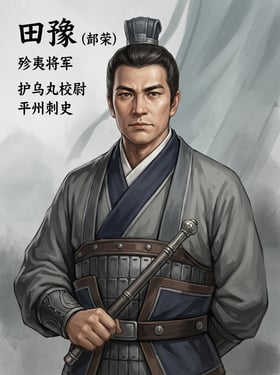
Pure and unstained in his conduct, clear and seasoned in strategy; poor and self-sufficient, he distributed all his rewards among his officers and men.

Life
In the novel: 1 chapter · In the Records: 6 volumes
Life171–252
213 CE (Jian'an 18)
218 CE (Jian'an 23)
228 CE (Taihe 2)
Appearances
- Cao Wei· Undated
- Gongsun Zan's faction· Undated
- Life event
On the boards
Compare with someone →Where this person ranks on each board.
Who they were
Character profile
- Character
- Pure and unstained in his conduct, clear and seasoned in strategy; poor and self-sufficient, he distributed all his rewards among his officers and men.
- Life
- A man of Yongnu in Yuyang, styled Guorang. In his youth he joined Liu Bei, later followed Gongsun Zan, and upon Zan's defeat submitted to the house of Cao. He administered and pacified the northern frontier, holding off the Xianbei and Wuhuan for several decades; he died at the age of eighty-two.
- Anecdotes
- He held such posts as General Who Exterminates the Yi, Inspector of Ping Province, Colonel of the Wuhuan, Protector-Colonel of the Wuhuan, Grand Administrator of Runan, Inspector of Bing Province, and Commandant of the Guards, and once served as Chief Clerk / adviser accompanying Cao Zhang on his northern campaign against the Wuhuan of Daijun. In Emperor Wen's time he was Colonel of the Wuhuan bearing the staff of authority to protect the Xianbei, and was once besieged by Bi Neng at Macheng for seven days.
Historical Record
Tian Yu, courtesy name Guorang, was from Yongnu in Yuyang. When Liu Bei fled to Gongsun Zan, Tian Yu was still young and voluntarily attached himself to Liu Bei, who thought highly of him. Later, when Liu Bei became Inspector of Yu Province, Tian Yu asked to leave because his mother was elderly. Liu Bei wept as they parted, regretting that he could not accomplish great things together with him. Afterward, Tian Yu served Gongsun Zan as magistrate of Dongzhou. When Wang Men, a general under Yuan Shao, led troops to attack, Tian Yu climbed the city wall and rebuked Wang Men for betraying his lord and causing disorder; Wang Men withdrew in shame. After Gongsun Zan’s defeat and death, Tian Yu urged Xianyu Fu to submit to the Cao clan, and Xianyu Fu accepted his advice. Tian Yu entered Wei service and held a succession of local offices, governing effectively. When he was Nanyang’s administrator, he released more than five hundred followers of Hou Yin whom his predecessor had imprisoned and intended to execute, allowing them to reform; the bandits promptly disbanded.
Early in the reign of Emperor Wen of Wei, Tian Yu was appointed, with an imperial tally, Colonel Who Protects the Wuhuan, and placed in charge of the Xianbei as well. His border strategy was to divide and balance the various tribes. While aiding Suli, he ventured deep into enemy territory and was besieged at Macheng. He broke out by using smoke and fire to create the impression of a decoy force and attacking from both north and south. He also dealt with Gujin, a defiant Wuhuan king, and his reputation spread far and wide. In the second year of the Taihe era, he led Xianbei forces beyond the frontier to campaign against Yuzhujian. On his return, he was besieged for seven days at Macheng by Kebineng, until Yan Zhi, the Administrator of Shanggu, came to lift the siege. Later, Tian Yu oversaw Qing Province’s forces in a campaign against Gongsun Yuan of Liaodong. He judged that a Wu fleet caught in a storm would follow the coast to Chengshan, and had troops lie in wait to intercept it. The Wu ships indeed struck the mountain and sank, and their crews were captured. But Cheng Xi, the Inspector of Qing Province, who resented him, secretly reported that his troops were lax in discipline and that the spoils had not been turned over to the authorities. As a result, Tian Yu’s military achievements were not officially reported.
When Cao Zhang campaigned against Dai Commandery, Tian Yu served as his adviser. After enemy cavalry ambushed them, he used the terrain to arrange the wagons in a circular formation, repelled the enemy with bows and crossbows and a decoy force, then pursued and defeated them. The historical account attributes this strategy to Tian Yu. In the sixth year of the Taihe era, he again led troops, holding the title General Who Quells the Barbarians, against the Wu general Zhou He at Chengshan, and killed Zhou He. When Sun Quan’s large army attacked Xincheng, Tian Yu advised against hurrying to its relief, recommending instead that they wait until the Wu army was exhausted by the siege before attacking. The emperor accepted his advice, and the Wu army later withdrew.
Tian Yu lived an upright and frugal life, often distributing his rewards among his soldiers. In his later years, he repeatedly asked to retire, warning himself that, though over seventy, he remained in office “like a man walking at night after the evening bell and the clepsydra have run out.” At last, he pleaded illness and resigned, and was appointed Grand Master of the Palace. He died at the age of eighty-two. The Wei court later ranked him alongside Xu Miao and Hu Zhi as a man of integrity, praising his loyalty and probity in public service, his lack of interest in acquiring property, and the fact that his family had no surplus wealth after his death.
In the Novel
Chapter 103 of Romance of the Three Kingdoms depicts Tian Yu as a Wei general. When Sun Quan divided his forces to attack, Cao Rui raised an army and sent it out along several routes to meet the enemy. He ordered Tian Yu to lead troops to relieve Xiangyang, while he and Man Chong went to relieve Hefei, and Liu Shao was ordered to relieve Jiangxia. The narrative focuses on Man Chong and others launching a night raid on the Wu naval camp at the mouth of Chao Lake. After Tian Yu is ordered to go to the rescue, no further action of his is described. In the novel, therefore, he is one of the generals deployed with the Wei army, rather than a central combatant in this engagement.
Historical accounts record Tian Yu’s long service governing the northern frontier and overseeing the Wuhuan and Xianbei, as well as his defeat of the Wu army at Chengshan and his advice during the siege of Xincheng. Chapter 103, by contrast, focuses on placing him within Cao Rui’s deployment of forces against the Wu army. His being ordered to relieve Xiangyang is part of the chapter’s arrangement of the campaign; this specific expedition is not recorded in the historical material provided and should not be conflated with the historical campaign at Chengshan.
Key Relationships
- Liu Bei: In his youth, Tian Yu attached himself to Liu Bei, who thought highly of him. When Tian Yu took his leave because his mother was elderly, Liu Bei wept as he saw him off.
- Gongsun Zan and Xianyu Fu: Tian Yu once defended a city for Gongsun Zan and drove off the rebel Wang Men. After Gongsun Zan’s defeat, he urged Xianyu Fu to submit to Cao, bringing about his allegiance.
- Cao Zhang: Tian Yu accompanied Cao Zhang on the northern campaign against Dai Commandery, using the terrain to form a battle array and defeat the Hu cavalry, and taking responsibility for planning and support.
- Kebineng and the Xianbei tribes: Tian Yu both mediated relations among the tribes of Suli, Kebineng, and others, and fought against Kebineng’s forces. He was once besieged by Kebineng at Macheng, but was later relieved.
- Cheng Xi: Cheng Xi and Tian Yu were at odds. Cheng Xi secretly reported problems with Tian Yu’s military discipline and handling of spoils, resulting in Tian Yu’s achievements not being officially reported.
- Cao Rui and Man Chong: In the novel, Cao Rui orders Tian Yu to relieve Xiangyang and Man Chong to accompany him to relieve Hefei. This deployment of forces for the relief effort appears only in the novel.
Signature Scenes
- Breaking out of the siege at Macheng: After aiding Suli, Tian Yu was surrounded. He first burned ox and horse dung to make it seem that campfires were still burning, then withdrew by another route. When pursued to Macheng and besieged by ten encirclements, he ordered drums and shouting at the south gate to draw the enemy’s attention, while leading elite troops in a sortie through the north gate. Attacked from both sides, the besieging forces broke apart. This escape demonstrates his skill in exploiting feints and terrain.
- The circular formation at Yibei: When Cao Zhang’s army was struck by an ambush of cavalry and thrown into confusion, Tian Yu used the terrain to arrange the wagons in a circular formation, stationed archers and crossbowmen in readiness, and used decoy troops to block the gaps. When the Hu cavalry withdrew, he pursued and defeated them.
- Lying in wait for the Wu ships at Chengshan: Tian Yu foresaw that Wu ships caught in autumn gales would reach Chengshan. He went ahead to inspect the islands and guard the strategic passes. The Wu ships indeed struck the mountain and sank, and the Wei army captured their crews. Cheng Xi later intervened, preventing the victory from being officially reported and casting a political shadow over it.
- Ordered to relieve Xiangyang: The novel only states that Tian Yu was included in Cao Rui’s deployment of forces to meet the Wu army and was ordered to relieve Xiangyang; it gives no detailed account of his march or its outcome. This specific scene appears only in the novel.
Quotes
5 lines in the books · 3 featured
「終能定天下者,必曹氏也。宜速歸命,無後禍期。」
Predicting that Cao Wei would unify the realm, it displays his outstanding strategic vision.
「賊悉衆大舉,非徒投射小利,欲質新城以致大軍耳。宜聽使攻城,挫其銳氣,不當與爭鋒也。城不可拔,衆必罷怠;罷怠然後擊之,可大克也。若賊見計,必不攻城,勢將自走。若便進兵,適入其計。又大軍相向,當使難知,不當使自畫也。」
Proposing the military strategy of 'wearing down the enemy to win,' it embodies his deep military wisdom.
「年過七十而以居位,譬猶鍾鳴漏盡而夜行不休,是罪人也。」
Likening himself to 'a tolling bell and a spent water-clock,' he expresses the magnanimity and self-reflection of retiring once his work is accomplished.
- Family
- Lord & vassal
- Enemies
- Other
Who is Tian Yu connected to?
Pick someone to see how many steps lie between them and Tian Yu.
Combat
On the field
Duels, kills and executions as the texts tell them, counted separately for the Records and the Romance.
- RecordsJuan 3Struck downZhou HeWon「殄夷將軍田豫帥衆討吴將周賀於成山,殺賀」
- RecordsJuan 26ExecutionGujinWon「進逆拜,遂使左右斬進,顯其罪惡以令衆」
Stratagems
Plans this person devised or saw through, as the texts tell them.
- Records
- 7 carried out · 7 worked · 0 turned down · 1 seen through
- RecordsHold Firm at Strategic PassesOtherWorkedagainst rebel HuJuan 19「用田豫計,固守要隙,虜乃退散」
- RecordsFeigned TroopsFeintWorkedagainst HuJuan 26「豫因地形,回車結圜陣,弓弩持滿於內,疑兵塞其隙」
- RecordsSowing DiscordSowing discordWorkedagainst XianbeiJuan 26「豫以戎狄爲一,非中國之利,乃先搆離之,使自爲讎敵,互相攻伐」
- RecordsBurning Dung to Feign an ArmyFeintWorkedagainst HuJuan 26「多聚牛馬糞然之,從他道引去。胡見煙火不絕,以爲尚在」
- RecordsMake a Sound in the East, Strike in the WestFeintWorkedagainst HuJuan 26「將步騎從南門出,胡人皆屬目往赴之。豫將精銳自北門出」
- RecordsLure Suli into Executing AiOtherWorkedagainst mountain banditsJuan 26「豫誘使鮮卑素利部斬艾,傳首京都」
All stratagems (8)
Loading…
Events
Events (4)
Battles and events the texts place this person in, by date.
Other events
Places
Continue
Cao Zhang's Northern Campaign Against the Wuhuan of Daijun
Relationship timeline6 entries ▸
History · vol. 3
- Zhou He§15
Fights
the General Who Exterminated the Barbarians, Tian Yu, led troops to attack the Wu general Zhou He at Chengshan and killed Zhou He
History · vol. 26
- Liu Bei§13
Lord
When Liu Bei fled to Gongsun Zan, Yu was young and placed himself in Liu Bei’s service; Liu Bei greatly admired him
- Xianyu Fu§14
Advised
Xianyu Fu had long been on good terms with Yu and appointed him Chief Clerk; Yu urged him to submit to the Cao clan
- Cao Zhang§15
Advised
Marquis of Yanling; campaigned against Dai Commandery and appointed Yu as his chancellor; turning the wagons around and forming a circular formation to defeat the Hu were both Yu’s strategies
- Gongsun Yuan§18
Commands
The emperor appointed Yu to supervise the troops of Qing Province and granted him imperial authority to go and attack them; later, the enemy ships struck the mountain, and all their men were captured
- Cheng Xi§18
Betrayer
Qing Province Inspector Cheng Xi harbored resentment and secretly reported that Tian Yu’s prohibitions and orders were lax; consequently, his achievements were not entered in the records
Inner monologues · AI-generated3 monologues ▸
- Now that I am past seventy and hold a place among the court officials, whenever I think of it, I feel that I cannot trea
- My name is Tian Yu, and my courtesy name is Guorang. On the frontier, what I saw was not the borders debated in court, b
- My name is Tian Yu, and my courtesy name is Guorang. I come from Yongnu in Yuyang. When I was young, turmoil broke out,