Huangfu Song
courtesy name 义真 · –c. 195
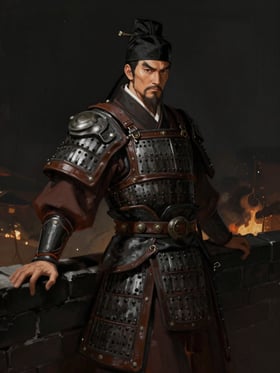
Huangfu Song, courtesy name Yizhen, was a late Han general who fought the Yellow Turbans and Qiang; Romance depicts his skill at Changshe.

Life
In the novel: 3 chapters · In the Records: 4 volumes
Life?–195
184 CE (Zhongping 1)
- Yellow Turban RebellionCommander
- Battle of GuangzongGuangzongCommander
Appearances
By chapter (7)
Novel
- 1
- 2
- 9
Records
- 6
- 8
- 32
- 46
- Life event
On the boards
Compare with someone →Where this person ranks on each board.
Historical Record
Huangfu Song, courtesy name Yizhen, is identified in the available sources as a general serving the court in the late Han. After the Yellow Turban uprising began, the Han court dispatched General of Agile Cavalry Huangfu Song and General of the Household Zhu Jun to lead troops against the rebels. The passage quoted in the Records of the Three Kingdoms does not detail Huangfu Song’s specific actions in attack or defense during this campaign, but it clearly records his participation in suppressing the uprising. The Yellow Turban Army arose in Wei Commandery. Zhang Jue and the others rallied people under the slogan “Great Peace under the Yellow Heaven,” and thirty-six divisions rose simultaneously, burning commanderies and counties and killing senior officials. This was the context for the court’s military response.
The Wu Shu, quoted in Pei Songzhi’s annotations, records that Tao Qian was once summoned by Huangfu Song, General Who Conquers the West, and appointed Commandant of Yangwu. He joined Song on a campaign against the Qiang, whom they decisively defeated. Later, when Bian Zhang and Han Sui rebelled, Tao Qian also took part in the affairs of Zhang Wen’s army. This passage shows that Huangfu Song once led troops in response to trouble on the frontier, while Tao Qian followed the army as a subordinate. Other accounts concerning Dong Zhuo record that when Dong Zhuo was Inspector of Bingzhou, the court ordered his troops placed under the authority of General Who Attacks the Left, Huangfu Song, but Dong Zhuo defied the edict. Later, when Huangfu Song served as Palace Secretary, he once bowed beneath Dong Zhuo’s carriage. These accounts depict the rise and fall of their official standing amid Dong Zhuo’s usurpation of power.
In the Novel
Romance of the Three Kingdoms places Huangfu Song on the front lines of the campaign against the Yellow Turbans, portraying him as a general adept at judging the moment for action and capable of coordinating his forces with Zhu Jun. The novel says that after Zhang Liang and Zhang Bao were driven back to Changshe, they made camp among the grass. Huangfu Song saw that the camp was vulnerable to a fire attack, so he consulted with Zhu Jun and ordered the soldiers to secretly prepare kindling. When a sudden night wind rose, they set the camp ablaze and launched an assault, throwing the Yellow Turban Army into disarray. The Records of the Three Kingdoms does not record the details of this fire attack at Changshe; Huangfu Song’s stratagem and the specific events are therefore part of the novel’s portrayal.
The novel then describes Cao Cao intercepting the fleeing rebels, while Huangfu Song continues in the role of commander responsible for suppressing the uprising. After Dong Zhuo suffered repeated defeats, the court ordered Huangfu Song to replace him. By the time Huangfu Song took command, Zhang Jue was already dead. Huangfu Song won seven battles in succession, killed Zhang Liang at Quyang, and ordered Zhang Jue’s coffin exhumed, his corpse mutilated, and his head sent to the capital. The court promoted him to General of Agile Cavalry and appointed him Inspector of Jizhou. He also made a case for Lu Zhi’s achievements, helping secure Lu Zhi’s reinstatement. The account of these military accomplishments and Huangfu Song’s appeal on Lu Zhi’s behalf does not appear in the supplied Records of the Three Kingdoms material and should be regarded as novelistic narrative.
The novel also says that Huangfu Song refused to send money and valuables to the eunuchs Zhao Zhong, Zhang Rang, and others, and was consequently impeached and dismissed along with Zhu Jun. This portrays him not only as a capable battlefield commander, but also as a man who refused to pay off powerful figures yet was constrained by court politics. This episode is part of the novel’s narrative; the Records of the Three Kingdoms does not provide the same details.
Key Relationships
Huangfu Song and Zhu Jun were both court generals sent to suppress the Yellow Turbans. Historical accounts explicitly record that the two were ordered to lead troops against them; the novel goes further, depicting them as partners who consult over a fire attack and work together to destroy the Yellow Turban Army’s camp. Huangfu Song’s relationship with Tao Qian appears in Pei Songzhi’s annotation to the Wu Shu: Tao Qian joined Huangfu Song’s campaign against the Qiang and served as Commandant of Yangwu.
The relationship between Dong Zhuo and Huangfu Song changed as their relative power shifted. Historical accounts record that Dong Zhuo disobeyed the order placing his troops under Huangfu Song, and that Huangfu Song later bowed beneath Dong Zhuo’s carriage. The novel additionally says that Huangfu Song replaced Dong Zhuo after his defeat and took part in the confiscation of records at Meiwu; this is unique to the novel. In the novel, Huangfu Song also earns Lu Zhi’s gratitude by recommending his reinstatement. His memorial on Lu Zhi’s behalf and the resulting restoration to office are likewise unique to the novel.
Signature Scenes
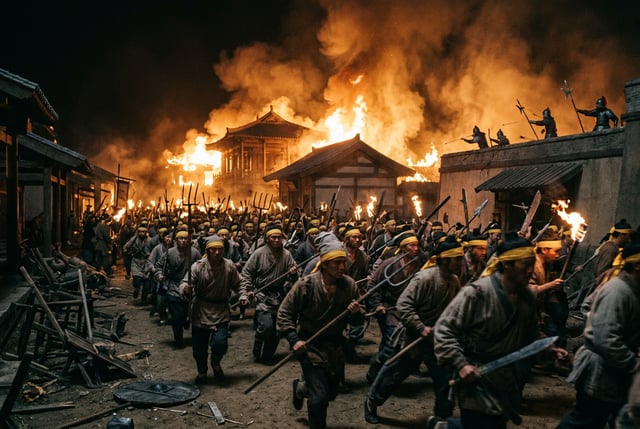
The night fire at Changshe is the representative scene through which the novel presents Huangfu Song’s military skill. He exploits the Yellow Turban Army’s weakness in making camp among the grass, sets it ablaze with the wind at his back, and launches an attack, sending the enemy fleeing in haste. The Records of the Three Kingdoms only records that the court sent Huangfu Song and Zhu Jun to suppress the Yellow Turbans; it does not mention this fire attack. The specific scene is unique to the novel.
Another scene follows the battle at Quyang, when Zhang Jue’s coffin is exhumed and his corpse mutilated before being sent to the capital. Through this, the novel emphasizes the victory in suppressing the uprising and the Han court’s punishment of the rebel leader. It concludes the account of Huangfu Song’s military achievements with his successive victories, the killing of Zhang Liang, and his appointment as General of Agile Cavalry. These specific episodes appear in the novel and should not be conflated with the brief historical record of the campaign against the Yellow Turbans.
Lines
- 演 ch.1 §26→ Liu Bei
「張梁、張寶勢窮力乏,必投廣宗去依張角。玄德可即星夜往助。」
- Family
- Enemies
- Other
Who is Huangfu Song connected to?
Pick someone to see how many steps lie between them and Huangfu Song.
Combat
On the field
Duels, kills and executions as the texts tell them, counted separately for the Records and the Romance.
Battles in command
Battles this person commanded in, with the outcome as each text tells it.
- Romance
- 1W 0L 0D 0 undecided
- Romance184Battle of GuangzongWonvs Yellow TurbansCh. 2「張梁統其眾,與我軍相拒,被皇甫嵩連勝七陣,斬張梁於曲陽」
Stratagems
Plans this person devised or saw through, as the texts tell them.
- Romance
- 1 carried out · 1 worked · 0 turned down · 0 seen through
- RomanceFire AttackFire attackWorkedagainst banditsCh. 1「嵩與儁計曰:「賊依草結營,當用火攻之。」」
Events
Events (4)
Battles and events the texts place this person in, by date.
Battles
- 184Battle of GuangzongCommander
Other events
- 184Yellow Turban RebellionCommander
- 189Dong Zhuo's Coup
- 192Wang Yun's Interlocking Stratagem
Places
- Governed
- Ji ProvinceRomance
Continue
Yellow Turban Rebellion
Relationship timeline2 entries ▸
Novel · ch. 2
Fights
Won seven consecutive battles and beheaded Zhang Liang at Quyang.
- Lu Zhi§2
Witnessed
Memorialized that Lu Zhi had rendered meritorious service and was not guilty; the court restored his former office
Inner monologues · AI-generated1 monologue ▸
- I have now been ordered to take Dong Zhuo’s place. As I join the campaign, I see not victories and defeats on paper, but