In 184 (the first year of the Zhongping era), Zhang Jue led followers of the Way of Great Peace in simultaneous uprisings across eight provinces. Wearing yellow turbans around their heads, they burned down commanderies and counties and killed senior officials. The Eastern Han court dispatched Huangfu Song, Zhu Jun, and Lu Zhi to lead troops in suppressing the revolt, and the main rebel forces were subdued by that winter. According to the “Biography of Sun Polu” in the Records of the Three Kingdoms, Zhang Jue rose in Wei Commandery, claiming to act on the authority of spirits. He sent out eight emissaries to teach the “Way of Goodness” in various regions, secretly forging connections, and proclaimed himself “Great Peace under the Yellow Heaven.” On the ji-zi day of the third month, all thirty-six divisions rose together, and the realm responded. Pei Songzhi’s commentary quotes the Spring and Autumn Annals of Emperor Xian, which says that Zhang Jue called himself General of Heaven, his younger brother Zhang Bao General of Earth, and Zhang Liang General of Humanity. The court sent Huangfu Song and Zhu Jun to suppress the revolt. Zhu Jun recommended Sun Jian as Assistant Army Commandant, and Sun Jian fought fiercely around Runan and Yingchuan, leading the assault on the walls when they attacked Wancheng. Across the provinces and commanderies, local forces also took up arms: Liu Bei distinguished himself in campaigns against the rebels under Commandant Zou Jing and was appointed Commandant of Anxi; Cao Cao campaigned against the Yellow Turbans in Yingchuan in his capacity as Cavalry Commandant.
According to the Book of the Later Han, the uprising had originally been planned for the ji-zi day of the third month. But after the disciple Tang Zhou informed on the plot and the Luoyang conspirator Ma Yuanyi was executed by being torn apart by chariots, Zhang Jue was forced to launch the revolt early, in the second month. (The Records of the Three Kingdoms says that all rose together on the ji-zi day of the third month.) Followers were spread throughout the eight provinces of Qing, Xu, You, Ji, Jing, Yang, Yan, and Yu. Lu Zhi led troops north and besieged Zhang Jue at Guangzong (see the Battle of Guangzong), but was later falsely accused by eunuchs and imprisoned. By the time Huangfu Song took over the fighting in Jizhou, Zhang Jue had already died of illness. Huangfu Song defeated and killed Zhang Liang at Guangzong, then joined forces with Guo Dian, the Administrator of Julu, to kill Zhang Bao at Xiaquyang. At the end of that year, the court changed the era name to Zhongping.
The first and second chapters of Romance of the Three Kingdoms portray Zhang Jue as an unsuccessful candidate who received a heavenly text from the immortal Nanhua Laoxian. They also say that Huangfu Song killed Zhang Liang at Quyang, while Zhang Bao was trapped at Yangcheng and killed by his subordinate Yan Zheng.
The Records of the Three Kingdoms mentions it only in passing with the phrase “the Yellow Turbans rose at the end of the Guanghe era,” treating it as a social unrest event. It focuses on the appointments and military achievements of government forces’ commanders, and gives little attention to Zhang Jue’s religious organization or prophetic sayings.
Romance
In Chapter 1, the novel devotes considerable space to supernatural episodes, such as the Immortal of the Southern Florescence giving Zhang Jue the Way of Great Peace, Zhang Jue summoning wind and rain, and Zhang Bao performing sorcery. It dramatizes the uprising as a religious upheaval that takes sorcery as its outward appearance and the transfer of Heaven’s mandate from the Han house as its underlying meaning.
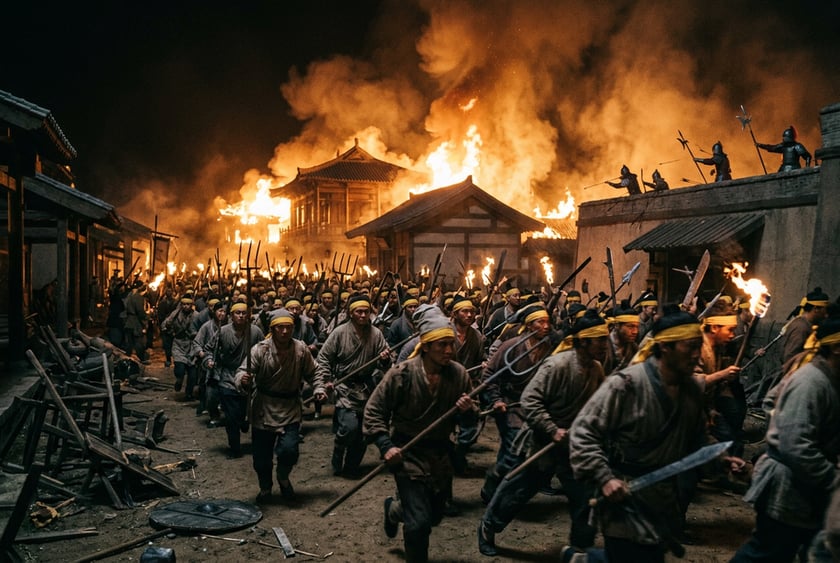
Hundreds of thousands of rebels wearing yellow turbans set fire to commanderies and counties in the night. Flames surge skyward and smoke billows as they charge government offices with makeshift weapons.
The Yellow Turban Rebellion broke out in 184. The year had originally been the seventh year of the Guanghe era, but the court changed the era name to Zhongping at the end of the year; later generations customarily called it the first year of Zhongping. The rebellion’s roots lay in the long-standing abuses of the late Eastern Han: eunuchs and imperial in-laws took turns controlling the court, the Disaster of the Partisan Prohibitions shut large numbers of scholars out of official careers, local officials attached themselves to powerful families and corruption became rampant, land consolidation deprived countless peasants of their livelihoods, and frequent epidemics and famines brought society at the grassroots level to the brink of explosion.
The Records of the Three Kingdoms offers, elsewhere, a glimpse of the decay in local government. After Cao Cao pacified the Yellow Turbans, he became Chancellor of Jinan. Most of the chief officials in more than ten counties of Jinan depended on powerful families and abused their office; Cao Cao memorialized to have eight of them dismissed in one stroke. There were also more than six hundred shrines dedicated to King Jing of Chengyang in the area. Merchants passed themselves off as officials by using official carriages and clothing, and lived extravagantly, leaving the common people increasingly impoverished. This was the social soil that enabled the Yellow Turbans to mobilize the people.
The first chapter of Romance of the Three Kingdoms opens with a series of portents: a green snake coiled around the imperial throne, hail and earthquakes, a hen turning into a rooster, and black vapor entering the palace. Cai Yong spoke frankly in a memorial but was framed by eunuchs; the Ten Attendants held power, and the emperor called Zhang Rang his father. Thus, people throughout the realm began to long for disorder. The novel recasts the social crisis as a warning from the heavens and misrule by eunuchs, a conventional expression of traditional historical thinking.
Factions Involved
The rebellion was centered on the three Zhang brothers. According to the “Biography of Sun Jian” in the Records of the Three Kingdoms, Zhang Jue rose in rebellion in Wei Commandery, invoking the spirits as a pretext. He sent eight emissaries to spread the “Way of Goodness” throughout the realm, secretly built a network of supporters, proclaimed himself “Great Peace under the Yellow Heaven,” and launched simultaneous uprisings in thirty-six divisions. According to the Book of the Later Han, the Way of Great Peace had been active for more than ten years and had hundreds of thousands of followers, organized into thirty-six divisions. The larger divisions had more than ten thousand people, and the smaller ones six or seven thousand; each had its own commander. Their slogan was, “The Blue Heaven is dead; the Yellow Heaven shall rise.” The novel adds supernatural episodes to this framework, including the Nanhua Immortal presenting Zhang Jue with a heavenly text and Zhang Jue’s ability to summon wind and rain.
On the court’s side, the regular forces advanced along three routes: Lu Zhi attacked Zhang Jue’s main force in Jizhou, while Huangfu Song and Zhu Jun attacked the Yellow Turbans around Yingchuan. At the same time, the court allowed local authorities to recruit troops on their own initiative, and large numbers of volunteer forces sprang up in the provinces and commanderies. This gave a number of future warlords the opportunity to establish themselves. Sun Jian joined Zhu Jun with more than a thousand local youths and elite troops from the Huai and Si regions, serving as Assistant Army Commander. Liu Bei led his followers in battle under the command of Colonel Zou Jing and, for his service, was appointed Commandant of Anxi. Cao Cao took part in the campaign at Yingchuan as a Cavalry Commandant. Local scholars also organized self-defense forces. After Wang Du, assistant magistrate of Dong’e County, joined the Yellow Turbans and the county magistrate fled, Cheng Yu devised a plan to urge the officials and people to return to the city and hold it. They defeated Wang Du and secured Dong’e.
Key Turning Points
The first turning point was the exposure of the uprising’s plan. According to the Book of the Later Han, Zhang Jue had originally planned for an uprising to begin simultaneously inside and outside the capital on the fifth day of the third month of the Jiazi year. He sent Ma Yuanyi to Luoyang to contact eunuchs who would serve as his agents within the court. His disciple Tang Zhou submitted a memorial exposing the plot, and Ma Yuanyi was torn apart by chariots in Luoyang. The court launched a sweeping manhunt, forcing Zhang Jue to notify the various divisions overnight and bring forward the revolt to the second month. The novel retains this episode, depicting Tang Zhou going straight to the authorities with a letter to report the plot. The early uprising disrupted the original plans, and the scheme to enlist support within Luoyang collapsed completely. From the very outset, the rebellion lost any chance of striking directly at the center of power.
The second turning point came at Yingchuan. According to the “Biography of Huangfu Song” in the Book of the Later Han, the Yellow Turbans gained the upper hand there for a time, besieging Huangfu Song and Zhu Jun at Changshe. Huangfu Song saw that the Yellow Turbans had set up camp among the grass and, taking advantage of the night wind, set it ablaze. He dealt the enemy a crushing defeat. Cao Cao arrived with reinforcements, and together they pursued the rebels, turning the tide at Yingchuan. The novel recounts this battle vividly and has Cao Cao intercept Zhang Liang and Zhang Bao head-on during the pursuit, killing more than ten thousand rebels while the two brothers fought desperately to escape. This is how the novel arranged Cao Cao’s first appearance.
The third turning point came in Jizhou. According to the “Biography of Lu Zhi” in the Book of the Later Han, Lu Zhi had Zhang Jue under siege at Guangzong and was on the verge of taking the city. But because he refused to bribe the eunuch Zuo Feng, who had come to inspect the campaign, he was falsely accused and imprisoned. Dong Zhuo took over from him but also failed to win. The first chapter of the novel likewise describes Lu Zhi being sent back to the capital in a caged carriage. The siege and defense of Guangzong are covered in a separate event page, “Battle of Guangzong.”
Suppression and Aftermath
According to the Book of the Later Han, after pacifying Yingchuan, Runan, and Dong Commandery, Huangfu Song marched north to replace Dong Zhuo. By then Zhang Jue had died of illness. Huangfu Song fought Zhang Liang at Guangzong, ultimately defeating his army and killing Zhang Liang. He had Zhang Liang’s corpse dismembered and sent Zhang Jue’s head to the capital. He then joined forces with Guo Dian, the Administrator of Julu, to attack and kill Zhang Bao at Xiaquyang. Along the Nanyang route, Zhu Jun captured Wancheng, which the Yellow Turbans had occupied, and Sun Jian was the first to scale its walls during the assault.
The ending in Romance of the Three Kingdoms differs. Huangfu Song wins seven battles in a row and kills Zhang Liang at Quyang. Zhang Bao is struck in the left arm by an arrow shot by Liu Bei and retreats to Yangcheng, where he is eventually killed by his subordinate Yan Zheng, who presents his head. Placing Zhang Liang’s death at Quyang and having Zhang Bao die at the hands of a subordinate both differ from the account in the Book of the Later Han. The novel also devotes considerable space to Zhu Jun’s battles in Wancheng against Zhao Hong, Han Zhong, Sun Zhong, and other remnants of the Yellow Turbans. Liu Bei urges Zhu Jun to leave an opening in the encirclement and lure the enemy out of the city. When Sun Jian attacks the southern gate, he is the first to scale the walls and kills Zhao Hong with a spear.
After the main forces had been pacified, the court rewarded those who had distinguished themselves, but the eunuchs controlled the process. In the novel, Sun Jian receives an official appointment, while Liu Bei waits a long time without being appointed. The Ten Attendants demand money from the meritorious generals; after Huangfu Song and Zhu Jun refuse, they are dismissed. Sima Chen Dan points out to the eunuchs in person that Feng Xu and others had colluded with the Yellow Turbans, but is instead imprisoned and killed. These episodes show that although the Yellow Turbans were suppressed, the ills that had sparked the rebellion remained entirely untouched.
Historical Legacy
The main force of the Yellow Turban Rebellion was suppressed within a year, but its impact extended far beyond the battlefield. First, remnants of the Yellow Turbans remained active for a long time. Zhang Yan and the Black Mountain Army in the Taihang Mountains claimed to number a million, while the Qing Province Yellow Turbans entered Yanzhou in 192 and were defeated and incorporated by Cao Cao, becoming the core of his later Qingzhou Army. Each of these events has its own dedicated sub-event page.
Second, to respond to the rebellion, the court gave local authorities free rein to recruit troops and later restored the provincial governor system, giving local leaders both military and civil authority. This structural change directly led to the later situation in which warlords carved up the realm. Sun Jian, Liu Bei, Cao Cao, and others all gained military distinction and gathered followers during the suppression of the Yellow Turbans, setting them on the path to contend for supremacy.
Finally, in the narrative tradition, the Yellow Turban Rebellion became the starting point of Three Kingdoms stories. The first chapter of Romance of the Three Kingdoms opens with the Yellow Turban uprising, and the Oath of the Peach Garden and Liu, Guan, and Zhang’s first battle against Cheng Yuanzhi both take place against this backdrop. For readers of the novel, the Yellow Turbans provide the stage on which the warlords make their entrance; for historians, the rebellion marks the collapse of the Eastern Han political order. Together, these two perspectives shape how people understand this great uprising.