Yellow Turban Army · General of Heaven
Zhang Jue
–184
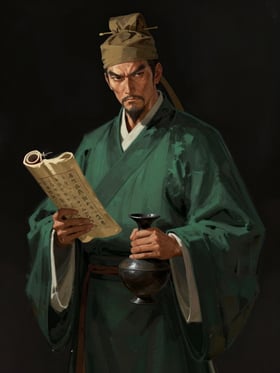
Zhang Jue led the Way of Great Peace and Yellow Turban Army; Romance says an immortal text spurred revolt, history cites 36 divisions.

Life
In the novel: 4 chapters · In the Records: 3 volumes
Life?–184
184 CE (Zhongping 1)
- Yellow Turban RebellionCommander
- Battle of GuangzongGuangzongCommander
Appearances
By chapter (7)
Novel
- 1
- 2
- 28
- 29
Records
- 8
- 22
- 46
- Yellow Turban Army
- Hatched: dated by chapter
- Life event
- Death
List all 2 stops
- Julu CommanderyBirthplace
- Guangzong184Battle of Guangzong
On the boards
Compare with someone →Where this person ranks on each board.
Historical Record
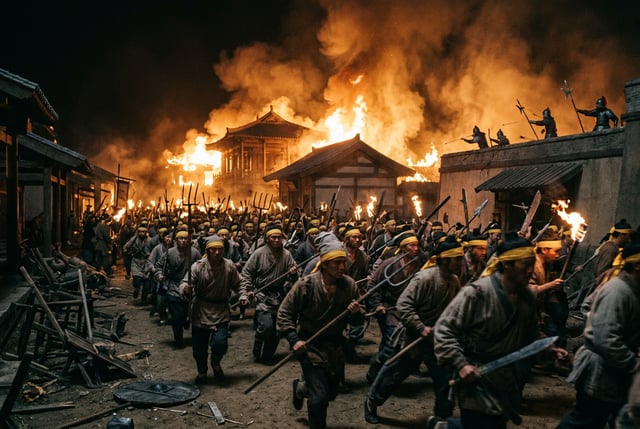
The Records of the Three Kingdoms states that Zhang Jue launched his uprising in Wei Commandery in the first year of Zhongping. Invoking the spirits, he sent eight envoys to spread the “Way of Goodness” throughout the realm and secretly contacted forces in various places, proclaiming, “The Yellow Heaven shall bring peace.” On the jiazi day in the third month, the thirty-six divisions rose simultaneously. Their supporters spread throughout the realm, burning commanderies and counties and killing officials. Pei’s annotations, quoting the Spring and Autumn Annals of Emperor Xian, say that Zhang Jue styled himself General of Heaven, while his younger brothers Zhang Bao and Zhang Liang styled themselves General of Earth and General of Humanity, respectively. The Han court dispatched Huangfu Song and Zhu Jun to lead troops against them. Pei’s annotations, quoting the Dianlüe, add that the Taiping Way founded by Zhang Jue used talismans and incantations to treat illness: patients were made to kowtow and reflect on their misdeeds, then drink talisman water. Recovery was taken as a sign of faith in the Way, while failure to recover was attributed to disbelief. The work also records that Zhang Jue was later executed, but gives no details of the specific battles or the circumstances of his death.
These accounts sketch Zhang Jue’s dual role as religious leader and rebel chief: the Taiping Way attracted followers through healing and repentance, while its organization linked and mobilized the thirty-six divisions. The historical accounts describe the uprising as political turmoil sweeping across many regions, but preserve no complete narrative of Zhang Jue’s personal words and actions. The titles of his brothers as generals appear in the Spring and Autumn Annals of Emperor Xian, quoted in Pei’s annotations.
In the Novel
The Romance of the Three Kingdoms portrays Zhang Jue’s rise as a legend imbued with the mandate of Heaven. The novel says that he was originally an unsuccessful examination candidate who, while gathering herbs in the mountains, met the immortal Nanhua Laoxian and received three volumes of the Book of Great Peace. He learned to summon wind and rain and took the title “Daoist of Great Peace.” When an epidemic spread, he treated people with talisman water, called himself the “Great Worthy Teacher,” and gained an ever-growing number of disciples before establishing the thirty-six divisions. The celestial book, the immortal’s transmission of teachings, and the supernatural arts are all inventions of the novel; the historical accounts mention only the Taiping Way, treatment with talisman water, and patients being made to kowtow and reflect on their misdeeds. They contain no account of Nanhua Laoxian giving Zhang Jue a book or of Zhang Jue performing magic.
The novel further depicts the uprising as a carefully planned rebellion against the Han: Zhang Jue rallied his followers with the words, “The Blue Heaven is dead; the Yellow Heaven shall rise. In the jiazi year, all under Heaven shall prosper,” and sent Ma Yuanyi to make contact with supporters inside the palace. After Tang Zhou exposed the plot, Zhang Jue learned of it and raised his troops, calling himself General of Heaven, while Zhang Bao and Zhang Liang took the titles General of Earth and General of Humanity. The novel says that four or five hundred thousand people in the four quarters responded, wearing yellow turbans, and has Lu Zhi, Huangfu Song, and Zhu Jun lead separate campaigns against them. The historical accounts record that eight envoys spread the teachings, the thirty-six divisions rose together, and Han forces were sent to suppress them; these specific plots, numbers, and episodes, however, belong to the novel and should not be conflated with the historical record.
The novel also places Zhang Jue himself on the battlefield at Guangzong. He leads his army in a standoff with Lu Zhi, then, after defeating Dong Zhuo, pursues the Han forces, only to be routed by Liu Bei, Guan Yu, and Zhang Fei. It later relates that Zhang Jue was already dead by the time Huangfu Song arrived, and describes his coffin being opened, his corpse mutilated, and his head sent to the capital. These battlefield details and the treatment of his remains are novelistic portrayals; the historical accounts merely state that he was executed.
Key Relationships
Zhang Bao and Zhang Liang were Zhang Jue’s two younger brothers. The novel explicitly calls the three men brothers and assigns them, in order, the titles General of Heaven, General of Earth, and General of Humanity. The Spring and Autumn Annals of Emperor Xian, quoted in the historical accounts, also records this set of three general titles.
Zhang Jue’s relationship with the Yellow Turban Army was that of a leader who joined religious proselytizing with political mobilization: the historical accounts say that he founded the Taiping Way, sent envoys to spread its teachings, and mobilized the thirty-six divisions; the novel casts him as the leader of the Yellow Turban Army and depicts him rallying people to revolt through slogans and secret plots.
In the novel, Tang Zhou is the figure who exposes Zhang Jue’s plans, causing the uprising to be discovered ahead of time; after learning of the news, Zhang Jue hastily mobilizes his forces. Tang Zhou’s exposure of the plot is unique to the novel; the Records of the Three Kingdoms makes no mention of it. (Unique to the novel)
Huangfu Song and Zhu Jun were Han court generals sent to suppress the Yellow Turban Army, and Lu Zhi was also ordered to campaign against Zhang Jue. The historical accounts record that the Han court sent Huangfu Song and Zhu Jun to attack the rebels; Lu Zhi’s campaign against Zhang Jue is mentioned in the Later Book of Han, quoted in Pei’s annotations. The novel, meanwhile, elaborates on the advance of the three armies and their clashes with Zhang Jue.
Signature Scenes
The simultaneous uprising of the thirty-six divisions. The historical accounts mark the event as taking place on the jiazi day of the third month in the first year of Zhongping, recording that the thirty-six divisions all rose at once and that the realm responded. This emphasizes the scale of the uprising and its impact on order in the commanderies and counties. Zhang Jue’s political and religious slogan, “The Yellow Heaven shall bring peace,” also appears in the historical record.
Talisman water and repentance. The Dianlüe, quoted in Pei’s annotations, describes how the Taiping Way made the sick kowtow and reflect on their misdeeds, then drink talisman water, and treated recovery or failure to recover as a sign of whether they believed in the Way. The Romance of the Three Kingdoms presents this healing method as the beginning of Zhang Jue’s fame, depicting him treating people with talisman water. Both accounts feature healing with talisman water, but the novel adds the transmission of magic and a legendary backstory.
Retreat at Guangzong and public display after death. The novel depicts Zhang Jue in a standoff with Lu Zhi at Guangzong, then says that when he pursued Dong Zhuo he encountered Liu Bei, Guan Yu, and Zhang Fei’s attack and fled more than fifty li. It later describes his coffin being opened after his death, his corpse mutilated, and his head sent to the capital. These scenes heighten the drama of Zhang Jue’s fall from a powerful rebel leader to a defeated man; their specific details are unique to the novel. The historical accounts record only his uprising and his later execution.
Lines
- 演 ch.1 §9
「至難得者,民心也。今民心已順,若不乘勢取天下,誠為可惜。」
- 演 ch.1 §9
「今漢運將終,大聖人出。汝等皆宜順天從正,以樂太平。」
- Family
- Lord & vassal
- Enemies
- Teacher & student
Events
Events (2)
Battles and events the texts place this person in, by date.
Battles
- 184Battle of GuangzongCommander
Other events
- 184Yellow Turban RebellionCommander
Famous objects

Places
- Native of
- Julu CommanderyRomance
- Was at
- GuangzongRomance
Continue
Yellow Turban Rebellion
Relationship timeline8 entries ▸
Inner monologues · AI-generated1 monologue ▸
- I am Zhang Jue. The records do not mention my courtesy name. Now, as my power reaches its height, I look back on the roa